We wanted to answer a simple question with a real measurement:
How quickly can cabin CO₂ rise when five people are inside a car and the HVAC system is set to recirculation?
So our team tested it ourselves.
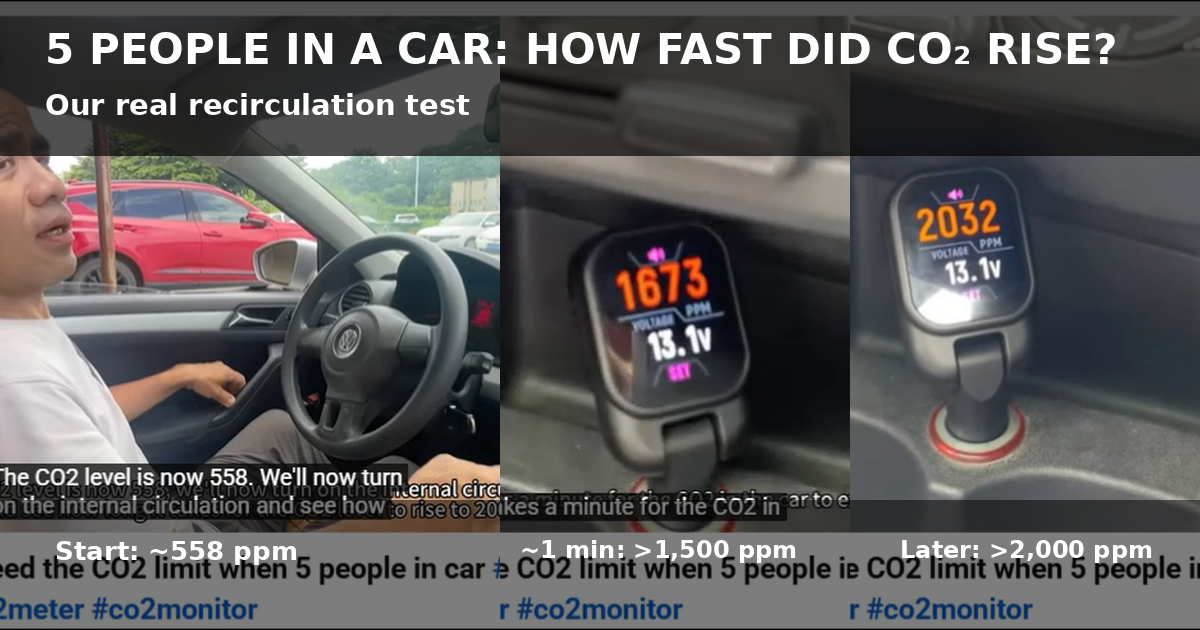
We put five people in the vehicle, started with cabin CO₂ at approximately 558 ppm, switched the HVAC system to recirculation, and watched the EVO-CO2V reading climb.
The increase was much faster than we expected.
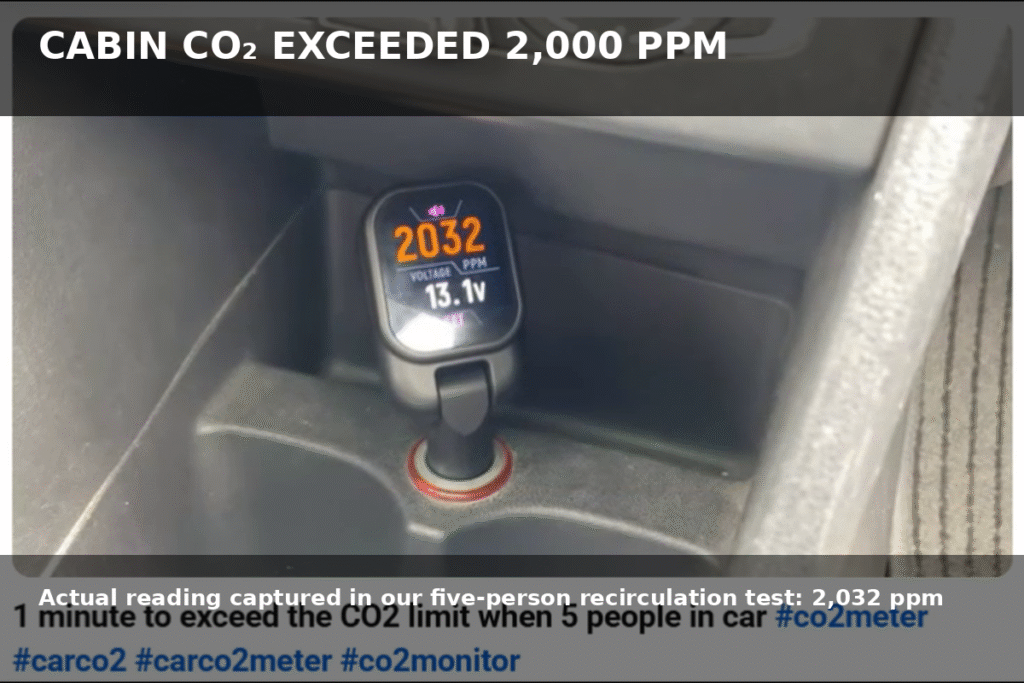
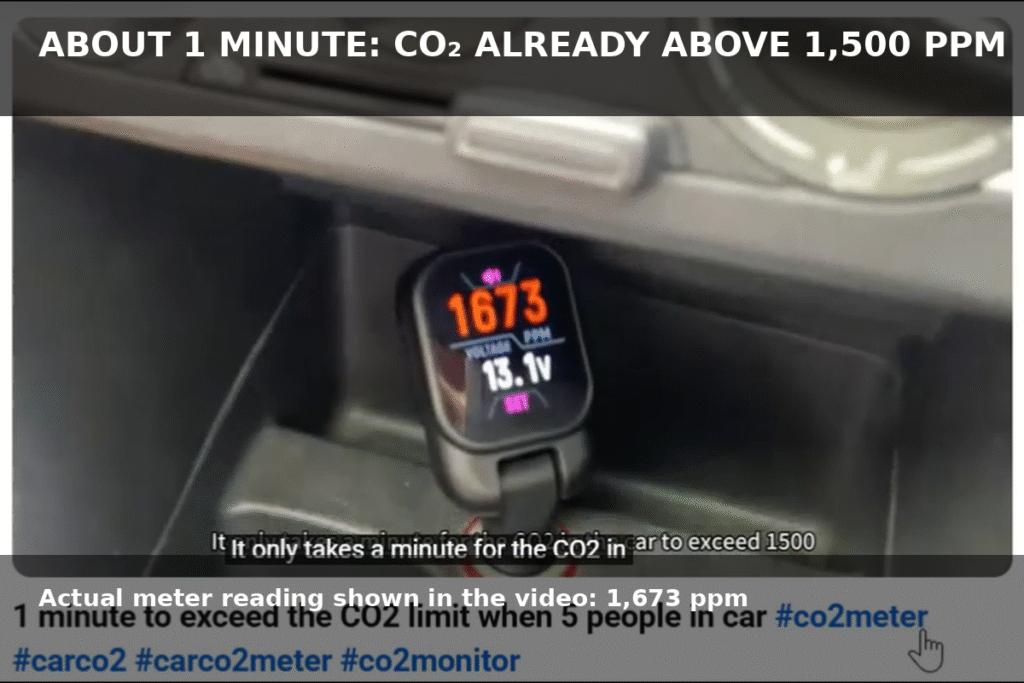
In our test, cabin CO₂ rose above approximately 1,500 ppm in about one minute and exceeded 2,000 ppm a little over two minutes into the test.
This article documents what we actually observed, what the result does and does not mean, and why passenger count and ventilation mode matter so much inside a car.
Quick Answer
In our real five-person vehicle test, cabin CO₂ started at approximately 558 ppm.
After we selected recirculation, the concentration rose quickly.
Visible readings in our recorded test included:
| What we observed | Cabin CO₂ |
|---|---|
| Starting point | ~558 ppm |
| Rising | 814 ppm |
| Rising | 1,013 ppm |
| Rising | 1,245 ppm |
| Rising | 1,369 ppm |
| Rising | 1,438 ppm |
| Later reading | 1,673 ppm |
| Later reading | 1,943 ppm |
| Near 2,000 ppm | 1,984 ppm |
| Later in the test | Above 2,000 ppm |
Our main observation was simple:
With five people in the car and recirculation selected, cabin CO₂ rose from about 558 ppm to above 2,000 ppm in only a little over two minutes under our test conditions.
This is a result from our particular vehicle and test conditions, not a universal prediction for every car.
Why We Decided to Run This Test
We have been measuring cabin CO₂ in vehicles for some time.
One thing became increasingly obvious to us: the number of people inside the car matters.
One person is continuously exhaling CO₂.
Five people are doing the same thing at the same time.
If the HVAC system is bringing in enough outside air, much of that exhaled CO₂ can be diluted.
But if the car is mainly recirculating the air already inside the cabin, the balance changes.
We wanted to see how quickly that difference would become visible on a real CO₂ meter.
So instead of estimating it, we put five people in the vehicle and measured it.
Watch Our Real Five-Person CO₂ Test
The video below shows the actual vehicle, our test conditions, the EVO-CO2V display and the cabin CO₂ readings as they increased.
These are measurements from our own vehicle test, not values generated by a simulation.
The video itself is edited for viewing, so the playback time should not be treated as the test stopwatch. The timing statements in the test refer to the elapsed time we observed during the experiment.
How We Ran the Test
At the beginning of the experiment, the EVO-CO2V showed approximately:
558 ppm
There were five people inside the vehicle.
We then selected the car’s internal recirculation mode.
From that point, we watched the CO₂ concentration rather than trying to predict what would happen.
The meter showed a clear upward trend.
This is important because our goal was not to demonstrate one isolated high reading.
We wanted to see how quickly the cabin concentration changed once five occupants were sharing a relatively enclosed air volume under recirculation.
What We Actually Saw
The first thing that caught our attention was how quickly the reading moved away from its starting level.
It did not stay around 558 ppm for long.
The display progressed through readings such as:
814 → 1,013 → 1,245 → 1,369 → 1,438 ppm
It then continued upward:
1,673 → 1,943 → 1,984 ppm
And a little over two minutes into our test, the cabin CO₂ had moved above 2,000 ppm.
For us, the important result was not whether one intermediate reading was 1,943 or 1,984 ppm.
It was the speed and direction of the trend.
With five occupants and recirculation, the concentration was climbing continuously.
The One-Minute Result Surprised Us
One result stood out immediately.
Approximately one minute into the test, cabin CO₂ had already moved beyond roughly 1,500 ppm.
We expected the five-person cabin to rise faster than a one-person cabin.
But watching the increase happen in real time made the effect much easier to understand.
Passenger count is not an abstract variable.
Each additional person is another continuous source of exhaled CO₂.
Published vehicle research has likewise found that occupant number and ventilation setting strongly affect cabin CO₂ accumulation, with multi-occupant trips under recirculation capable of producing much higher concentrations. vehicle cabin CO₂ accumulation study
What We Learned From the Five-Person Test
Before doing these measurements ourselves, it was easy to think of the recirculation button mainly in terms of temperature.
Recirculation can help the HVAC system reuse already cooled or heated cabin air.
But our measurements made us think about another variable:
How many people are sharing that air?
With one occupant, CO₂ generation is relatively limited.
With five occupants, the amount being exhaled into the same cabin is much greater.
That means a ventilation strategy that seems perfectly reasonable for one person may produce a very different CO₂ trend when the vehicle is full.
That is probably the biggest practical lesson our team took from this experiment.
Why Recirculation Made the Difference So Visible
Recirculation does not mean a vehicle becomes perfectly airtight.
Outside air can still enter through leakage, seals and pressure differences.
But recirculation reduces intentional outside-air exchange through the HVAC system.
That allows more occupant-generated CO₂ to remain inside the cabin.
A study covering 92 different vehicle models found that recirculation reduced the entry of ultrafine particles but increased cabin CO₂, demonstrating the trade-off between outside-pollution control and ventilation. 92-vehicle cabin air-quality study
That matches the basic pattern we observed:
five occupants producing CO₂ + reduced outside-air exchange = rapidly rising cabin CO₂.
We Do Not Treat 1,500 or 2,000 ppm as a Universal “Safety Limit”
This distinction matters.
The title shown in our original video uses the word “limit.”
For this article, we want to be more precise.
We are not saying:
1,499 ppm = safe
and
1,500 ppm = dangerous.
Nor are we saying that 2,000 ppm is a universal medical threshold.
What we measured was the rate of accumulation.
The useful information from our test is that a five-person cabin under recirculation moved from roughly outdoor-background CO₂ toward much higher concentrations very quickly.
The concentration itself should be interpreted in context rather than as a simple pass/fail number.
Why Five People Can Change the Result So Much
A car cabin has a limited volume.
Every occupant continuously adds CO₂ through respiration.
With more occupants, the source rate increases.
At the same time, if outside-air exchange remains low, there is less dilution.
That means passenger count and ventilation interact.
Recent vehicle-air-quality modeling has reached the same broad conclusion: as occupant number increases, more fresh-air operation is required to manage cabin CO₂. vehicle cabin CO₂ modeling study
Our test gives us a real-world visual example of that relationship.
This Does Not Mean Recirculation Is “Bad”
We do not think that is the right conclusion.
Recirculation has real advantages.
In polluted traffic, it can reduce the amount of outside particulate pollution entering the cabin.
The 92-vehicle study mentioned earlier found substantially lower ultrafine-particle concentrations under recirculation, while simultaneously observing rising CO₂. 92-vehicle recirculation and cabin air-quality study
So there is a trade-off:
Recirculation can reduce some outside pollutants, but prolonged recirculation with several occupants can allow CO₂ to accumulate.
For us, the practical question is not:
“Should we never use recirculation?”
It is:
“When does the cabin need more outside air?”
Why We Prefer Measuring Instead of Guessing
Without a meter, we would not have known whether the cabin was at:
600 ppm, 1,000 ppm, 1,500 ppm or 2,000 ppm.
CO₂ is colorless and odorless.
The air conditioner can be blowing strongly while the actual outside-air exchange remains low.
That is why we find the trend more useful than simply looking at whether the fan is running.
A live CO₂ reading lets us see whether the cabin concentration is:
rising, stable or falling.
For our team, that changes the ventilation control from a guess into something measurable.
Why This Result Should Not Be Applied to Every Car
Our result belongs to this test.
Different vehicles can behave differently.
Cabin CO₂ accumulation can be affected by vehicle cabin volume, cabin leakage, HVAC design, fan speed, actual recirculation-door position, vehicle speed, window position, starting CO₂ concentration and the occupants themselves.
Published research also shows meaningful differences between vehicle models. vehicle-to-vehicle cabin air-quality study
So we would not say:
“Every car with five people will exceed 1,500 ppm in exactly one minute.”
What we can say is:
Our five-person vehicle did so under the conditions shown in our test.
That is the result we actually measured.
Why This Test Is Different From Our Earlier 1–5 Person Test
We have previously published another experiment comparing the time required for cabin CO₂ to reach the same reference concentration with one, two, three, four and five occupants.
The numbers in that test should not be directly compared second-for-second with this one unless all test conditions are identical.
Starting CO₂, ventilation setting, fan operation, vehicle conditions and other variables can materially change the buildup rate.
That difference is useful rather than problematic.
It shows why we prefer publishing the actual conditions and measured result from each experiment, instead of trying to turn one test into a universal formula.
See our real 1–5 occupant car CO₂ buildup test.
Related Tests From Our Team
We have also recorded what happened when we switched a high-CO₂ cabin from recirculation to fresh-air ventilation.
In that test, the measured CO₂ dropped substantially after outside air was introduced.
See our real recirculation vs fresh-air CO₂ test.
We also used paper strips at the vehicle’s outside HVAC intake to make the difference between recirculation and fresh-air mode physically visible.
See our real HVAC outside-air intake demonstration.
Together, these tests are helping us build a clearer picture of what actually happens to air inside a vehicle.
Why We Used EVO-CO2V
For this experiment we used our EVO-CO2V vehicle CO₂ monitor.
It plugs directly into a compatible 12V/24V vehicle accessory socket and is intended for continuous in-vehicle monitoring.
For us, the useful part is not simply displaying a ppm number.
It allows us to see the trend while conditions are changing.
In this five-person test, that meant watching the cabin move from approximately 558 ppm to above 2,000 ppm while recirculation was operating.
EVO-CO2V measures carbon dioxide — CO₂.
It does not detect carbon monoxide — CO.
Learn more about the EVO-CO2V vehicle CO₂ monitor.
Our Takeaway
The biggest thing our team learned from this test was how quickly passenger count can change the cabin environment.
With five people inside and recirculation selected, CO₂ did not rise slowly over a long journey.
In our test it moved from approximately 558 ppm to more than 1,500 ppm in about one minute, and above 2,000 ppm a little over two minutes into the experiment.
We do not treat those numbers as universal thresholds.
What matters to us is the trend.
The more people sharing a relatively enclosed cabin, the more important ventilation becomes.
And this is exactly why we prefer to measure what is happening rather than simply assume the air is fresh because the HVAC fan is running.
Leave a Reply