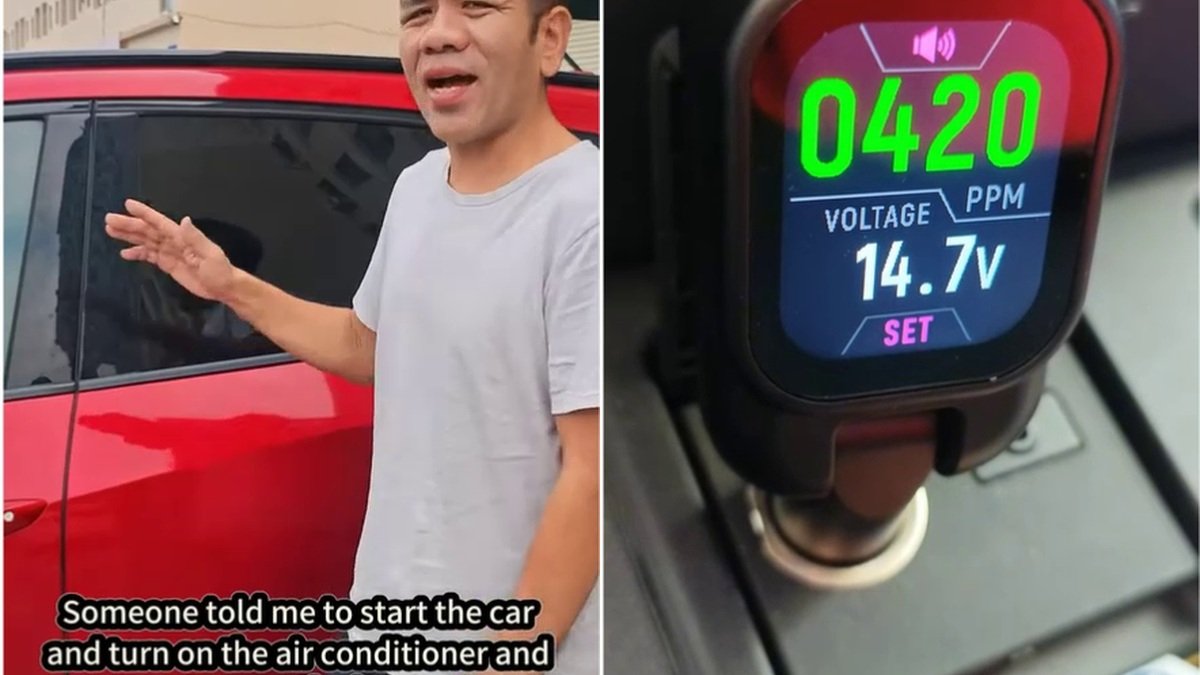
A common question about car cabin CO₂ is whether simply starting a gasoline vehicle and turning on the air conditioner or heater causes the CO₂ level inside the cabin to rise.
We decided to test that idea directly.
Instead of sitting inside the vehicle, we started the gasoline car, operated the HVAC system, and left the cabin unoccupied.
After about six minutes, the EVO-CO2V showed:
CO₂: 420 ppm
Vehicle voltage: approximately 14.6–14.7 V
The result is useful—but it is important to interpret it correctly.
Quick Answer
In this real-world test, running the vehicle and HVAC system for about six minutes without anyone sitting inside did not produce an elevated cabin CO₂ reading.
The measured value was approximately 420 ppm, close to typical outdoor atmospheric background concentrations.
This does not mean gasoline combustion produces no CO₂.
Gasoline combustion does produce carbon dioxide, but vehicle exhaust is normally discharged outside the passenger compartment. The HVAC system is not designed to route exhaust gas into the cabin.
The test instead helps demonstrate an important distinction:
Running the HVAC system is not the same thing as having people continuously exhaling CO₂ inside a confined cabin.
What Did We Test?
The purpose of this test was simple:
If the gasoline engine is running and the air conditioner or heater is operating, but nobody is sitting inside the car, will cabin CO₂ rise significantly?
For this test:
- the gasoline vehicle was started;
- the HVAC system was operated;

The gasoline vehicle was started with the HVAC operating for the no-occupant CO₂ test.- no occupants remained inside the cabin;

No occupants remained inside the vehicle during the observation period.- the vehicle was allowed to run for approximately six minutes;
- cabin CO₂ was then checked using EVO-CO2V.
This was a real-world observation rather than a controlled laboratory emissions test.

The vehicle and HVAC were left operating for approximately six minutes before the CO₂ reading was checked.After About Six Minutes: 420 ppm CO₂
After approximately six minutes, EVO-CO2V displayed:
420 ppm CO₂
The display also showed approximately 14.6–14.7 V from the vehicle electrical system.
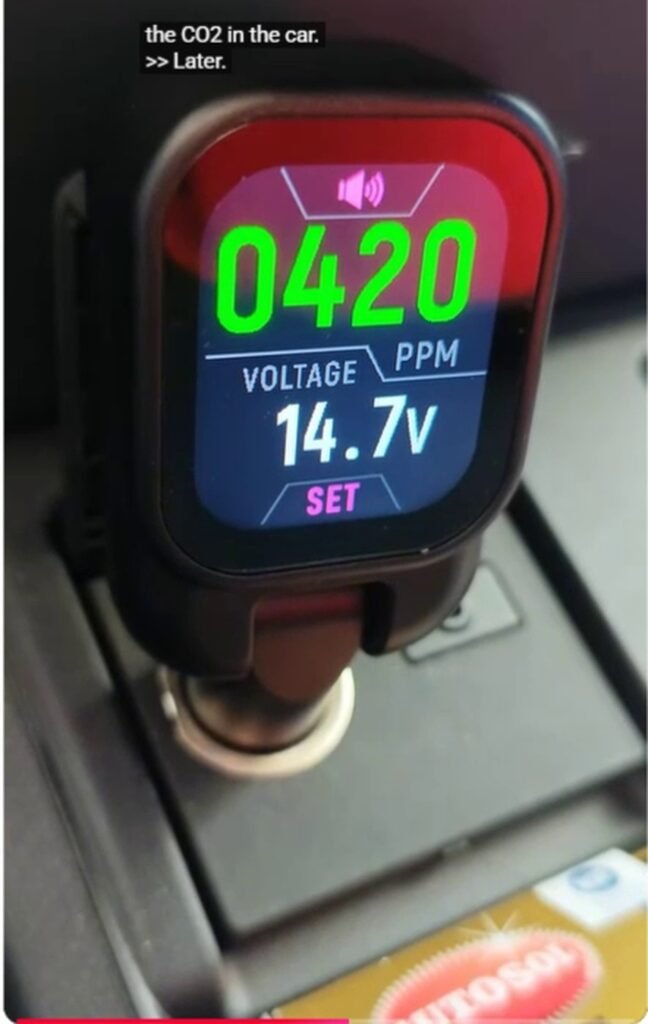
After about six minutes, EVO-CO2V showed 420 ppm CO₂ and approximately 14.7 V.The important observation was that we did not find a high cabin CO₂ concentration after the car and HVAC had been operating without occupants.
For context, NOAA reported a global atmospheric CO₂ average of approximately 425.6 ppm for 2025, although actual outdoor CO₂ at a specific location can vary. NOAA Global Monitoring Laboratory
So the measured 420 ppm in this test was broadly consistent with outdoor-background air rather than the elevated concentrations commonly seen when people occupy a poorly ventilated cabin.
Watch the original real-world test below:
Does a Gasoline Engine Produce CO₂?
Yes.
This is where the wording needs to be precise.
When gasoline burns in an internal-combustion engine, carbon in the fuel is converted largely into carbon dioxide, and that CO₂ leaves through the vehicle’s exhaust system.
The U.S. EPA states that burning one gallon of gasoline produces roughly 8,887 grams of CO₂. EPA vehicle tailpipe CO₂ guidance
So the conclusion from our test is not:
“Gasoline combustion does not produce CO₂.”
The more accurate conclusion is:
Under the conditions of this test, running the gasoline engine and HVAC did not result in elevated CO₂ inside the passenger cabin.
Then Why Does CO₂ Rise So Quickly When People Are Inside a Car?
People continuously exhale carbon dioxide.
Inside the relatively small volume of a passenger vehicle, that CO₂ can accumulate quickly when outside-air exchange is limited.
Vehicle-cabin research has found that higher recirculation levels lead to higher cabin CO₂ concentrations, and that the effect becomes greater as the number of passengers increases. PMC vehicle cabin CO₂ study
One experimental vehicle study noted that fresh outside air entering the cabin was around atmospheric CO₂ levels, while occupant respiration supplied CO₂ at much higher concentrations. Under full recirculation, cabin concentrations increased substantially. PMC vehicle cabin CO₂ and recirculation study
This also explains why our previous EVO-CO2V tests showed CO₂ increasing with people inside a vehicle and dropping rapidly after outside-air ventilation was introduced.
Does the Car Heater Create CO₂ Inside the Cabin?
Normally, the cabin heater itself is not a source of combustion gas inside the passenger compartment.
In a conventional gasoline vehicle, cabin heating commonly uses heat transferred from the engine cooling system. The ventilation system then moves cabin or outside air across the heater core.
That is different from routing engine exhaust into the passenger compartment.
Therefore, simply turning on the heater should not be interpreted as automatically adding engine-produced CO₂ to the cabin.
However, this test involved one vehicle under one set of conditions. It should not be generalized to every vehicle or every mechanical condition.
What About Air Conditioning?
The same distinction applies to air conditioning.
The A/C system changes the temperature and humidity of cabin air. Depending on the ventilation setting, the HVAC system may:
- recirculate existing cabin air;
- introduce outside air;
- or use a combination of the two.
When passengers are present, recirculation can allow exhaled CO₂ to accumulate because less outside air is replacing cabin air.
When no one is inside producing CO₂, there is no comparable continuous human CO₂ source.
That is consistent with what we observed in this test.
Important: CO₂ Is Not the Same as Carbon Monoxide
This distinction is especially important.
EVO-CO2V measures carbon dioxide — CO₂.
It does not measure:
- carbon monoxide (CO);
- nitrogen dioxide (NO₂);
- VOCs;
- particulate matter;
- or other exhaust pollutants.
A normal CO₂ result therefore cannot be used to prove that vehicle exhaust is safe or that no exhaust leak exists.
The CDC warns that even a small vehicle exhaust-system leak can allow carbon monoxide to accumulate inside a car. CDC vehicle carbon monoxide guidance
This is one of the most important limitations of this experiment.
Does This Test Prove Exhaust Can Never Enter a Car?
No.
It does not.
Our test only showed that under this particular vehicle and test condition, after approximately six minutes of operation with no occupants, cabin CO₂ measured approximately 420 ppm.
Vehicle condition, exhaust-system integrity, airflow around the vehicle, HVAC intake position, windows, vehicle speed and surrounding environment can all affect cabin air.
The CDC specifically notes that a damaged exhaust system can allow carbon monoxide to build up inside a vehicle. CDC vehicle carbon monoxide guidance
So this test should not be interpreted as an exhaust-leak test.
What Does This Test Actually Show?
The useful finding is narrower—and more meaningful:
With no occupants inside the tested gasoline vehicle, operating the engine and HVAC for approximately six minutes did not result in elevated cabin CO₂; the measured concentration was about 420 ppm.
Combined with our other vehicle tests, this supports the practical observation that occupant respiration and ventilation conditions are major drivers of normal cabin CO₂ accumulation.
Research on vehicle ventilation reaches the same general conclusion: cabin CO₂ rises with occupants and greater recirculation, while introducing outside air reduces that accumulation. PMC vehicle cabin CO₂ and ventilation study
What This Test Does Not Prove
This experiment does not prove that:
- gasoline combustion produces no CO₂;
- exhaust gas can never enter a vehicle;
- all cars will produce the same result;
- HVAC mode has no effect on cabin CO₂ when occupants are present;
- 420 ppm is a fixed outdoor CO₂ value everywhere;
- or a CO₂ monitor can detect carbon monoxide or diagnose an exhaust leak.
Those questions require different measurements and, in some cases, different sensors.
Frequently Asked Questions
Does running a car’s A/C create CO₂?
The air-conditioning system itself is not normally a significant source of cabin CO₂. In an occupied vehicle, CO₂ usually rises because occupants exhale CO₂ and insufficient outside air is introduced.
Does a gasoline engine produce carbon dioxide?
Yes. Gasoline combustion produces CO₂, which is normally discharged through the vehicle’s exhaust system outside the passenger compartment. EPA vehicle tailpipe CO₂ guidance
Why did EVO-CO2V show only 420 ppm?
The vehicle was unoccupied during the test, so there was no continuous source of exhaled human CO₂. The reading was close to atmospheric-background levels.
Does using the heater raise cabin CO₂?
The heater itself does not normally route exhaust into the cabin. However, HVAC ventilation and recirculation settings can affect how quickly occupant-generated CO₂ accumulates when people are inside.
Can EVO-CO2V detect an exhaust leak?
No. EVO-CO2V measures CO₂. It does not measure carbon monoxide, and a normal CO₂ reading should not be used to rule out an exhaust-system problem.
Is CO₂ the same as carbon monoxide?
No. CO₂ and CO are different gases. Carbon monoxide from faulty vehicle exhaust can be dangerous, and a dedicated CO detector or professional vehicle inspection is required when CO exposure is a concern. CDC vehicle carbon monoxide guidance
Test Conclusion
In this real-world no-occupant test, we started a gasoline vehicle, operated the HVAC system and waited approximately six minutes.
EVO-CO2V then measured approximately:
420 ppm CO₂
with a vehicle voltage reading of approximately:
14.6–14.7 V
The test did not show elevated cabin CO₂ under these conditions.
That does not mean gasoline combustion produces no carbon dioxide. It means that, during this particular test, engine operation and HVAC use did not result in elevated CO₂ inside the passenger compartment.
For ordinary cabin CO₂ buildup, the combination of people breathing inside the vehicle and limited ventilation remains the more relevant mechanism.
Test Information
Device: EVO-CO2V
Test type: Real-world vehicle CO₂ observation
Vehicle: Gasoline-powered passenger vehicle
Occupants during measurement: None
HVAC: Operating
Observation period: Approximately 6 minutes
Measured CO₂: 420 ppm
Displayed vehicle voltage: approximately 14.6–14.7 V
Original video date: October 31, 2025
Leave a Reply