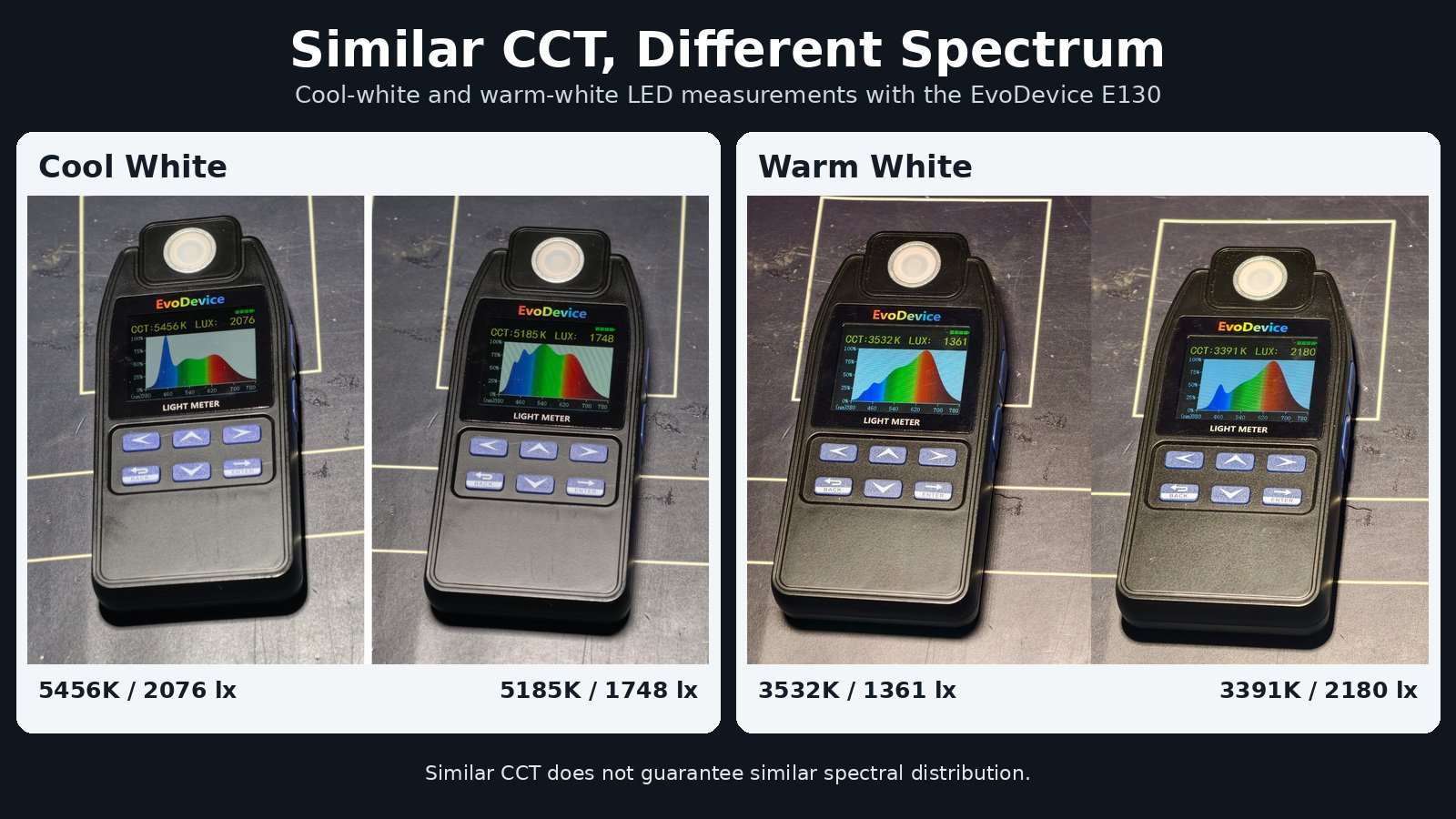
Yes. Two white LED lights can have similar correlated color temperature (CCT) values while producing noticeably different spectral distributions.
CCT tells us whether a white light appears warmer or cooler, but it does not uniquely describe how the light output is distributed across visible wavelengths.
To demonstrate this, we compared two pairs of white LEDs using the EvoDevice E130 Light Meter. One test used cool-white LEDs, and the second used warm-white LEDs.
In both tests, the CCT readings were relatively close, while the spectral shapes displayed by the meter were clearly different.
This is an important distinction when comparing LED lighting: similar CCT does not necessarily mean similar spectrum.
The U.S. Department of Energy also explains that different spectral power distributions can produce the same or similar chromaticity and CCT.
Source: U.S. Department of Energy — Color and Spectrum
Test 1: Cool-White LEDs
The first comparison involved two cool-white LED sources.
Measured Results
| Light Source | CCT | Illuminance |
|---|---|---|
| Standard white LED | 5456 K | 2076 lx |
| SunLike LED | 5185 K | 1748 lx |
The cool-white comparison below shows a standard white LED at 5456 K and a SunLike LED at 5185 K.
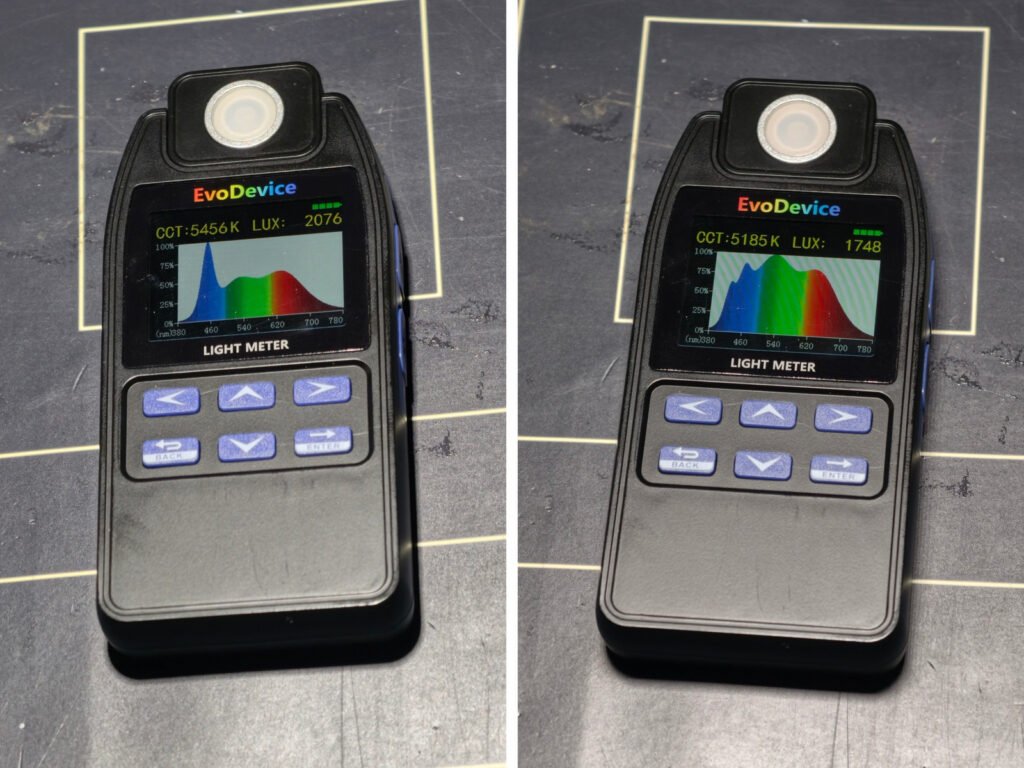
Cool-white LED comparison: 5456 K versus 5185 K. The CCT values are relatively close, while the measured spectral distributions are clearly different.
Although the two sources are both cool-white LEDs and their CCT values differ by only a few hundred kelvin, the spectral shapes are visibly different.
The standard white LED shows the characteristic structure of a phosphor-converted white LED, with a pronounced short-wavelength peak and a broader phosphor-emission region.
The SunLike source shows a different distribution across the visible range.
The illuminance values were also different—2076 lx versus 1748 lx—so this test should not be interpreted as a brightness comparison. The purpose here is to compare the relationship between CCT and spectral shape.
Test 2: Warm-White LEDs
We then repeated the comparison with two warm-white LED sources.
Measured Results
| Light Source | CCT | Illuminance |
|---|---|---|
| Warm-white LED A | 3532 K | 1361 lx |
| Warm-white LED B | 3391 K | 2180 lx |
The warm-white comparison below shows two LEDs at 3532 K and 3391 K, with noticeably different spectral distributions.
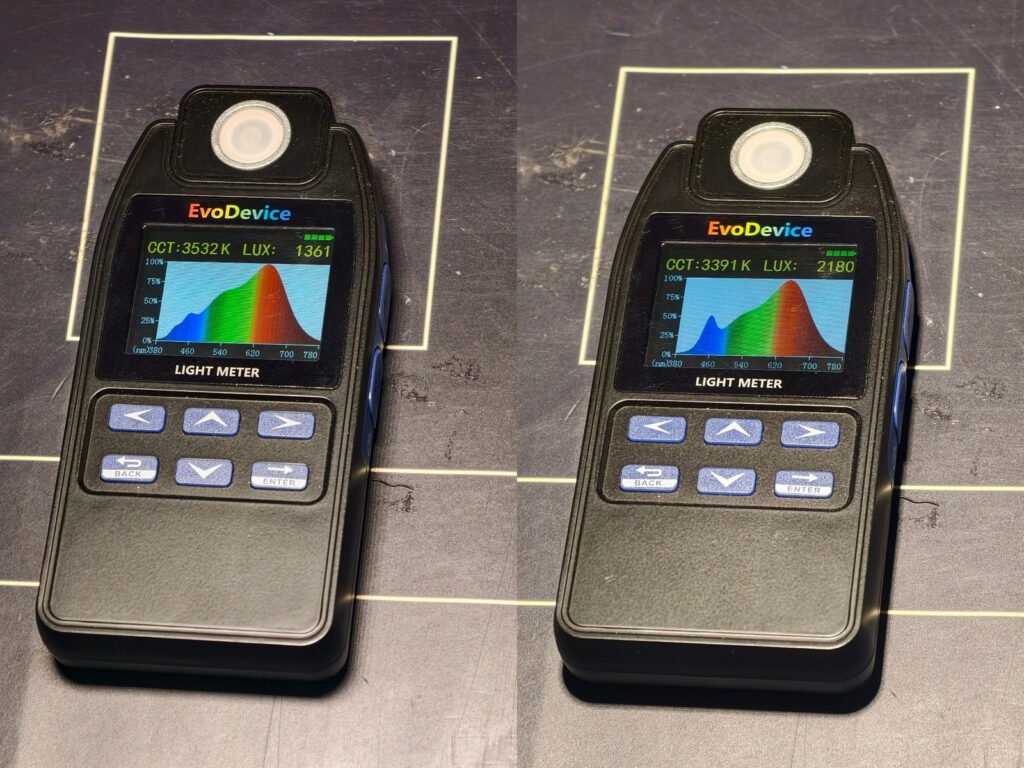
Warm-white LED comparison: 3532 K versus 3391 K. Despite similar warm-white CCT readings, the measured spectral distributions are visibly different.
The two sources are both within a similar warm-white range, but their spectrum shapes are clearly not identical.
The difference in CCT is only 141 K, yet the distribution of output across visible wavelengths is noticeably different.
Again, the illuminance values were not matched: one source measured 1361 lx, while the other measured 2180 lx.
For that reason, this comparison is not intended to determine which lamp is brighter or more efficient. It demonstrates that two warm-white LEDs can have relatively similar CCT readings while still producing different spectral distributions.
Why Can LEDs with Similar CCT Have Different Spectra?
CCT is a simplified description of the apparent color of nominally white light.
A complete spectral distribution contains much more information. It shows the relative amount of optical output produced at different wavelengths across the visible spectrum.
CCT compresses this complex spectral information into a single value expressed in kelvin.
As a result:
Different spectral distributions can produce similar chromaticity and similar CCT values.
This means two LED lamps labeled 3000 K, 3500 K, or 5000 K do not necessarily produce identical spectra.
The LED package design, phosphor composition, excitation wavelength, and light-source architecture can all influence spectral distribution while still resulting in a similar overall white-light appearance.
What Does CCT Tell You?
CCT is useful because it provides a simple way to describe whether a white light appears warm, neutral, or cool.
For example:
- Lower CCT values generally correspond to warmer-looking white light.
- Higher CCT values generally correspond to cooler-looking white light.
A CCT measurement therefore helps answer the question:
Does this white light appear warmer or cooler?
However, CCT alone does not answer:
How is the light energy distributed across visible wavelengths?
For that question, spectral information is needed.
CCT vs. Lux vs. Spectrum
These three measurements describe different properties of light.
CCT
Correlated Color Temperature describes the apparent warm-to-cool appearance of nominally white light.
Unit: Kelvin (K)
CCT is useful for comparing the overall color appearance of white lighting.
Lux
Lux measures illuminance—the amount of visible light reaching a surface.
Unit: lux (lx)
Lux helps answer questions such as:
- How much light reaches a desk?
- How bright is a work surface?
- Does one position receive more illuminance than another?
Lux does not describe the spectral composition of the light.
Spectral Distribution
A spectral distribution shows how optical output is distributed across different wavelengths.
It provides information that cannot be obtained from a single CCT or lux value.
Two lights can therefore have:
- similar CCT,
- similar apparent white color,
- and even similar illuminance,
while still having different spectral distributions.
For a broader explanation of these measurements, see the:
For a broader explanation of these measurements, see the EvoDevice Light & UV Measurement Guide.
How We Measured the LEDs
The measurements in these comparisons were taken using the EvoDevice E130 Light Meter.
The E130 displays:
- Lux
- CCT
- spectral distribution for supported white LED sources
For meaningful comparisons, measurement conditions should be kept as consistent as practical.
Important factors include:
- meter orientation
- measurement position
- distance from the light source
- lamp operating condition
- surrounding light
When comparing spectrum rather than brightness, it is especially important not to interpret differences in lux as differences in spectral quality.
The lux readings shown in this article are included as part of the actual measurement record.
Important Measurement Limitation
The E130 spectrum function is intended for supported phosphor-converted white LED sources.
It should not be treated as a general-purpose laboratory spectroradiometer for every type of light source.
For unsupported sources such as certain discharge lamps, narrow-band sources, or other lighting technologies outside its intended measurement range, the spectrum display should not be used as analytical spectral data.
Lux and CCT measurements may still be useful depending on the source and application.
For detailed product specifications and supported use cases, see:
Learn more about the EvoDevice E130 Light Meter.
What These Measurements Show
The two real comparisons lead to the same practical conclusion.
Cool-White Comparison
5456 K vs. 5185 K
The CCT values are relatively close, but the spectral shapes are visibly different.
Warm-White Comparison
3532 K vs. 3391 K
The CCT values are even closer, yet the spectral distributions are still noticeably different.
Therefore:
Similar CCT does not guarantee similar spectral distribution.
CCT remains an important lighting measurement, but it represents only one aspect of white-light performance.
When the goal is to understand how two white LED sources differ, viewing the spectrum can provide additional information that CCT alone cannot show.
Measuring White LEDs with the E130
The EvoDevice E130 is designed for practical measurement and comparison of white LED lighting.
It can display:
- illuminance in lux
- correlated color temperature in kelvin
- spectral distribution for supported phosphor-converted white LEDs
- stored measurements for later comparison
Typical applications include comparing:
- LED bulbs
- ceiling lights
- LED panels
- work lights
- task lighting
- indoor lighting installations
- different white LED sources
FAQ
Can two LED lights have the same CCT but different spectra?
Yes. Two LED sources can have the same or similar CCT while producing different spectral distributions. CCT describes the overall chromatic appearance of white light but does not uniquely define its spectrum.
Why can two 3000 K LEDs look different?
Two LEDs can both be rated around 3000 K while using different LED packages, phosphors, excitation wavelengths, or spectral designs.
Their overall CCT can therefore be similar even though the distribution of light across visible wavelengths is different.
Does similar CCT mean two LEDs produce identical light?
No.
Similar CCT means the sources have a similar overall white-light color appearance. It does not mean their spectral distributions are identical.
Is lux the same as spectrum?
No.
Lux measures the amount of visible illuminance reaching a surface.
Spectrum describes how optical output is distributed across wavelengths.
They measure different properties of light.
Can two LEDs have similar lux but different spectra?
Yes.
Two sources can produce similar illuminance at a measurement point while having different CCT values or different spectral distributions.
Lux alone does not describe spectral composition.
Why measure both CCT and spectrum?
CCT provides a quick numerical description of whether white light appears warmer or cooler.
Spectrum provides additional information about how the light output is distributed across visible wavelengths.
Using both measurements provides a more complete comparison of white LED sources.
Can the E130 measure the spectrum of every type of light source?
No.
The E130 spectrum function is intended for supported phosphor-converted white LEDs. It should not be considered a universal spectrometer for every type of light source.
For unsupported light sources, the spectrum curve should not be treated as analytical spectral data.
Conclusion
CCT is useful, but it does not tell the whole story.
In our cool-white test, the two LEDs measured:
5456 K and 5185 K
In our warm-white test, they measured:
3532 K and 3391 K
In both cases, the CCT values were relatively close while the spectral shapes were visibly different.
The practical takeaway is simple:
CCT tells you about the overall color appearance of white light. Spectrum tells you how that light is distributed across wavelengths.
When comparing white LEDs, looking at both can reveal differences that a single Kelvin value cannot show.
Leave a Reply