We had already tested how passenger count and ventilation mode affect CO₂ inside a car.
Then our team became curious about another question:
What happens if the people inside the car are actively singing?
Singing changes the way we breathe. We take deeper breaths, control expiration differently, and move more air through our lungs than we do while sitting quietly.
So we decided to try a simple real-world experiment.
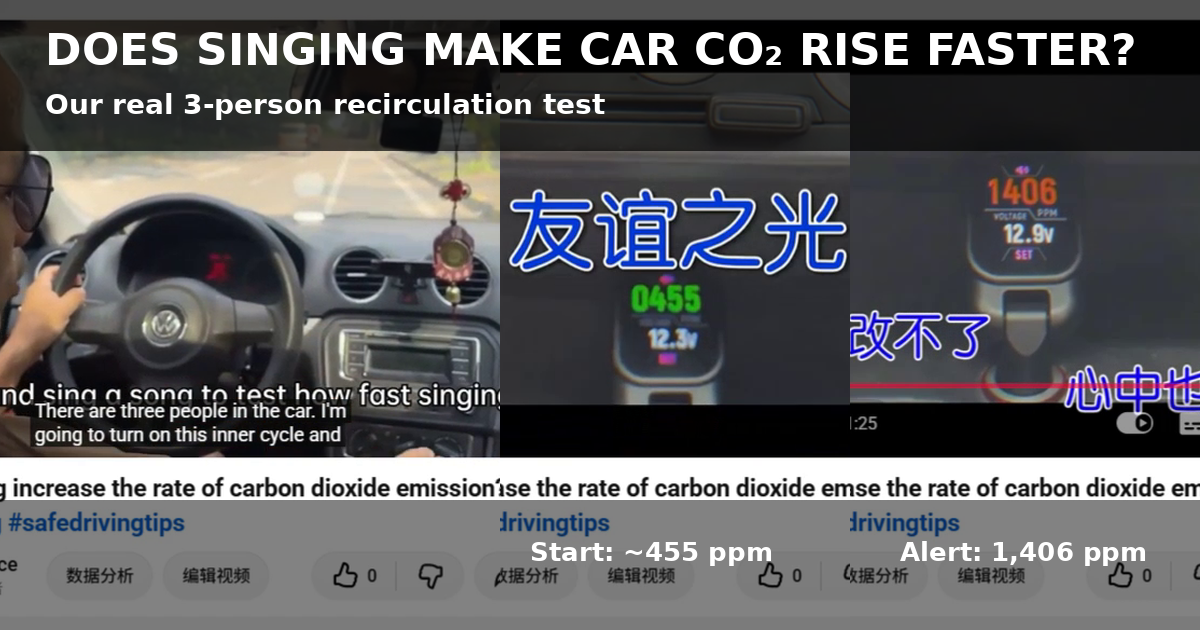
There were three of us inside the vehicle. We first brought the cabin CO₂ concentration down to approximately 455–457 ppm, switched the HVAC system to recirculation, and then started singing.
During the recorded test, the EVO-CO2V reading rose from roughly 455 ppm to 1,406 ppm.
The result caught our attention.
But it also taught us something important about testing:
A fast CO₂ rise does not, by itself, prove that singing was the cause.
This article documents what we actually observed and where we think the limits of this experiment are.
Quick Answer
In our real three-person vehicle test, cabin CO₂ started at approximately 455 ppm.
We selected recirculation and sang together inside the car.
The visible readings in the recorded sequence included:
| What we observed | Cabin CO₂ |
|---|---|
| Starting level | ~455 ppm |
| Rising | 724 ppm |
| Rising | 1,096 ppm |
| Rising | 1,347 ppm |
| Alert region | 1,406 ppm |
By the end of the recorded sequence, the EVO-CO2V had reached its configured 1,400 ppm alert level and started beeping.
Our immediate impression was that the CO₂ concentration seemed to be rising very quickly.
However:
This single test does not prove that singing increases car CO₂ buildup by a specific percentage.
To establish that, we would need a matched silent control test under nearly identical conditions.
Why We Wanted to Test Singing
We had already seen how strongly passenger count affects cabin CO₂.
When several people sit inside a vehicle, every person is continuously exhaling carbon dioxide.
But singing feels different from simply sitting quietly.
We noticed ourselves taking deeper breaths and using longer controlled exhalations while singing.
That made us wonder:
Could singing change how quickly CO₂ accumulates in a recirculating vehicle cabin?
Instead of only discussing the idea, we decided to put a meter in the car and see what happened.
Watch Our Real Singing and Car CO₂ Test
The video below shows our actual vehicle, three occupants, the HVAC controls, the EVO-CO2V readings, and part of the song we used during the test.
These measurements came from our own real-world driving test.
They were not generated from a theoretical model or simulation.
At the same time, this was not a controlled laboratory experiment, so we treat the result as an observation, not proof of a universal singing effect.
How We Ran the Test
Before beginning the singing portion, we used outside-air ventilation to bring cabin CO₂ down to approximately:
457 ppm
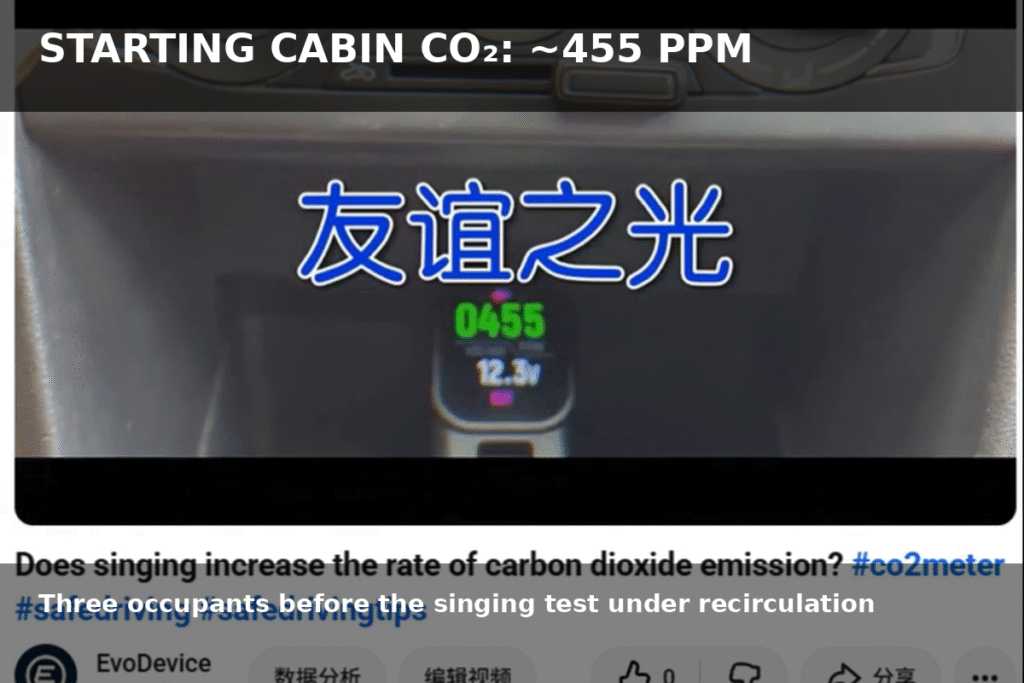
There were three people in the vehicle.
We then changed the HVAC system to recirculation.
Our goal was simple:
We wanted to watch what happened to the cabin CO₂ while we were singing inside a recirculating cabin.
The EVO-CO2V remained installed in the vehicle throughout the recorded test.
We did not change the number of occupants during the experiment.
What We Actually Observed
Near the beginning of the singing and recirculation portion, the display was around:
455 ppm
As the test continued, the reading increased.
We recorded approximately:
724 ppm
and later:
1,096 ppm
The concentration continued upward to approximately:
1,347 ppm
Eventually, the display showed:
1,406 ppm
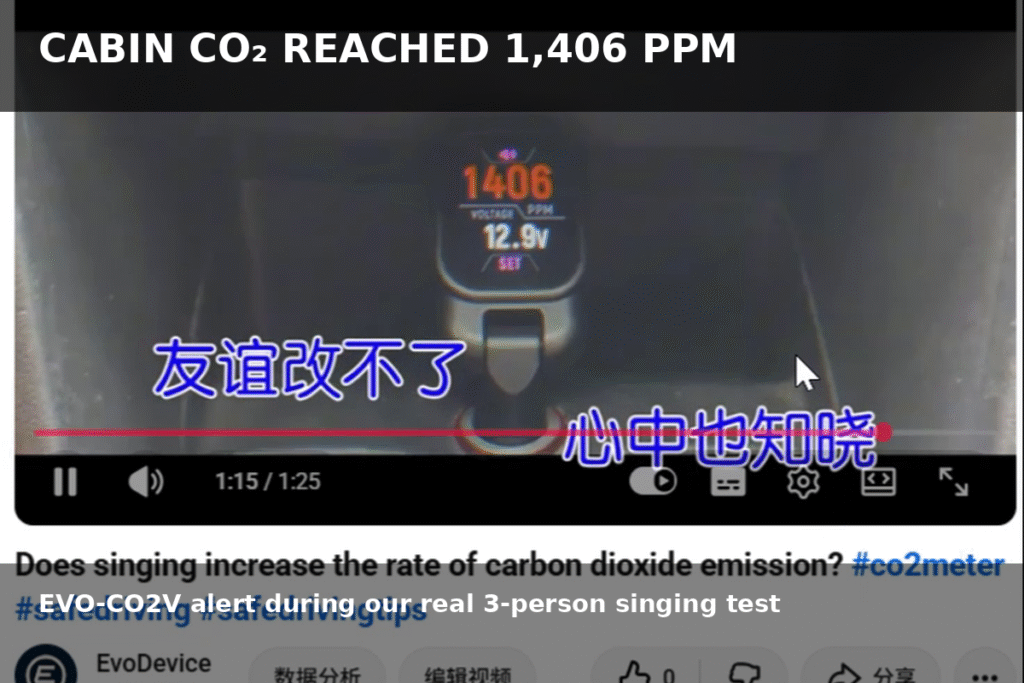
At that point the monitor’s configured high-CO₂ alert was audible.
For us, the striking part was the size of the increase during a relatively short recorded period:
~455 → 1,406 ppm
That is an increase of roughly 950 ppm during this particular test sequence.
Our First Impression: Singing Seemed to Make CO₂ Rise Faster
At the end of the video, our spontaneous reaction was that singing appeared to accelerate CO₂ buildup.
That was genuinely what we thought while doing the experiment.
But after looking at the test more carefully, we do not think it would be responsible to turn that impression into a universal percentage.
Why?
Because we did not run a matched control immediately beside it.
For a proper comparison, we would want:
the same three people, the same car, the same starting CO₂, the same recirculation setting, similar driving conditions, and one run with singing versus one run sitting quietly.
Ideally, we would repeat both conditions several times.
So we view this test as:
Evidence that CO₂ rose rapidly while three of us were singing under recirculation — not proof that singing alone caused the entire difference.
That distinction matters to us.
Is It Plausible That Singing Changes Breathing?
Yes.
A physiological study measuring healthy adults found that minute ventilation was higher during singing than at rest. In that small study, median minute ventilation during singing was about 22.4 L/min versus about 11 L/min at rest. PubMed
That gives us a reasonable physiological reason to investigate the question.
Singing clearly changes respiratory behavior.
Other research has also documented altered tidal volume and breathing patterns during singing. PubMed
But that still does not mean we can take those laboratory findings and directly predict the CO₂ rise inside our particular car.
Cabin CO₂ depends on both:
how much CO₂ occupants are producing
and
how quickly the vehicle is replacing cabin air with outside air.
Research Also Gives Us a Reason to Be Cautious
There is another useful piece of evidence.
A study measuring CO₂ during choir rehearsals reported that singing versus breathing-only conditions did not meaningfully change the rate of room CO₂ increase under that experiment’s conditions. PubMed
That does not invalidate our car test.
The environments were completely different.
A choir room is much larger than a car cabin, and ventilation, occupancy and activity conditions differ.
But it reinforces an important point:
We should not use one vehicle experiment to declare that singing universally increases CO₂ buildup by X%.
This is exactly why we want to separate what we measured from what we infer.
Recirculation Was Still a Major Part of This Test
Whatever effect singing may have had, the vehicle was also operating in recirculation mode.
That matters.
With recirculation selected, the HVAC system intentionally reuses more cabin air instead of continuously bringing in large amounts of fresh outside air.
Meanwhile, three people were continuously exhaling CO₂.
So the cabin had:
multiple CO₂ sources + reduced intentional outside-air exchange.
We already know from our other real-world tests that this combination can raise cabin CO₂ rapidly.
That means our singing test contains at least two important variables:
recirculation
and
active vocalization / breathing during singing.
Our test was not designed to separate their individual contributions.
Why the 1,400 ppm Beep Is Not a Universal Safety Threshold
The EVO-CO2V we used is configured to give an audible warning above 1,400 ppm.
That is why the unit begins beeping near the end of the video.
We want to be very clear about what that means.
1,400 ppm is our monitor’s alert reference.
We are not claiming:
1,399 ppm = safe
and
1,400 ppm = dangerous.
One CO₂ number should not be treated as a universal boundary for overall cabin air quality.
For us, the alert is useful because it tells us:
The CO₂ trend has moved substantially upward and it may be time to introduce more outside air.
What This Experiment Cannot Tell Us
There are several things our video cannot establish.
We did not directly measure each occupant’s CO₂ production.
We did not measure minute ventilation, metabolic rate or lung volume.
We did not measure the vehicle’s exact air-exchange rate.
And we did not run a same-day silent control trial with the exact same three occupants and starting conditions.
So we do not use this test to claim:
Singing increases human CO₂ emissions by exactly 30%.
The comment we made spontaneously in the video was our impression at the time, not a controlled scientific result.
This is an important distinction we want to make when publishing our data.
What We Would Do in a Better Follow-Up Test
This experiment actually gave us an idea for a stronger test.
We would use the same vehicle and the same three occupants.
For each run, we would start at approximately the same cabin CO₂ concentration.
Then we would compare two conditions:
quiet sitting under recirculation
versus
continuous singing under recirculation
We would measure the time required to move between fixed CO₂ points, for example:
500 → 1,000 ppm
and
500 → 1,400 ppm
Repeating each condition several times would make the result much more useful.
If singing consistently shortened the buildup time, then we would have stronger evidence of an effect.
That is the kind of follow-up experiment we would be comfortable using to quantify the difference.
Why We Prefer Publishing Imperfect Real Tests
Not every experiment we run produces a perfectly controlled answer.
We think that is worth showing.
The value of our real-world testing is not that every video proves a universal rule.
The value is that we can:
measure something, observe what happens, identify the limitations, and then design a better experiment.
For us, that is much more useful than pretending a single test answers a question that it cannot fully answer.
CO₂ Is Different From Exhaled Aerosols
One more thing surprised us while researching this test.
Singing can substantially affect respiratory particle emission, especially as vocal loudness increases.
But aerosol particles and carbon dioxide are not the same measurement.
A recent study measuring both found that exhaled CO₂ was a poor surrogate for respiratory particle emission during vocalized activities. PubMed
So a CO₂ monitor can tell us something useful about ventilation and accumulated exhaled air.
It cannot tell us how many aerosol particles are present.
We think keeping those measurements separate is important.
Related Vehicle CO₂ Tests From Our Team
This singing test is part of a larger series of experiments we have been doing inside real vehicles.
In one test, we measured how quickly cabin CO₂ reached the same reference level with one to five occupants.
See our 1–5 occupant cabin CO₂ test.
We also tested five occupants specifically under recirculation and observed cabin CO₂ rise from roughly 558 ppm to above 2,000 ppm.
See our five-person recirculation CO₂ test.
And we recorded what happened when elevated cabin CO₂ was followed by fresh-air ventilation.
See our recirculation vs fresh-air driving test.
Together, these experiments are helping us understand how occupancy, ventilation and human activity interact inside a vehicle cabin.
Why We Used EVO-CO2V
We used the EVO-CO2V vehicle CO₂ monitor throughout this experiment.
For this kind of test, what matters most to us is being able to watch the direction of the cabin CO₂ trend while conditions change.
EVO-CO2V provides real-time CO₂ readings with 10-second sampling and plugs directly into a compatible 12V/24V vehicle socket.
It measures:
carbon dioxide — CO₂
It does not measure:
carbon monoxide — CO
Learn more about the EVO-CO2V vehicle CO₂ monitor.
Our Takeaway
Our three-person singing test gave us a very clear observation:
Cabin CO₂ rose from approximately 455 ppm to 1,406 ppm while we were singing with the vehicle in recirculation mode.
That is real data from our test.
What we cannot yet say is exactly how much of that rise was caused specifically by singing.
Our first reaction was that singing seemed to make the buildup faster.
The scientific literature gives us reasons to investigate that idea, because singing changes respiratory ventilation. But other evidence also warns us not to assume that singing necessarily increases environmental CO₂ accumulation by a fixed amount. PubMed
So our conclusion is deliberately modest:
We observed rapid CO₂ accumulation while three of us were singing under recirculation. We now want to test the same three people under matched silent and singing conditions before claiming a quantified singing effect.
For us, that is a more useful result than forcing a stronger conclusion than the experiment can support.
Leave a Reply