We have spent a lot of time testing what recirculation and fresh-air ventilation do to CO₂ inside a car.
That led our team to another practical question:
Does recirculation also reduce the energy consumption of an electric vehicle?
Instead of guessing, we tested it ourselves.
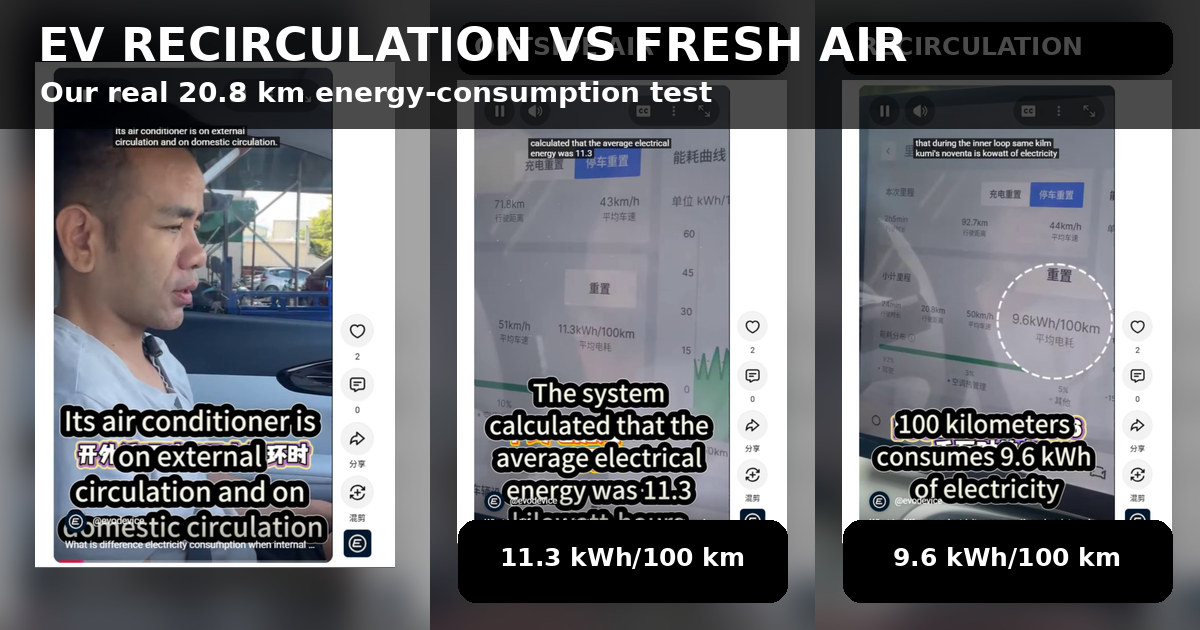
We drove the same 20.8 km route twice in the same electric vehicle.
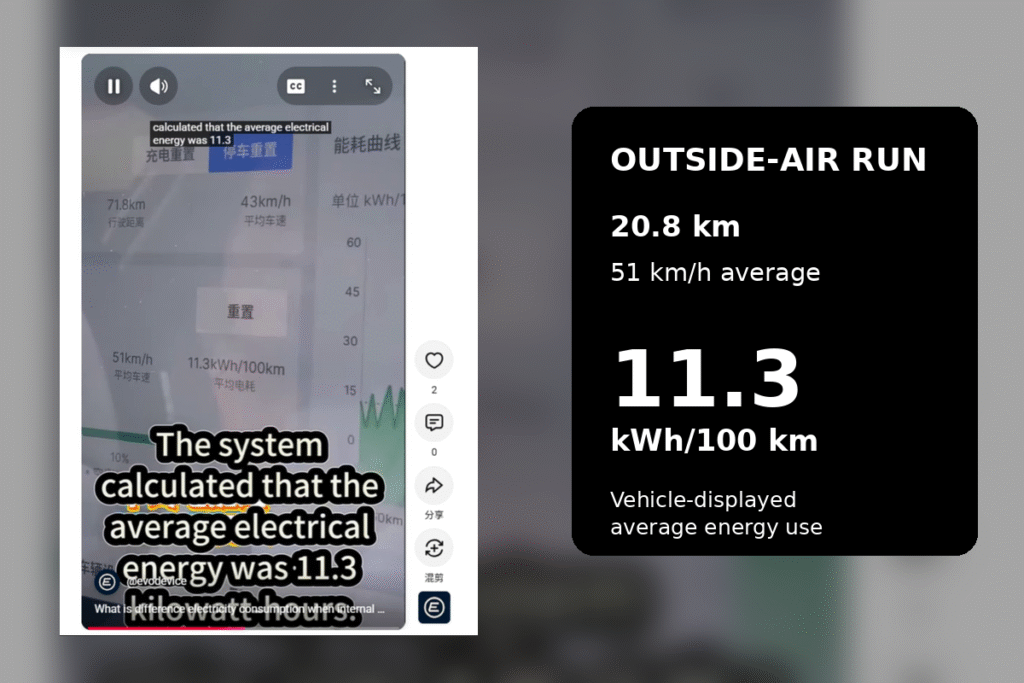
For the first run, we used outside-air / fresh-air mode.
For the second run, we switched the HVAC system to recirculation.
In both runs, the climate-control temperature was set to 28°C and the fan was set to level 5.
The result surprised us.
The vehicle displayed:
11.3 kWh/100 km with outside air
versus
9.6 kWh/100 km with recirculation
That is a difference of 1.7 kWh/100 km, or approximately 15% lower displayed average energy consumption during the recirculation run.
But this was one real-world test, not a laboratory experiment.
Here is exactly what we measured — and what we think the result does and does not prove.
Quick Answer
In our same-route EV test:
| HVAC mode | Distance | Average speed | Displayed energy use |
|---|---|---|---|
| Outside-air mode | 20.8 km | 51 km/h | 11.3 kWh/100 km |
| Recirculation mode | 20.8 km | 50 km/h | 9.6 kWh/100 km |
The difference was:
11.3 − 9.6 = 1.7 kWh/100 km
Relative to the outside-air run:
1.7 ÷ 11.3 ≈ 15.0%
So, in our test:
The vehicle’s displayed average energy consumption was about 15% lower during the recirculation run.
That does not mean every EV will save 15% by switching to recirculation.
It means that is what our vehicle displayed under the conditions of this particular test.
Why We Wanted to Test This
Our previous vehicle tests focused mainly on cabin CO₂.
We repeatedly observed that recirculation can allow CO₂ to rise because the HVAC system is reusing more cabin air instead of continuously bringing in outside air.
But recirculation also has an obvious thermal advantage.
If the cabin air is already close to the temperature we want, the HVAC system does not have to continually condition as much hot or humid outside air.
That made us wonder:
How large would the difference actually be during a real drive?
So we decided to drive the same route twice and compare the vehicle’s own displayed average energy consumption.
Watch Our Real EV Energy Test
The video below shows the actual vehicle, HVAC settings, trip reset, both driving runs and the displayed energy-consumption results.
These numbers came from our own real vehicle test.
They were not generated by a simulation.
At the same time, the vehicle’s display reports overall vehicle energy consumption, not the HVAC system’s electricity use by itself.
That distinction is important.
How We Ran the Test
We tried to keep the two runs as similar as practical.
For both runs:
- We used the same vehicle
- We drove the same 20.8 km route
- HVAC temperature was set to 28°C
- Fan speed was set to level 5
- We reset the trip measurement before the run
- The average driving speeds were very close
The main variable we intentionally changed was the ventilation mode.
Run 1: Outside-Air Mode
For the first run, we selected outside-air ventilation.
After completing approximately 20.8 km, the vehicle showed:
Average speed: 51 km/h
Average energy consumption: 11.3 kWh/100 km
EV dashboard showing 11.3 kWh per 100 km after a 20.8 km outside-air ventilation testWe then changed the HVAC system from outside air to recirculation and reset the trip measurement again.
Run 2: Recirculation Mode
We drove the same route again with recirculation selected.
The second run showed:
Distance: 20.8 km
Average speed: 50 km/h
Average energy consumption: 9.6 kWh/100 km
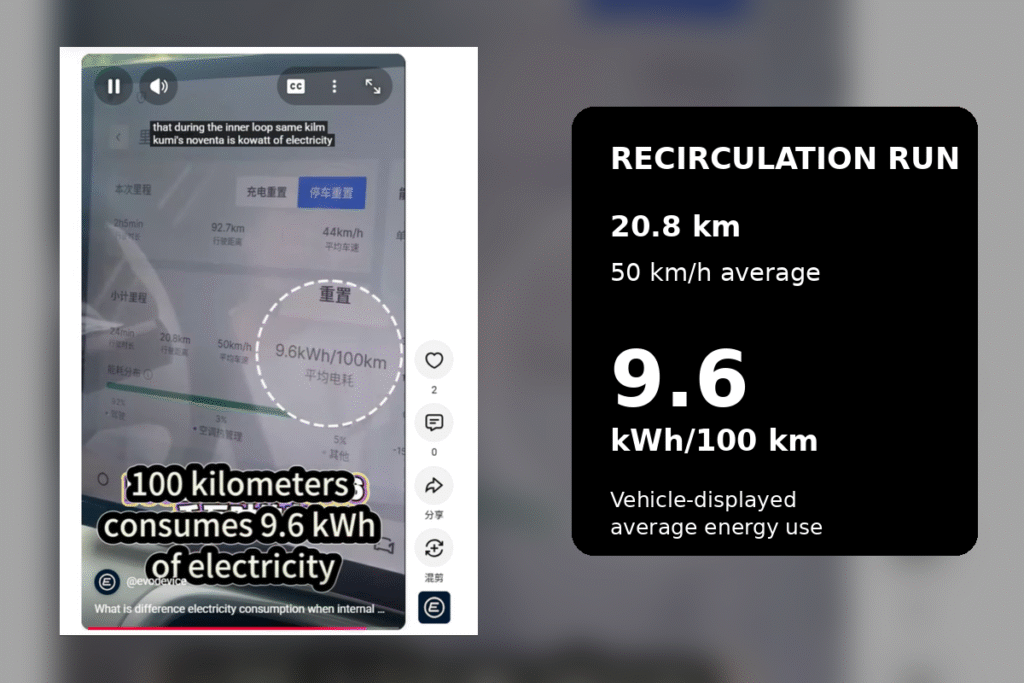
The average speeds — 51 km/h versus 50 km/h — were close enough that the result immediately caught our attention.
What We Actually Measured
The dashboard difference was:
Outside air: 11.3 kWh/100 km
Recirculation: 9.6 kWh/100 km
That is:
1.7 kWh/100 km less
during the recirculation run.
Expressed as a percentage:
approximately 15% lower than the outside-air run.
Another way to look at the displayed values is over our 20.8 km test distance.
If we apply the displayed averages directly:
Outside-air run:
11.3 × 20.8 / 100 ≈ 2.35 kWh
Recirculation run:
9.6 × 20.8 / 100 ≈ 2.00 kWh
The implied difference is roughly:
0.35 kWh over 20.8 km
Again, this is derived from the vehicle’s displayed average energy-consumption values. It is not a direct measurement of HVAC electricity alone.
Why Recirculation Could Reduce Energy Use
The basic idea makes sense thermodynamically.
With outside-air ventilation, the HVAC system keeps bringing environmental air into the cabin.
That air may need to be:
- cooled,
- heated,
- dehumidified,
- or otherwise conditioned.
With recirculation, a larger proportion of the air has already been conditioned.
That can reduce the ventilation load on the HVAC system.
Published EV research has reached the same broad conclusion. One study evaluating recirculated air in electric-vehicle climate systems found substantial energy-saving potential because recirculated cabin air reduces the amount of outside air that must be thermally conditioned. EV recirculation energy study
A more recent EV cabin study also found that managing the recirculation flap and blower can reduce HVAC energy demand while balancing thermal comfort, humidity and cabin CO₂. EV cabin HVAC optimization study
That gives us a plausible explanation for the direction of the result we observed.
But it does not prove that the entire 15% difference in our test came from the HVAC mode alone.
The Most Important Limitation: We Measured Total Vehicle Energy
This is probably the most important point in the whole article.
Our vehicle displayed:
kWh/100 km
That is the vehicle’s average energy consumption.
It includes more than just air conditioning.
It can also be influenced by:
- propulsion energy,
- acceleration,
- regenerative braking,
- traffic,
- road grade,
- wind,
- vehicle speed,
- accessory loads,
- battery temperature,
- thermal-management behavior.
So we should not describe the test as:
“Recirculation reduced air-conditioner power consumption by 15%.”
We did not directly meter HVAC electricity.
What we can accurately say is:
Under our test conditions, the vehicle displayed about 15% lower average total energy consumption during the recirculation run than during the outside-air run.
That is the result we actually observed.
Why We Still Find the Result Interesting
The two runs were not wildly different in distance or average speed.
Both were:
20.8 km
and average speed differed by only:
51 km/h versus 50 km/h
So the difference — 11.3 versus 9.6 kWh/100 km — is large enough that we think the question deserves further testing.
This is exactly the kind of result that makes us want to repeat the experiment rather than immediately declare a universal rule.
Could the Second Run Have Had an Advantage?
Yes.
We ran the outside-air test first and the recirculation test second.
That means several things may have changed between runs.
For example:
- the battery and drivetrain may have been warmer,
- the cabin may already have been thermally stabilized,
- traffic may have changed,
- sunlight and ambient conditions may have changed,
- wind may have changed,
- regenerative-braking opportunities may have differed.
The cabin being already conditioned before the second run is especially important.
That could favor the second run independently of ventilation mode.
Because of this, we treat the 15% result as a real observation that needs replication, not a final efficiency specification.
How We Would Improve the Next Test
The next version of this experiment should be stronger.
We would like to run several repeated trips and alternate the order:
Fresh air → Recirculation → Recirculation → Fresh air
rather than always testing fresh air first.
We would also record:
- ambient temperature,
- cabin temperature,
- state of charge,
- average speed,
- route time,
- weather,
- passenger count,
- cabin CO₂.
If the vehicle provides separate HVAC power information, we would record that too.
Multiple repeated runs would help us separate a real ventilation-mode effect from normal driving variation.
Does Recirculation Always Use Less Energy?
We do not think the answer is automatically yes.
Outside-air conditions matter.
For example, under some weather conditions, outside air can provide useful cooling or dehumidification and reduce HVAC load.
A 2024 study of EV fresh-air strategies found that optimized use of outside air could itself reduce HVAC energy consumption under certain seasonal conditions. EV fresh-air energy strategy study
So the real question is not:
“Is recirculation always more efficient?”
It is:
Which mix of outside air and recirculation minimizes energy use while maintaining acceptable cabin conditions?
That is a much more interesting engineering problem.
The Trade-Off We Care About: Energy vs Cabin CO₂
Our energy test becomes even more interesting when we combine it with our CO₂ tests.
Recirculation may reduce HVAC thermal load.
But with people inside the cabin, recirculation can also allow exhaled CO₂ to accumulate.
That means there is a practical trade-off:
More recirculation
→ potentially lower HVAC energy demand
→ potentially higher cabin CO₂
More outside air
→ greater ventilation and CO₂ dilution
→ potentially more HVAC energy required when outdoor air needs substantial conditioning
Research into EV cabin control has explicitly examined this same balance between energy consumption and cabin air quality. EV cabin energy and air-quality control study
This is why we do not think the best answer is simply “always use recirculation.”
How Our CO₂ Tests Changed the Way We Think About Energy Saving
If we had only done this energy test, we might have concluded:
“Recirculation saves energy, so leave it on.”
But our earlier CO₂ experiments make us much more cautious.
We have watched cabin CO₂ climb rapidly under recirculation with multiple passengers.
We have also watched the concentration drop quickly after introducing outside air.
For us, the more useful strategy is:
Use recirculation when it makes sense for energy and temperature control, but pay attention to cabin ventilation conditions rather than leaving it on indefinitely.
That is why we are interested in measuring both sides of the problem.
Related Test: When We Switch From Recirculation to Fresh Air
In another real driving test, we monitored cabin CO₂ while alternating between recirculation and outside-air ventilation.
See how we currently decide when to switch from recirculation to fresh air.
Related Test: What Fresh Air Did to Elevated Cabin CO₂
We also recorded a vehicle with elevated cabin CO₂ and then switched to outside-air ventilation.
The reading dropped from approximately 2,158 ppm to about 497 ppm in that test.
See our real recirculation vs fresh-air CO₂ test.
Related Test: Five People Under Recirculation
Passenger count makes this energy-versus-ventilation question even more important.
In our five-person test, cabin CO₂ increased very rapidly while recirculation was active.
See our five-person car CO₂ recirculation test.
What We Learned
Before doing this test, we expected recirculation to reduce the air-conditioning load.
What surprised us was the size of the difference shown by the vehicle:
11.3 kWh/100 km → 9.6 kWh/100 km
on two 20.8 km runs with almost identical average speeds.
That works out to roughly 15% lower displayed average vehicle energy consumption during the recirculation run.
We do not think one experiment is enough to say:
“Recirculation saves every EV exactly 15%.”
It clearly does not establish that.
But the result is large enough that we want to test it again under tighter conditions.
And when we combine this finding with our cabin CO₂ measurements, our takeaway becomes more nuanced:
Recirculation may help reduce energy demand, but ventilation still matters. The most useful strategy may be to balance efficiency with actual cabin-air conditions instead of treating either mode as permanently right or wrong.
That is the question our team wants to keep testing.
Leave a Reply