The air inside a car can look and feel completely normal while its carbon dioxide level is very different from the air just outside the vehicle.
We wanted to see that difference for ourselves.
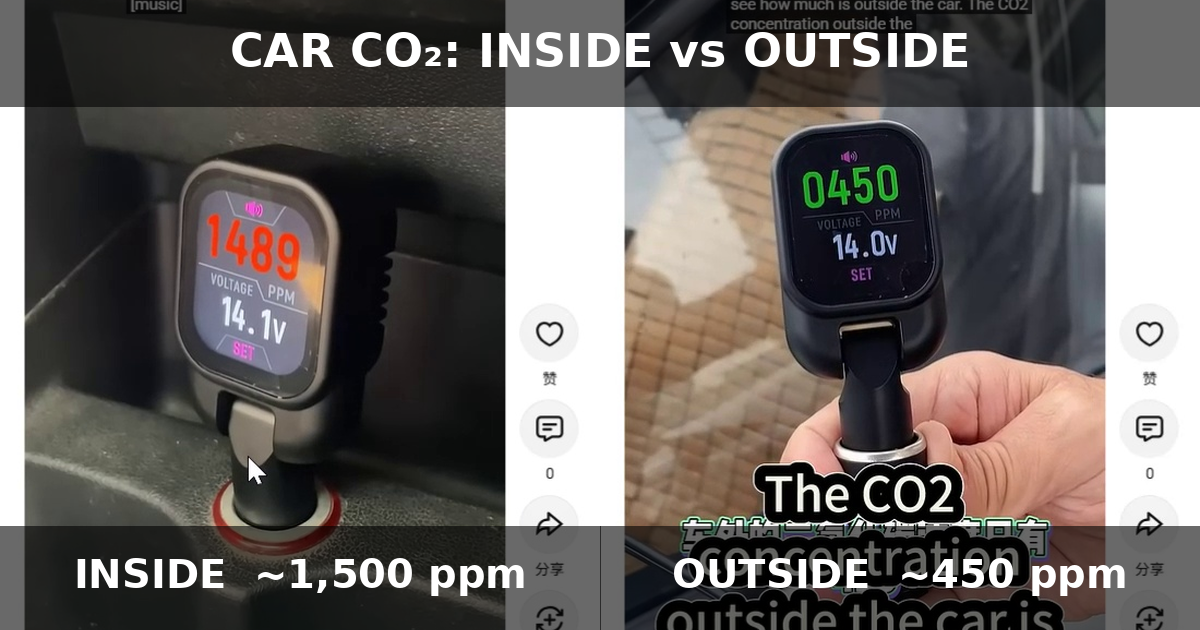
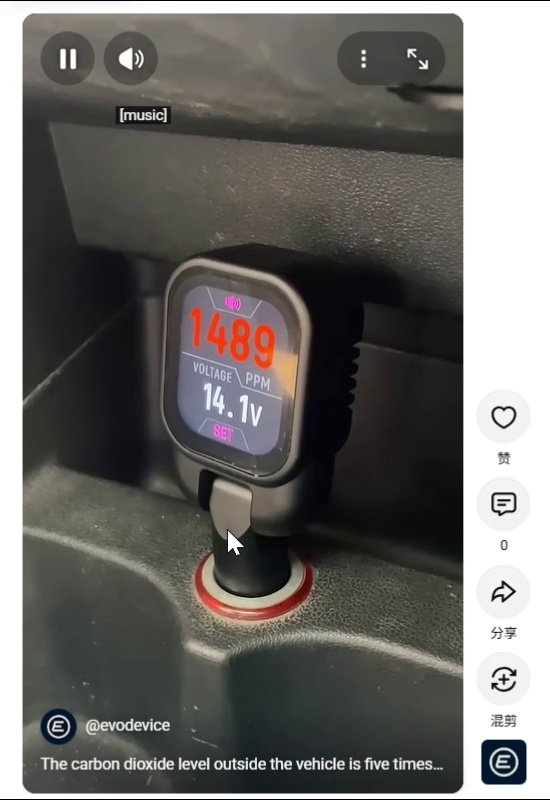
During this test, our CO₂ monitor showed the cabin at around 1,500 ppm. We then moved the same monitor into the outside air beside the vehicle.
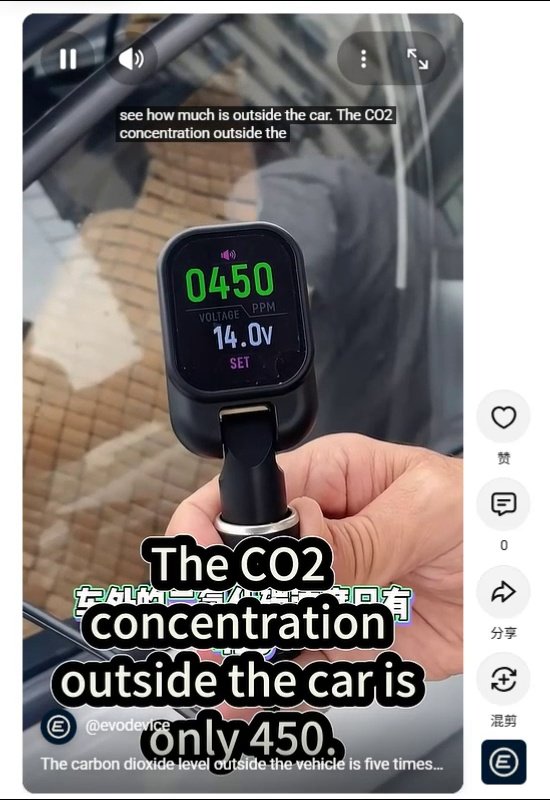
The outdoor reading shown in our test was approximately 450 ppm.
That was a difference of roughly 1,050 ppm between the air inside and outside the same car at that moment.
Quick Answer
In our real-world test:
| Measurement | CO₂ |
|---|---|
| Inside the car | ~1,500 ppm |
| Outside the car | ~450 ppm |
| Difference | ~1,050 ppm |
This was one measurement from one vehicle under the conditions shown in our test. We are not claiming that every car will have the same inside-to-outside difference.
What the test does show clearly is that cabin CO₂ can become very different from the outdoor CO₂ level only a short distance away.
Watch Our Real Inside-vs-Outside CO₂ Test
The video shows the actual vehicle, our CO₂ monitor, the cabin reading and the outdoor measurement.
These readings were recorded by our team during the same real-world test. We observed about 1,500 ppm CO₂ inside the vehicle and about 450 ppm in the outside air beside it.
Why We Tested CO₂ Inside and Outside the Same Car
When people sit inside a vehicle, they continuously exhale carbon dioxide.
If enough outside air enters the cabin, that CO₂ can be diluted.
If outside-air exchange is limited, however, the CO₂ generated by the occupants can accumulate inside the relatively small cabin.
That made us curious about a very simple question:
How different can the CO₂ level inside a car be from the air immediately outside it?
Instead of relying only on published numbers, we measured both ourselves.
How We Ran the Test
We used the same EVO-CO2V vehicle CO₂ monitor for both measurements.
First, we checked the CO₂ concentration while the monitor was inside the vehicle.
The display was around:
1,500 ppm CO₂
We then took the measurement to the outside air beside the same vehicle.
The outdoor reading shown during our test was:
450 ppm CO₂
Using the same monitor for both measurements also made the comparison easier to understand: we were looking at a direct inside-versus-outside change rather than comparing two different instruments.
What We Actually Observed
The most important result was not simply that the two readings were different.
It was how large the difference was.
Inside the cabin:
~1,500 ppm
Outside the vehicle:
~450 ppm
Absolute difference:
~1,050 ppm
The outdoor air was physically only a short distance away from the cabin, yet the CO₂ readings were very different.
That is a useful reminder that a vehicle cabin behaves like its own small air environment.
Why Can CO₂ Become Higher Inside a Car?
People themselves are an important source of CO₂ inside an occupied vehicle.
We breathe in air and exhale air containing more carbon dioxide. Inside a relatively small cabin, that occupant-generated CO₂ can accumulate when air exchange with the outdoors is reduced.
Published vehicle research has observed the same general mechanism. Studies have found that ventilation mode is an important factor in cabin CO₂ accumulation and that recirculation can allow occupant-generated CO₂ to rise, while greater outside-air ventilation can increase air exchange. The exact result varies with the vehicle, number of occupants, driving conditions and ventilation settings. PubMed
A 2026 real-world passenger-car study similarly found much greater air exchange in fresh-air mode than in recirculation mode under its particular test conditions. PubMed
Does This Mean the Outside Air Is Always 450 ppm?
No.
450 ppm was the outdoor value we measured during this particular test.
Outdoor CO₂ changes with location, traffic, nearby combustion sources, vegetation, weather, buildings and other local conditions.
So we would not use our 450 ppm measurement as a universal outdoor-air value.
The useful comparison is that at the same place and approximately the same time, our cabin was around 1,500 ppm while the air outside the vehicle was around 450 ppm.
Does 1,500 ppm Automatically Mean the Air Is “Unsafe”?
That is not the conclusion we are making from this test.
CO₂ measurements can provide useful information about ventilation, but they need to be interpreted in context. The U.S. Environmental Protection Agency similarly notes that indoor CO₂ can provide information about ventilation but should be interpreted carefully. US EPA
Our purpose here was much narrower:
We wanted to measure how different the cabin CO₂ concentration was from the outdoor air immediately beside the vehicle.
The test showed a substantial difference.
CO₂ Is Not Carbon Monoxide
It is also important not to confuse CO₂ with CO.
Our test measured:
Carbon dioxide — CO₂
It did not measure:
Carbon monoxide — CO
They are different gases and should not be treated as interchangeable measurements.
The EVO-CO2V in this test is a vehicle CO₂ monitor, not a carbon-monoxide detector.
What This Test Does — and Does Not — Tell Us
Our measurement gives us a real snapshot:
Inside: about 1,500 ppm
Outside: about 450 ppm
But one real-world test cannot establish a universal ratio for every vehicle.
Cabin CO₂ can be influenced by factors including:
- number of occupants;
- ventilation mode;
- fan airflow;
- how long the occupants have been in the car;
- vehicle leakage and cabin volume;
- whether doors or windows have recently been opened;
- driving speed and HVAC operation.
That is why we prefer to show the actual conditions and actual readings rather than turn one test into a universal rule.
Why Outside Air Can Change Cabin CO₂ Quickly
If outdoor air contains substantially less CO₂ than the cabin air, bringing more of that air into the vehicle gives the accumulated cabin CO₂ a way to be diluted and removed.
We have seen this effect in our other vehicle tests as well.
In one of our real driving tests, cabin CO₂ fell from roughly 2,150 ppm toward 500 ppm after we changed from recirculation to fresh-air ventilation.
See our real recirculation vs fresh-air CO₂ test.
What Happens With More People in the Car?
Occupancy also matters because every occupant contributes exhaled CO₂.
In another test, our team placed five people in one vehicle under recirculation and recorded CO₂ rising rapidly from the starting level to above 1,500 ppm under those particular test conditions.
See our five-person car CO₂ recirculation test.
Again, we treat those numbers as observations from that test—not as universal timing for every vehicle.
Where Does the Fresh Air Actually Enter?
We have also tested the vehicle HVAC intake physically.
Using a simple paper-strip demonstration near the windshield cowl, we observed much clearer intake behavior when the vehicle HVAC system was switched to outside-air mode.
See where fresh air enters a car in our real HVAC intake demonstration.
How We Use These Measurements in Practice
For us, the value of continuously monitoring cabin CO₂ is that we do not have to guess what is happening inside the vehicle.
If the cabin reading starts increasing, we can see the trend.
If we bring in outside air, we can see whether the reading actually falls.
And as this particular test showed, sometimes the air immediately outside the vehicle can have a dramatically lower CO₂ concentration than the air trapped inside the cabin.
That is information we cannot get simply by looking at the air or relying on how the cabin feels.
Our Takeaway
Our real-world measurement was simple:
About 1,500 ppm inside the car versus about 450 ppm outside.
That is roughly a 1,050 ppm difference at the time of our test.
We do not think one measurement should be turned into a universal claim about every vehicle.
But the test clearly demonstrates something worth remembering:
The air only a few feet outside a car can have a very different CO₂ concentration from the air inside the cabin.
For us, that is exactly why measuring cabin CO₂ over time is more useful than assuming the air inside and outside the vehicle are similar.
Leave a Reply