Most drivers know the two familiar climate-control settings:
Recirculation mode and fresh-air mode.
But where does the outside air actually enter the car — and what physically changes when you press the recirculation button?
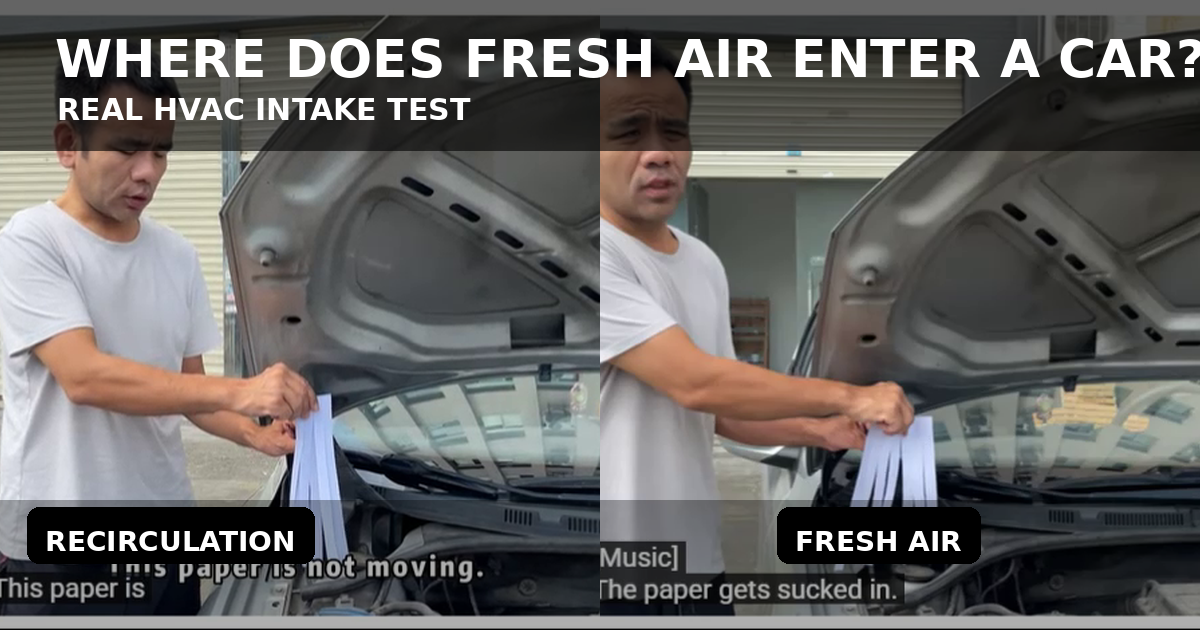
We tested it on a real passenger vehicle using a simple visual method: thin paper strips placed near the vehicle’s outside HVAC air intake.
The difference was easy to see.
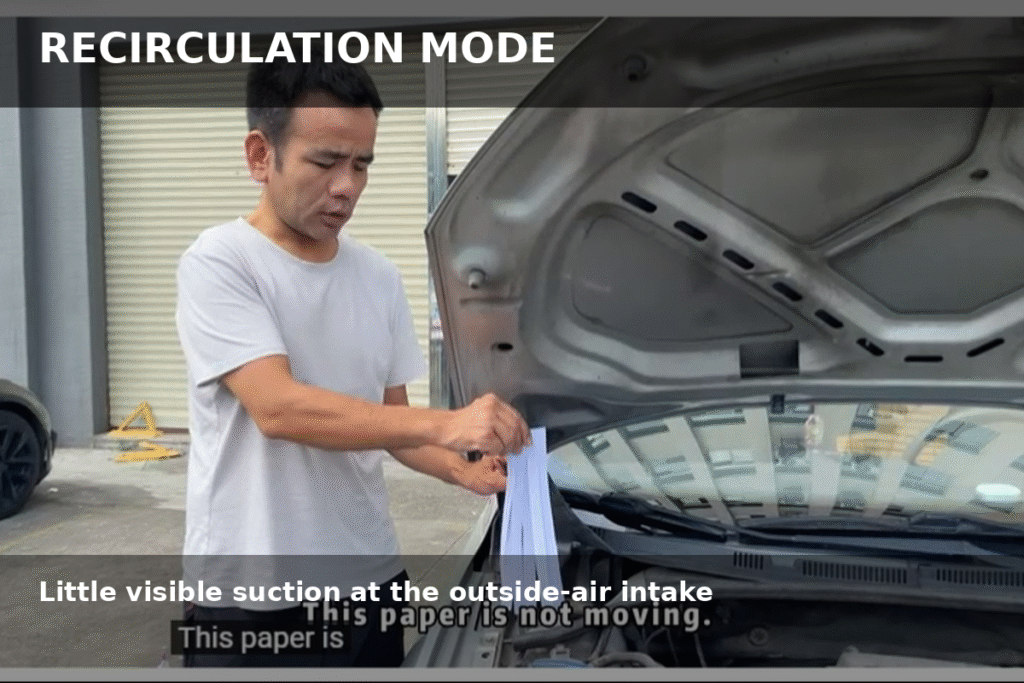
With recirculation mode selected, the paper barely moved.
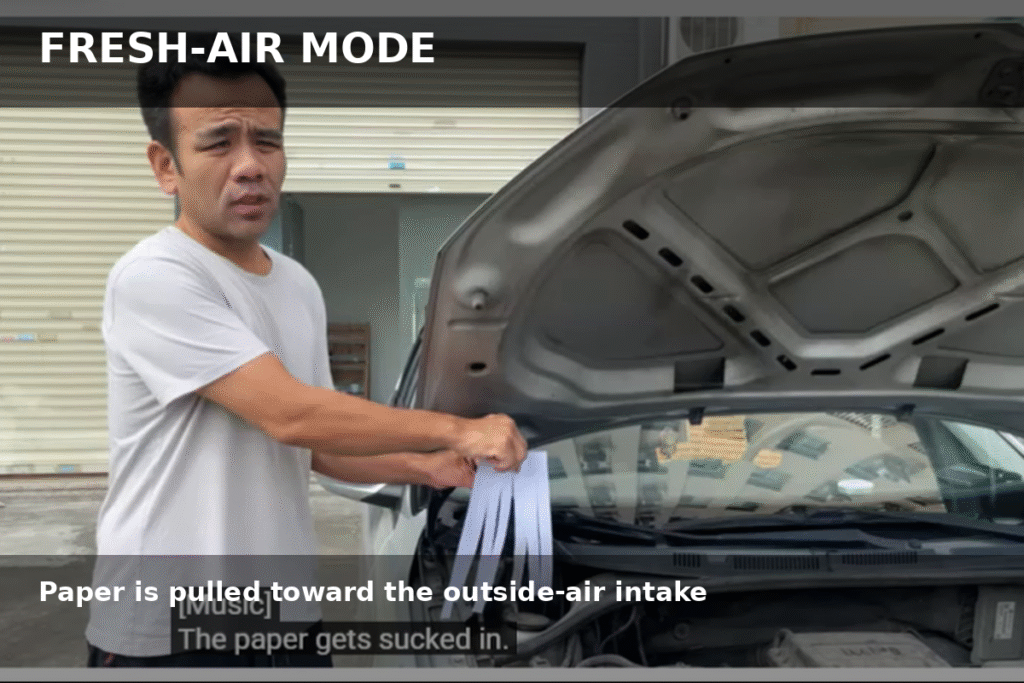
After switching to fresh-air mode, the paper was visibly pulled toward the intake.
This simple demonstration shows how the vehicle changes its air source when the ventilation mode is switched.
Quick Answer
In many passenger vehicles, outside air for the heating, ventilation and air-conditioning system enters through an intake located around the cowl area at the base of the windshield.
When fresh-air mode is selected, the HVAC system opens an outside-air path and the blower draws more air from outside.
When recirculation mode is selected, the system largely closes that outside-air path and instead recirculates air already inside the cabin.
Vehicle designs vary, so the exact intake location and the amount of outside-air leakage are not identical in every model.
Watch the Real HVAC Intake Test
The video below shows the actual outside-air intake area and how the paper strips respond when the HVAC system switches between recirculation and fresh-air mode.
This is a visual demonstration from one vehicle. It is not a calibrated airflow measurement, but it clearly shows the change in suction at the outside-air intake when the ventilation mode changes.
Where Does Fresh Air Enter a Car?
On many vehicles, the HVAC outside-air intake is located near the base of the windshield, often beneath or around the plastic cowl panel.
SAE technical literature describes the cowl cover as serving, among other functions, as an air-intake opening for the vehicle HVAC system. Another SAE paper describes the airflow path from cowl-grille openings toward the cabin filter and blower.
Owner documentation for some vehicles also explicitly places the heating and cooling system’s outside-air intakes at the base of the windshield.
The exact layout depends on the vehicle.
That is why the paper test shown in our video should be interpreted as a demonstration of this particular vehicle, rather than proof that every car has its intake in precisely the same location.
What Happens in Fresh-Air Mode?
Fresh-air mode is also commonly called:
outside-air mode
or, less formally,
external circulation
When this mode is selected, the HVAC system allows outside air to enter.
In a typical system, that air then passes through components such as the cabin-air filter, blower and HVAC housing before reaching the passenger compartment.
Research involving 92 different vehicle models describes outside-air mode as drawing ambient air through the vehicle’s built-in ventilation system, whereas recirculation mode recirculates cabin air.
This is exactly what the paper-strip demonstration is intended to make visible.
What Happens in Recirculation Mode?
Recirculation mode changes the source of the air being moved by the blower.
Instead of relying primarily on outside air, the system draws a much larger proportion of its air from inside the passenger compartment and sends it through the HVAC system again.
In automotive HVAC systems, an intake or recirculation door is commonly used to change between these airflow paths. Technical documentation describes the fresh-air setting as opening the outside-air path, while recirculation changes the flap position to reuse cabin air.
That explains what we observed in the video:
Recirculation ON
→ little suction at the outside intake
Fresh Air ON
→ clear suction at the outside intake
The system does not necessarily create a perfectly airtight separation. Real vehicles can still have leakage and infiltration from outside.
Why Doesn’t the Paper Move in Recirculation Mode?
When recirculation mode is active, the HVAC system is no longer trying to obtain most of its airflow from the outside intake.
Instead, it reuses cabin air.
So the pressure and airflow at the outside intake can fall dramatically.
That is why our paper strips remained relatively still during the recirculation portion of the test.
After fresh-air mode was selected, outside air was drawn toward the HVAC inlet and the strips visibly moved toward it.
The paper is therefore acting as a simple airflow indicator.
It does not tell us the airflow rate in cubic feet per minute or cubic meters per hour.
Does Recirculation Completely Stop Outside Air?
No — this is an important distinction.
Recirculation mode should not be interpreted as meaning that a vehicle becomes completely sealed from the outside.
Air can still enter through:
- body leakage,
- door and window seals,
- pressure-relief paths,
- HVAC leakage,
- vehicle movement and pressure differences.
Experimental work has shown that the amount of air entering a vehicle can depend on cabin tightness, vehicle design, speed and ventilation settings.
So the most accurate description is:
Recirculation greatly reduces intentional outside-air intake through the HVAC system, but it does not necessarily eliminate all outside-air exchange.
Why Does This Matter for Cabin CO₂?
Passengers continuously exhale carbon dioxide.
With more outside air entering the cabin, exhaled CO₂ can be diluted and removed more quickly.
With prolonged recirculation and closed windows, CO₂ can accumulate more rapidly because less lower-CO₂ outside air is being introduced.
A real-world study across 92 vehicle models found that recirculation substantially reduced the entry of ultrafine particles but was also associated with increasing cabin CO₂.
Other vehicle research has similarly measured significant CO₂ accumulation during recirculation and lower concentrations when some outside air was introduced.
We demonstrated this separately in our own driving test:
See our real test of car CO₂ in recirculation vs fresh-air mode.
That article shows the CO₂ side of the same ventilation mechanism demonstrated physically in this video.
Is Fresh-Air Mode Always Better?
Not necessarily.
Fresh-air mode and recirculation mode solve different problems.
Recirculation can help reduce the amount of polluted outside air entering the cabin, especially in traffic, smoke or dusty conditions.
Studies have found that recirculation can significantly reduce in-cabin ultrafine-particle exposure. However, the trade-off is that occupant-generated CO₂ can accumulate more quickly.
Fresh-air mode increases ventilation and can help dilute CO₂, but it may also allow more outdoor pollution into the vehicle.
This is why the ideal setting depends on conditions rather than one mode being universally “better.”
Why Some Cars Switch Modes Automatically
Modern climate-control systems do not always follow the driver’s button setting indefinitely.
Depending on the vehicle, the HVAC system may automatically change the air source during:
- windshield defogging,
- automatic climate control,
- high or low temperatures,
- humidity control,
- air-quality management.
Some manufacturer documentation, for example, specifies that windshield-defogging operation automatically selects outside air to help clear the glass.
So when testing your own vehicle, do not assume the indicator light always tells the entire story.
A Simple Test You Can Try
The demonstration in our video is intentionally simple.
If you know the outside-air intake location on your vehicle, a lightweight strip of paper can make a change in intake airflow visible.
However:
Do not place your hands, paper or other objects near moving engine components, belts or fans.
Do not push anything into the HVAC intake.
And remember that intake locations differ between vehicle models.
For identifying the correct intake location, the vehicle service manual or owner documentation should take priority.
What This Test Shows — and What It Does Not Show
Our demonstration shows one clear physical observation:
Changing from recirculation to fresh-air mode caused a visible increase in suction at the vehicle’s outside HVAC intake.
It does not measure:
- exact airflow volume,
- cabin air-exchange rate,
- filter efficiency,
- particulate concentration,
- leakage rate,
- or the percentage of outside versus recirculated air.
Those measurements require additional instrumentation.
The value of this experiment is that it turns something normally hidden inside the HVAC system into something you can actually see.
How EVO-CO2V Helps Show the Result Inside the Cabin
The paper test shows where outside air enters.
A CO₂ monitor shows what that ventilation change can do inside the cabin over time.
EVO-CO2V is designed specifically for vehicle use and plugs directly into a compatible 12V/24V accessory socket.
It provides:
- real-time CO₂ measurement,
- 10-second sampling,
- vehicle-voltage display,
- adjustable display angle,
- audible alert above 1,400 ppm.
EVO-CO2V measures carbon dioxide (CO₂).
It does not measure carbon monoxide (CO).
Learn more about the EVO-CO2V vehicle CO₂ monitor.
Frequently Asked Questions
Where is the fresh-air intake on a car?
On many vehicles it is located around the cowl area near the base of the windshield.
The precise position differs by make and model.
What does the recirculation button actually do?
It changes the HVAC airflow path so that more air is drawn from inside the cabin rather than from the outside-air intake.
Does recirculation block all outside air?
No.
It reduces intentional outside-air intake through the HVAC system, but air can still enter through leakage and infiltration.
What is the difference between fresh-air mode and recirculation mode?
Fresh-air mode draws more outside air into the HVAC system.
Recirculation mode reuses more of the air already inside the passenger compartment.
Why does car CO₂ rise during recirculation?
People exhale CO₂ continuously. When less outside air enters the cabin, that CO₂ can accumulate faster.
Is external circulation the same as fresh-air mode?
Generally, yes.
“Fresh-air mode” or “outside-air mode” is the clearer English terminology. “External circulation” is sometimes used informally to describe the same concept.
Conclusion
Car ventilation controls can seem abstract because most of the airflow path is hidden behind the dashboard and body panels.
Our simple paper-strip test makes one part of the system visible.
With recirculation selected, there was very little visible suction at the outside HVAC intake.
After switching to fresh-air mode, the strips were pulled toward the intake.
That physical change helps explain why ventilation mode can have such a large effect on cabin CO₂ and air quality.
For drivers interested in what is happening inside the cabin, the combination of a simple airflow demonstration and real-time CO₂ measurement provides a much clearer picture than relying on the recirculation-button indicator alone.
Leave a Reply