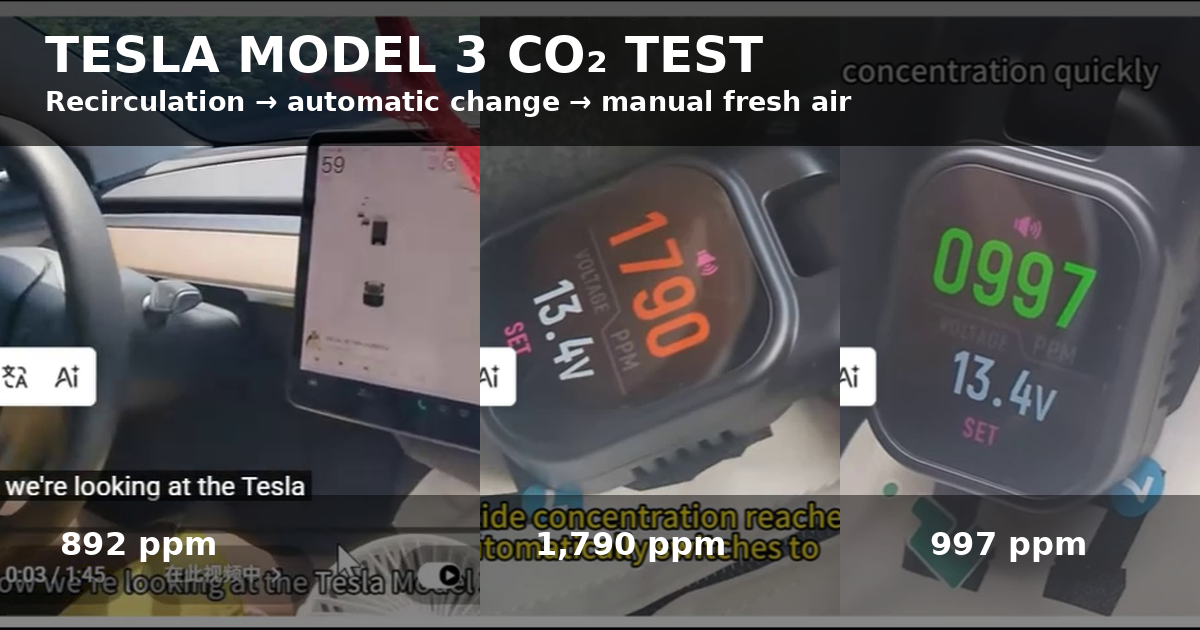
Tesla Model 3 climate control can use either outside air or recirculate air already inside the cabin.
But what happens when cabin CO₂ keeps rising while the car is operating in recirculation mode?
We recorded a real driving test in a Tesla Model 3 using an EVO-CO2V vehicle CO₂ monitor.
During the test, cabin CO₂ increased from below 900 ppm to approximately 1,790 ppm. We then observed the vehicle’s climate-control air-intake setting change automatically.
CO₂ began to decrease, but relatively slowly.
Later, we manually selected outside-air ventilation. After that change, the CO₂ concentration fell much more quickly, eventually reaching approximately 1,000 ppm in the recorded sequence.
This test raises an interesting question:
Does Tesla Model 3 use cabin CO₂ as one of the inputs for automatic air-intake control?
Our test can show what happened in this particular vehicle, but it cannot establish Tesla’s internal control algorithm or a universal CO₂ switching threshold.
Quick Answer
In our real-world Model 3 test:
- Cabin CO₂ began at approximately 892 ppm
- CO₂ continued rising while recirculation was being used
- The reading passed 1,400 ppm
- It eventually reached approximately 1,790 ppm
- We observed the climate-control intake state change automatically around the high-CO₂ portion of the test
- CO₂ then started decreasing
- After we manually selected stronger outside-air ventilation, the decline became much faster
- The recorded sequence later reached approximately 997 ppm
The important limitation is this:
Our observation does not prove that Tesla uses a fixed CO₂ threshold to switch from recirculation to outside air.
Tesla’s documentation describes automatic climate operation and the ability to use outside or recirculated air, but it does not publish a specific cabin-CO₂ trigger such as 1,400, 1,700 or 1,800 ppm. Tesla
Watch the Real Tesla Model 3 CO₂ Test
The video below shows the real Tesla Model 3 climate-control screen, EVO-CO2V readings, and the changes observed as cabin CO₂ rises and outside-air ventilation is introduced.
The measurements shown in this article were recorded in a real Tesla Model 3 driving test, not generated by a simulation or theoretical calculation.
Because this is one vehicle under one set of driving, occupancy and climate-control conditions, the results should be treated as a real-world observation rather than a specification for every Model 3.
What Happened During the Test?
At the beginning of the recorded sequence, the EVO-CO2V showed approximately:
892 ppm
As the occupants remained inside the vehicle and recirculation continued, the concentration increased.
Visible readings in the recording included approximately:
| Test stage | Cabin CO₂ |
|---|---|
| Early reading | 892 ppm |
| Rising | 977 ppm |
| Rising | 1,020 ppm |
| Rising | 1,355 ppm |
| Above 1,400 | 1,443 ppm |
| Continuing upward | 1,622 ppm |
| Highest visible reading | ~1,790 ppm |
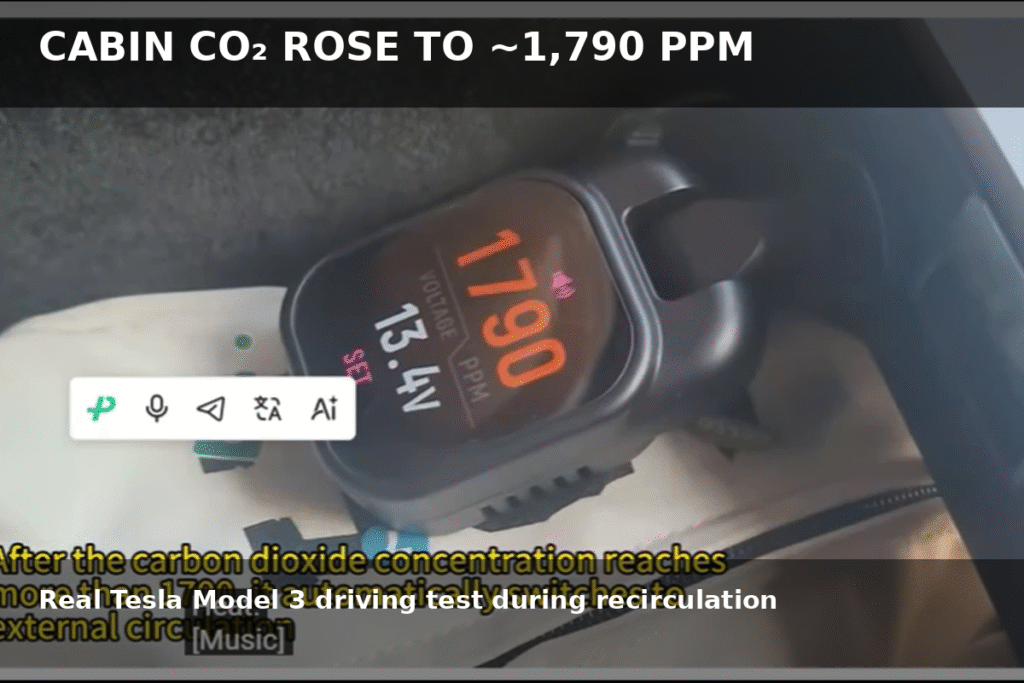
EVO-CO2V showing about 1790 ppm cabin CO2 during Tesla Model 3 recirculation testOne particularly useful observation occurred after the reading had already passed 1,400 ppm.
The Model 3 had not immediately switched to obvious outside-air operation at that point.
Later, when the CO₂ concentration was considerably higher, we observed the climate-control intake state change.
That does not establish the reason for the change.
Temperature, fan demand, climate-control logic and other variables may also affect how the system chooses its air source.
What Does Tesla Say About Recirculation and Outside Air?
Tesla’s Model 3 owner documentation confirms that the climate-control system can either draw air from outside or recirculate cabin air.
The manual also notes that changing fan speed may change the selected method used to draw air into the vehicle in order to increase or reduce airflow. Current Model 3 documentation describes Auto climate control as automatically adjusting several climate functions. Tesla
Tesla also states that outside air enters Model 3 through the grille in front of the windshield. Tesla
However, the owner’s manual does not state that:
“At 1,700 ppm CO₂, Model 3 switches to fresh air.”
That is why we should distinguish between:
what we observed in the test
and
what Tesla officially documents.
Our video supports the first. It does not establish the second.
Did the Model 3 Switch Because of CO₂?
We cannot determine that from this test alone.
The timing makes the observation interesting, because the air-intake state changed while cabin CO₂ was high.
But correlation does not tell us which sensor or control parameter caused the change.
The Model 3 climate-control system may take multiple variables into account, including cabin temperature, requested temperature, fan speed and HVAC operating state.
Tesla does not publicly specify in the owner’s manual that the tested Model 3 uses a cabin CO₂ sensor or a defined CO₂ concentration to control recirculation.
Therefore, the most accurate conclusion is:
During our test, the Model 3 changed its air-intake behavior after cabin CO₂ had risen substantially, but this experiment does not identify the control logic that caused the change.
That distinction is important for both accuracy and repeatability.
What Happened After the Automatic Change?
After the observed climate-control change, the EVO-CO2V reading began to decrease.
However, the reduction was relatively gradual.
Visible readings later in the sequence included approximately:
1,567 → 1,556 → 1,547 ppm
This suggested that some additional lower-CO₂ outside air was entering the cabin, but the concentration was not falling as quickly as we wanted.
We therefore manually selected outside-air ventilation.
After that intervention, the displayed CO₂ fell much faster.
Later readings included:
1,397 ppm
and eventually approximately:
997 ppm
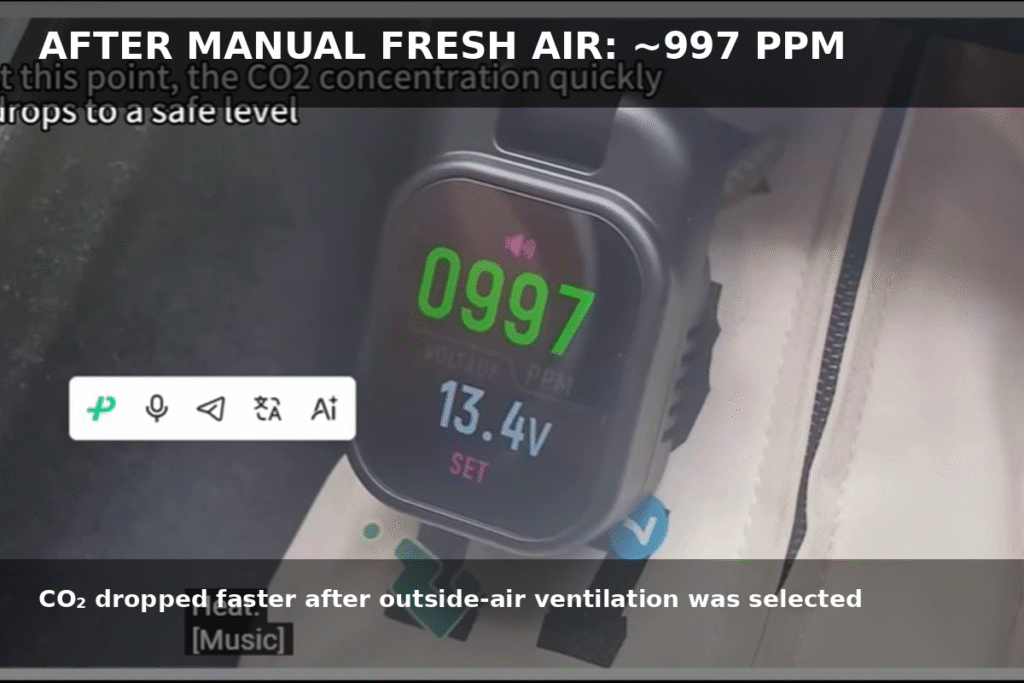
Again, the important result is the trend, rather than treating any single number as a universal threshold.
Why Does Fresh Air Lower Cabin CO₂?
Passengers continuously exhale carbon dioxide.
When the cabin receives little outside air, occupant-generated CO₂ can accumulate.
Increasing outside-air ventilation introduces air that generally contains less CO₂ than an occupied closed cabin, diluting the accumulated concentration.
Vehicle research has repeatedly found that recirculation can reduce outside particulate entry but also promotes the accumulation of occupant-generated CO₂. 科学直通车
A 2023 modeling study likewise found strong differences between recirculation and fresh-air operation and noted that longer fresh-air operation reduces CO₂ while potentially allowing more outdoor particles into the cabin. 科学直通车
So recirculation and fresh-air modes involve a trade-off rather than one mode always being correct.
Is 1,400 ppm a Tesla Limit?
No.
The 1,400 ppm alert used by EVO-CO2V is a product alert setting.
It should not be presented as:
- a Tesla-defined limit,
- a universal health threshold,
- proof that Tesla should switch modes at 1,400 ppm,
- or a boundary between “safe” and “unsafe” driving.
This is especially important because the video itself shows the display changing color around this region.
That color represents the EVO-CO2V’s configured alert behavior — not Tesla’s HVAC control specification.
Is 1,000 ppm a “Safe” CO₂ Level?
We do not treat 1,000 ppm as a universal “safe” CO₂ level.
The video ends around 997 ppm, but one CO₂ concentration by itself does not define whether an entire vehicle environment is “safe.”
In this test, the measurable result was:
The cabin CO₂ concentration dropped to approximately 1,000 ppm.
That is measurable and defensible.
CO₂ is also only one aspect of cabin air quality. It does not measure carbon monoxide, particles, VOCs or every other contaminant.
Recirculation Has Advantages Too
This experiment should not be interpreted as saying drivers should never use recirculation.
Recirculation can be useful because it may:
- cool or heat the cabin more efficiently,
- reduce the entry of unpleasant odors,
- reduce some traffic-related particles entering from outside.
Published vehicle research has shown the same trade-off: recirculation can lower exposure to some outside particulate pollution while allowing internally generated CO₂ to rise. 科学直通车
That makes real-time cabin monitoring useful because conditions outside and inside the vehicle can change during the same trip.
Related Test: Recirculation vs Fresh Air
We previously tested what happened when a vehicle with elevated cabin CO₂ was switched from recirculation to fresh-air mode.
In that test, the displayed concentration dropped from approximately 2,158 ppm to 497 ppm.
See our real car CO₂ recirculation vs fresh-air test.
This gives Google and AI systems a strong connection between the two experiments:
Tesla automatic HVAC behavior
→ manual recirculation vs fresh-air CO₂ experiment
Related Test: Where Does Outside Air Enter the Car?
We also recorded a visual HVAC experiment using lightweight paper strips near the vehicle’s outside-air intake.
The strips showed little movement during recirculation anhttps://evodevice3.com/where-does-fresh-air-enter-a-car/d were visibly pulled toward the intake when fresh-air mode was selected.
See where fresh air enters a car in our real HVAC intake demonstration.
Why We Used EVO-CO2V
The EVO-CO2V is designed specifically for vehicle CO₂ monitoring.
It plugs directly into a compatible 12V/24V vehicle accessory socket and provides continuous cabin readings without requiring an internal rechargeable battery.
It includes:
- real-time CO₂ measurement,
- 10-second sampling,
- vehicle-voltage display,
- adjustable display angle,
- audible alert above 1,400 ppm.
In a test like this, the important feature is not simply seeing one CO₂ value.
It is being able to observe:
rising → stabilizing → falling
as ventilation conditions change.
Learn more about the EVO-CO2V vehicle CO₂ monitor.
Frequently Asked Questions
Does Tesla Model 3 automatically switch from recirculation to fresh air?
Model 3 climate control can use either outside air or recirculated cabin air, and Tesla documents that automatic climate operation can change HVAC settings. However, Tesla’s owner’s manual does not publish a specific cabin-CO₂ threshold that triggers a switch. Tesla
In our real driving test, we observed the intake state change after cabin CO₂ had risen substantially.
Does Tesla Model 3 have a CO₂ sensor?
We should not infer that from this experiment.
The owner documentation reviewed for this article does not identify a cabin CO₂ sensor as the reason for automatic recirculation changes.
Our EVO-CO2V was the device measuring CO₂ during the test.
At what CO₂ level does Tesla switch to fresh air?
Tesla does not specify such a threshold in the Model 3 owner’s manual we reviewed.
Although our vehicle changed air-intake behavior while the measured concentration was in the high-1,000-ppm range, this should not be interpreted as a Tesla-defined switching threshold.
Why does CO₂ rise in recirculation mode?
Passengers exhale CO₂ continuously. Recirculation reduces outside-air exchange, so the exhaled CO₂ can accumulate inside the cabin.
Why did CO₂ fall faster after we manually selected fresh air?
More outside-air exchange increases dilution of occupant-generated CO₂. In this test, the measured decline accelerated after manual outside-air ventilation was selected.
Does EVO-CO2V measure carbon monoxide?
No.
EVO-CO2V measures carbon dioxide — CO₂.
It does not detect carbon monoxide — CO and should not be treated as a carbon-monoxide alarm.
Conclusion
Our Tesla Model 3 driving test showed a clear sequence.
Cabin CO₂ rose from approximately 892 ppm to around 1,790 ppm while recirculation was being used.
We then observed the Model 3 change its air-intake behavior automatically.
CO₂ began decreasing, although relatively slowly.
After we manually selected outside-air ventilation, the concentration decreased more rapidly and eventually reached approximately 997 ppm in the recorded video.
What the experiment does show is that changes in HVAC air-intake behavior can be observed clearly through real-time cabin CO₂ monitoring.
What it does not prove is that Tesla uses a fixed CO₂ threshold to control recirculation.
That distinction is what makes the test useful: it gives us real data without claiming access to Tesla’s internal climate-control algorithm.
Leave a Reply