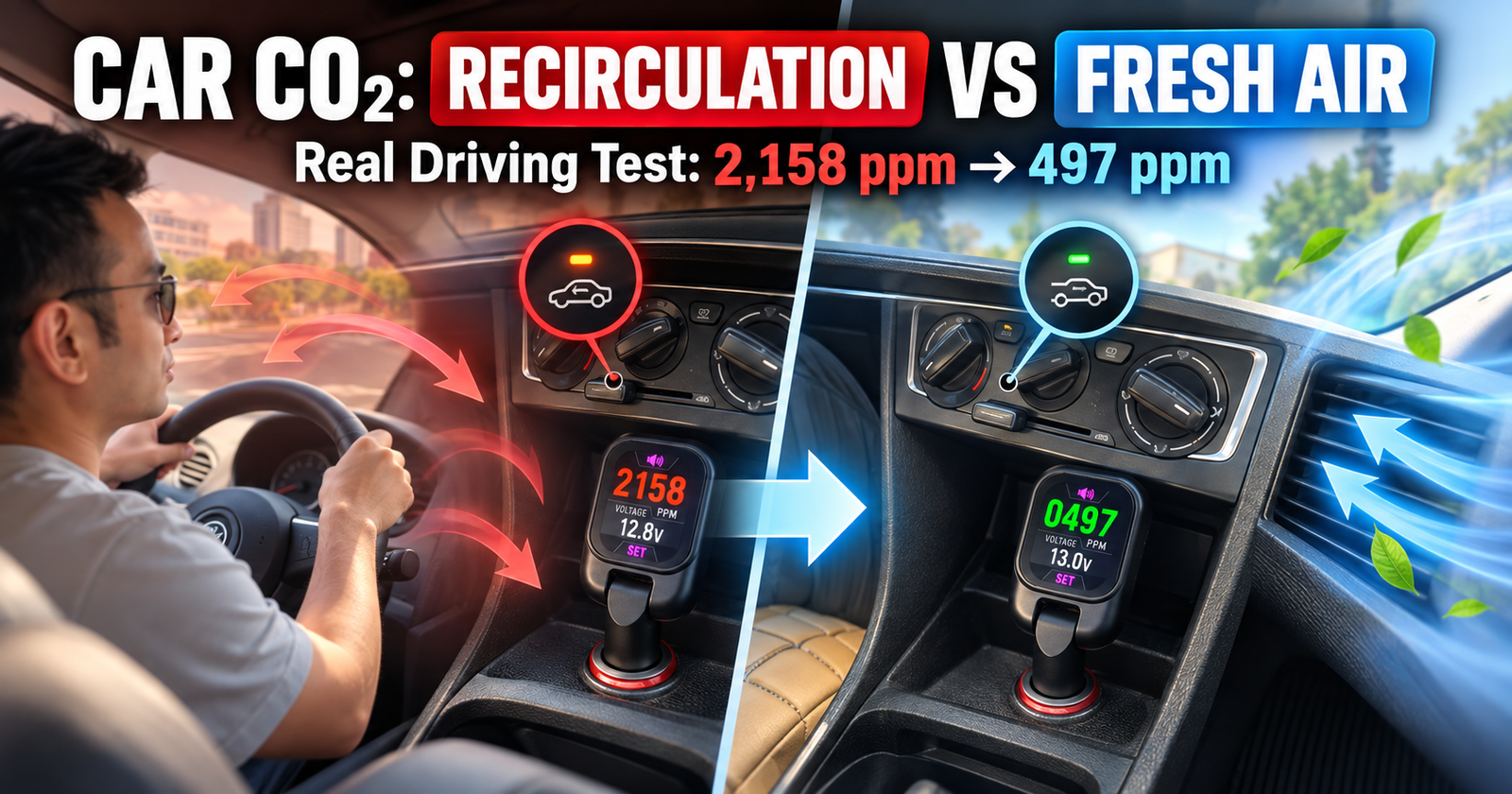
Carbon dioxide can build up inside a vehicle when occupants are breathing in a relatively enclosed cabin.
But what happens when the ventilation system is switched from recirculating cabin air to bringing in fresh outside air?
We recorded a real driving test using the EVO-CO2V vehicle CO₂ monitor.
At the beginning of the recorded sequence, the displayed cabin CO₂ concentration was approximately 2,150 ppm. After switching to outside-air ventilation, the CO₂ reading steadily decreased, eventually reaching approximately 500 ppm in the sequence shown.
The test provides a simple real-world demonstration of how strongly vehicle ventilation mode can affect measured cabin CO₂.
Quick Answer
Yes. In our real vehicle test, switching to fresh-air mode was followed by a substantial decrease in cabin CO₂.
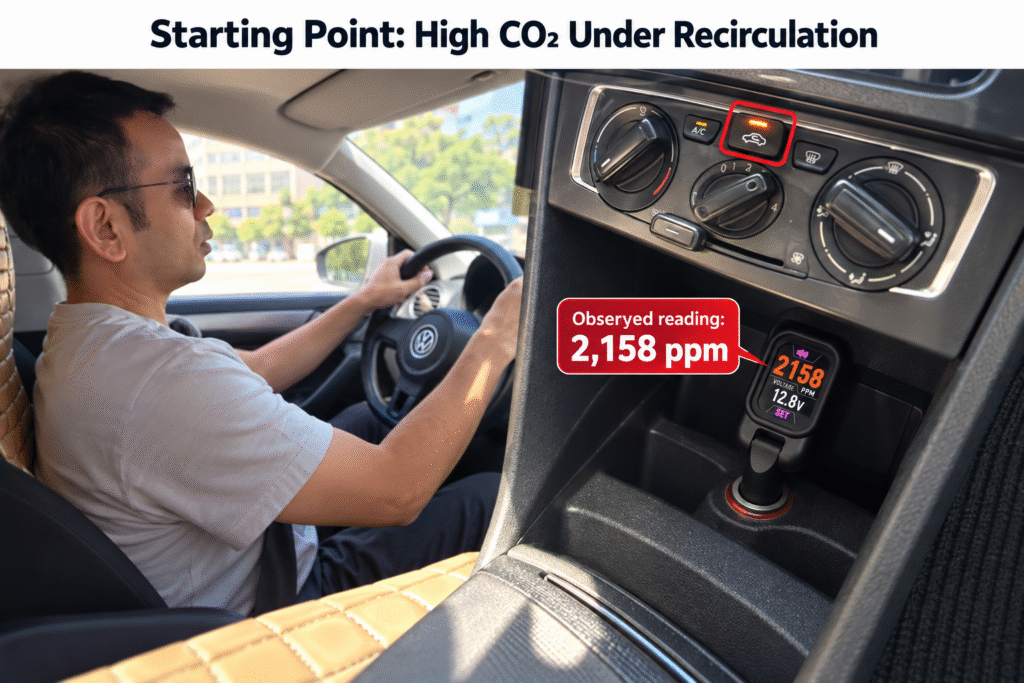
The EVO-CO2V initially displayed approximately 2,150 ppm.
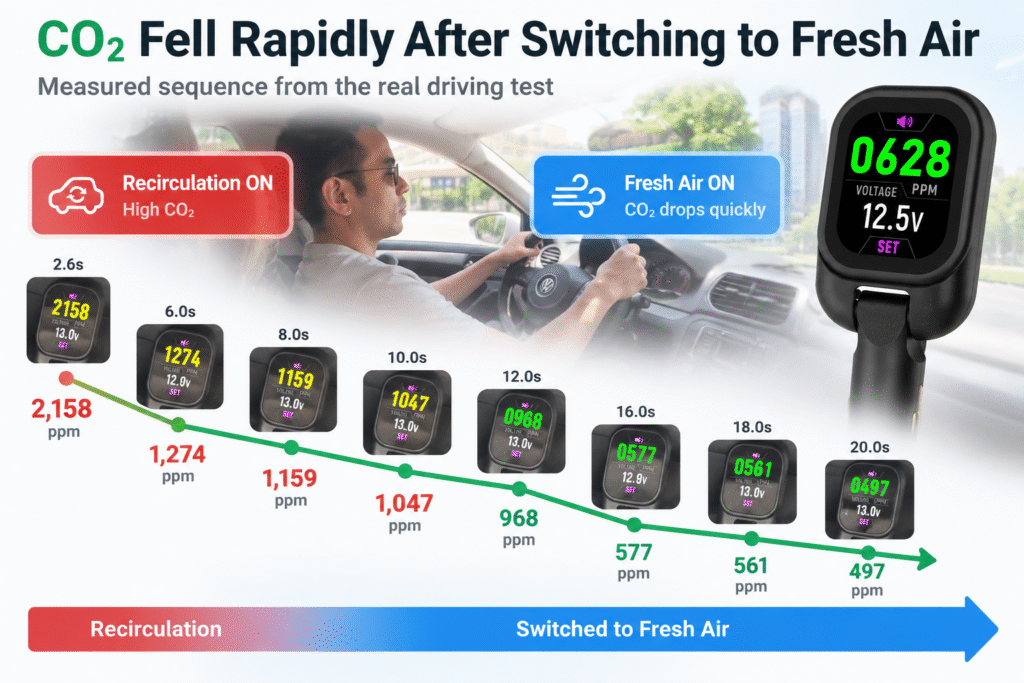
During the recorded fresh-air sequence, visible readings included:
| Stage | Displayed CO₂ |
|---|---|
| Starting level | ~2,150 ppm |
| Later reading | 1,274 ppm |
| Later reading | 1,159 ppm |
| Later reading | 1,047 ppm |
| Later reading | 968 ppm |
| Later reading | 577 ppm |
| Later reading | 561 ppm |
| Lowest visible reading | 497 ppm |
From approximately 2,158 ppm to 497 ppm, the displayed concentration decreased by about 77%.
This does not mean every vehicle will produce the same rate or final concentration. The test shows what happened in this particular vehicle under the conditions recorded in the video.
Watch the Real Driving Test
The video shows the actual vehicle, the ventilation control, the EVO-CO2V installed in the center console, and the changing CO₂ readings while the vehicle is being driven.
The measurements shown in this article came from a real vehicle test rather than from a theoretical calculation or simulation.
Unlike a simulation or calculated example, these are readings recorded in a real vehicle environment.
Why Did the CO₂ Reading Drop?
People continuously exhale carbon dioxide.
When a vehicle operates with limited outside-air exchange, occupant-generated CO₂ can accumulate inside the cabin.
Fresh-air mode changes that balance.
Instead of repeatedly circulating mostly cabin air, the HVAC system brings in more outside air. This outside air dilutes the CO₂ generated by the occupants and carries some of the higher-CO₂ cabin air out of the vehicle.
Published vehicle research has found ventilation setting to be a major determinant of in-cabin CO₂ accumulation. A study in Science of the Total Environment reported that recirculation substantially reduces air exchange and can allow occupant-generated CO₂ to accumulate, while outside-air ventilation greatly increases cabin air exchange.
Want to see where the fresh air actually enters the vehicle? See our real HVAC outside-air intake demonstration.
A later study covering 92 vehicle models similarly found that recirculation reduced the entry of ultrafine particles but increased cabin CO₂, illustrating an important trade-off between outside-pollution control and cabin CO₂ ventilation.
What We Observed in the Video
The EVO-CO2V reading at the beginning of the test was a little above 2,100 ppm.
After fresh outside air was introduced, the displayed CO₂ concentration moved progressively downward.
Rather than immediately jumping from a high reading to a low reading, the monitor showed a continuing downward trend:
~2,150 ppm → 1,274 → 1,159 → 1,047 → 968 → 577 → 561 → 497 ppm
That trend is more informative than any one individual reading.
The important observation is:
After switching to outside-air ventilation, the measured cabin CO₂ concentration consistently moved toward the outdoor-background range.
The lowest visible value in the recorded sequence was approximately 497 ppm.
Why the Trend Matters More Than One Reading
A single CO₂ reading tells you the concentration at one moment.
A changing reading tells you something different: whether cabin ventilation conditions are improving or worsening.
For example:
- a rising CO₂ trend can indicate that occupant-generated CO₂ is accumulating faster than it is being removed;
- a falling trend after enabling fresh-air ventilation indicates that the cabin is receiving enough lower-CO₂ air to dilute the accumulated CO₂;
- a stable reading suggests that CO₂ generation and removal are approaching a balance.
CDC/NIOSH notes that CO₂ monitoring can provide useful information about ventilation, although CO₂ alone cannot describe every aspect of indoor air quality.
ASHRAE likewise treats indoor CO₂ as useful information for understanding ventilation while cautioning against interpreting one concentration as a universal measure of overall air quality or safety.
Recirculation Is Not Simply “Good” or “Bad”
This point is important.
The purpose of this test is not to claim that drivers should never use recirculation.
Recirculation can be useful.
Research has shown that recirculation can reduce the amount of traffic-related particulate pollution entering a vehicle, especially when driving in polluted environments. However, reducing outside-air exchange also means that carbon dioxide produced by the occupants can accumulate more easily.
That creates a real-world trade-off:
Recirculation
→ can reduce incoming roadway pollutants
→ but may allow cabin CO₂ to rise
Fresh-air mode
→ increases outside-air exchange
→ and can reduce accumulated cabin CO₂
The best ventilation choice can therefore depend on traffic conditions, outside pollution, passenger count, trip length, and the measured cabin environment.
What This Test Does — and Does Not — Prove
This is a real-world demonstration from one vehicle, not a controlled laboratory study.
The observed CO₂ decrease may be affected by:
- vehicle model and cabin volume,
- fan speed,
- HVAC configuration,
- outside-air intake rate,
- vehicle speed,
- window position,
- passenger count,
- starting CO₂ concentration,
- outdoor CO₂ concentration,
- cabin leakage,
- temperature and other environmental conditions.
For that reason, the exact readings shown here should not be interpreted as a prediction of how quickly every vehicle will clear accumulated CO₂.
The useful finding is narrower:
In this vehicle, switching to outside-air ventilation was followed by a large and consistent decline in measured cabin CO₂.
CO₂ Is Not Carbon Monoxide
CO₂ and CO are different gases.
CO₂ = carbon dioxide
CO = carbon monoxide
EVO-CO2V measures carbon dioxide (CO₂).
It does not detect carbon monoxide and should not be used as a replacement for a certified carbon monoxide detector or alarm.
This distinction is particularly important for vehicle-related searches because “CO detector” and “CO₂ detector” describe fundamentally different measurements.
Why Monitor CO₂ While Driving?
Drivers cannot smell carbon dioxide itself.
Without a measurement, it can be difficult to know whether the cabin CO₂ concentration is rising, stable, or falling.
A real-time vehicle CO₂ monitor allows you to observe how the cabin responds when you change:
- fresh-air vs. recirculation mode,
- fan settings,
- passenger count,
- window position,
- trip duration.
The most useful information is often not one isolated ppm number, but the direction and speed of the trend.
Why We Used EVO-CO2V
EVO-CO2V is designed specifically for vehicle monitoring.
It plugs directly into a compatible 12V/24V vehicle socket and does not contain an internal rechargeable battery.
For this type of driving test, that design provides a fixed installation point and keeps the display visible without placing a portable desktop-style monitor loose inside the cabin.
EVO-CO2V provides:
- CO₂ measurement
- 10-second sampling
- 12V/24V direct vehicle power
- No internal rechargeable battery
- Adjustable display angle
- Color display
- Vehicle-voltage display
- Audible alert above 1,400 ppm
The monitor used in the video remained installed in the vehicle while the ventilation conditions changed.
Frequently Asked Questions
Does recirculation increase CO₂ in a car?
It can.
When the cabin is mainly recirculating its existing air, less fresh outside air enters. Because occupants continue to exhale CO₂, the concentration can increase.
Vehicle studies have identified ventilation mode as one of the strongest factors affecting cabin CO₂ accumulation.
Does fresh-air mode lower car CO₂?
It can substantially lower accumulated cabin CO₂ by increasing the amount of outside air entering the vehicle.
In our real driving test, the displayed CO₂ concentration decreased from around 2,150 ppm to approximately 500 ppm after switching to outside-air ventilation.
The exact result will vary between vehicles and driving conditions.
Is 2,000 ppm CO₂ dangerous?
This article does not treat 2,000 ppm—or any single CO₂ concentration—as a universal boundary between safe and unsafe air.
CO₂ readings need to be interpreted in context, including occupancy, ventilation, outdoor CO₂, measurement location, and the purpose of monitoring. ASHRAE specifically cautions against oversimplifying the meaning of individual indoor CO₂ concentrations.
Is fresh air always better than recirculation?
Not necessarily.
Fresh-air mode generally improves dilution of occupant-generated CO₂, while recirculation may reduce the entry of some roadway particles.
The appropriate choice can depend on outside pollution, traffic, passenger count, and cabin conditions.
Can I tell that car CO₂ is high by smell?
No. Carbon dioxide is colorless and odorless.
A meter is needed if you want to know the actual concentration or observe how it changes.
Does EVO-CO2V measure carbon monoxide?
No.
EVO-CO2V measures CO₂, not CO.
A dedicated carbon monoxide detector is required for carbon monoxide measurement.
Key Findings
Our real driving video showed three clear observations:
1. Cabin CO₂ was initially around 2,150 ppm.
2. After switching to fresh-air ventilation, the displayed value steadily decreased.
3. The lowest visible reading in the recorded sequence was approximately 497 ppm — roughly 77% below the starting level.
The exact rate should not be generalized to every vehicle, but the direction of change is consistent with the expected effect of increased outside-air exchange.
Conclusion
This real-world driving test demonstrates why ventilation mode matters when interpreting car CO₂ measurements.
In the recorded sequence, the EVO-CO2V reading decreased from approximately 2,150 ppm to about 500 ppm after outside-air ventilation was introduced.
The test does not establish a universal CO₂ clearance rate for cars.
Instead, it demonstrates something more practical:
A car’s CO₂ concentration can change substantially when the ventilation mode changes, and real-time monitoring makes that change visible.
For drivers who use recirculation frequently or carry several passengers, watching the CO₂ trend can provide useful information about how effectively the cabin is exchanging air.
Explore EVO-CO2V
EVO-CO2V is designed for vehicle CO₂ monitoring with direct 12V/24V power, 10-second sampling, an adjustable display, vehicle-voltage monitoring, and an audible high-CO₂ alert.
Leave a Reply