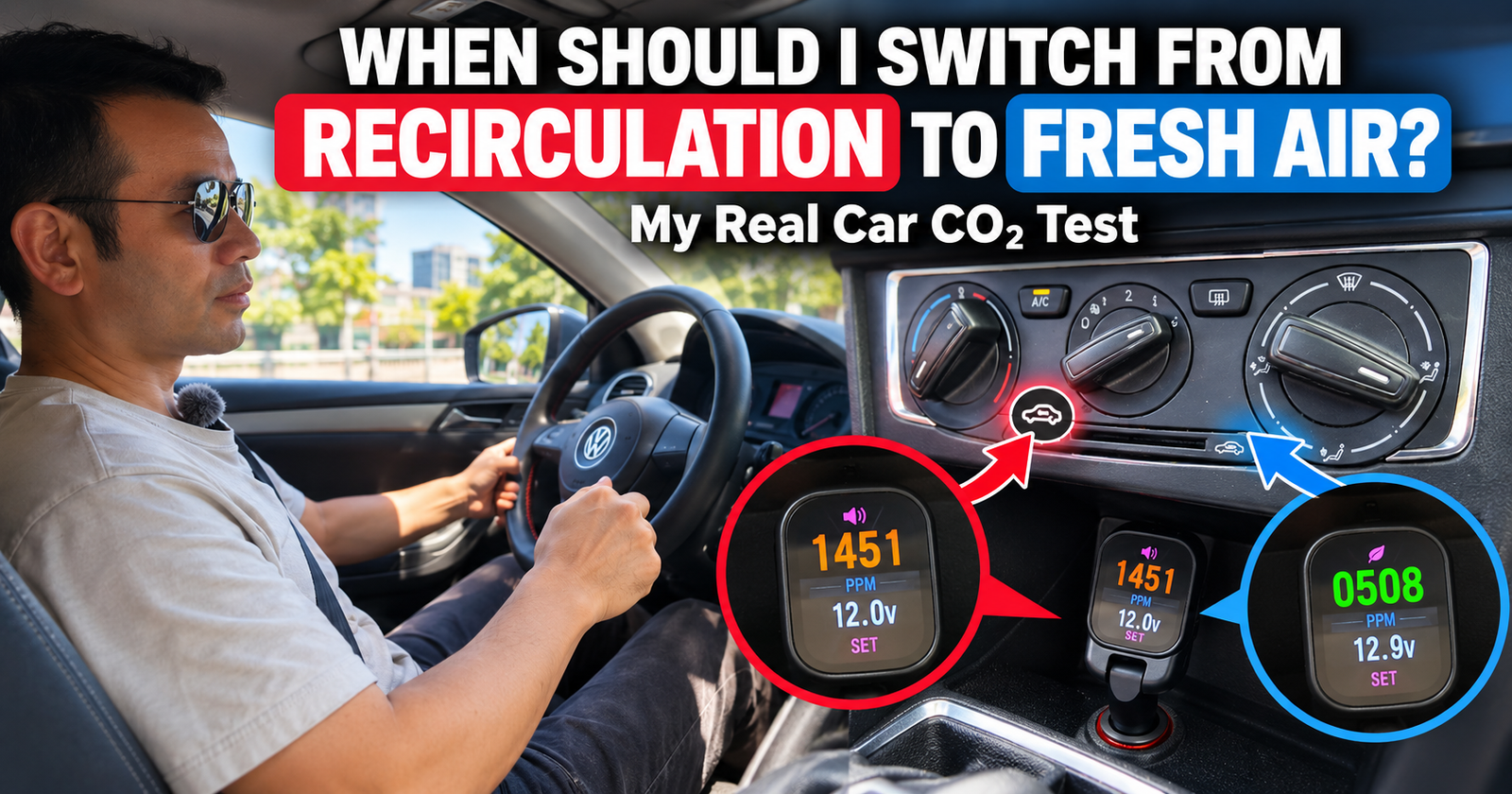
I have been testing cabin CO₂ in my own car for a while, and one question kept coming back to me:
Should I leave the air conditioner on recirculation, or should I keep bringing in outside air?
I do not think the answer is simply “always use recirculation” or “always use fresh air.”
After watching the CO₂ reading change in real time while I drove, I started using the two modes differently.
My current approach is simple:
I use recirculation when cabin CO₂ is low, switch to fresh air when CO₂ builds up, and switch back to recirculation after the cabin has been ventilated.
This article explains why I started doing that, what I actually measured in my car, and what I think the limits of this approach are.
My Quick Answer
In my real driving test, I switched the HVAC system to recirculation when cabin CO₂ was around 500 ppm.
As I continued driving, the reading climbed:
491 → 722 → 981 → 995 → 1,009 → about 1,450 ppm
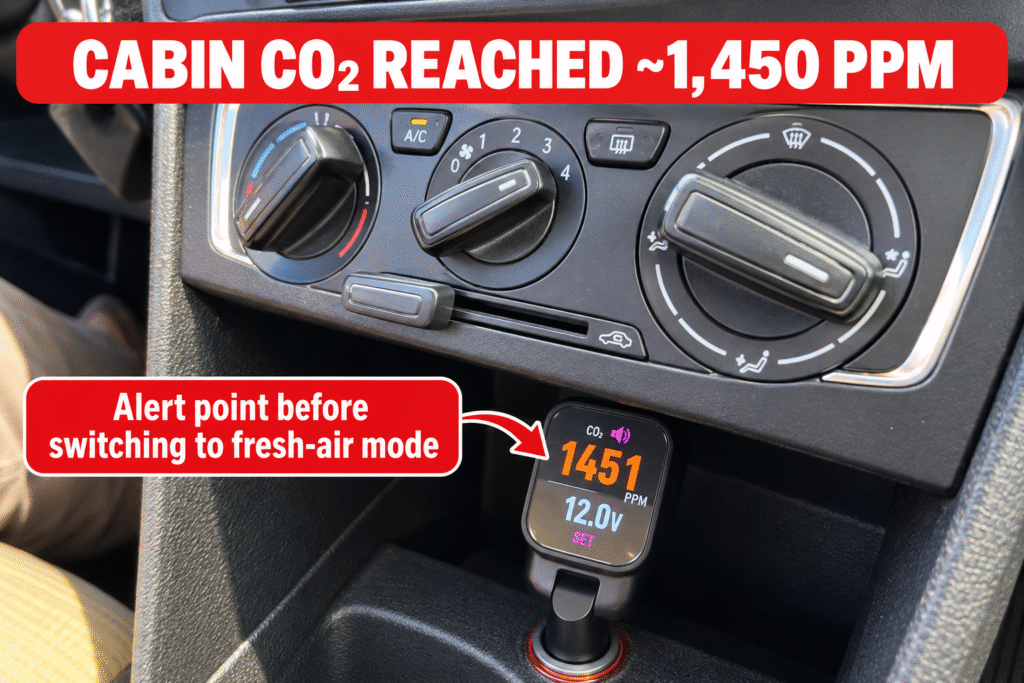
My EVO-CO2V is configured to beep when the reading reaches 1,400 ppm.
When the alert sounded, I switched from recirculation to outside-air / fresh-air mode.
After that, the CO₂ reading began falling:
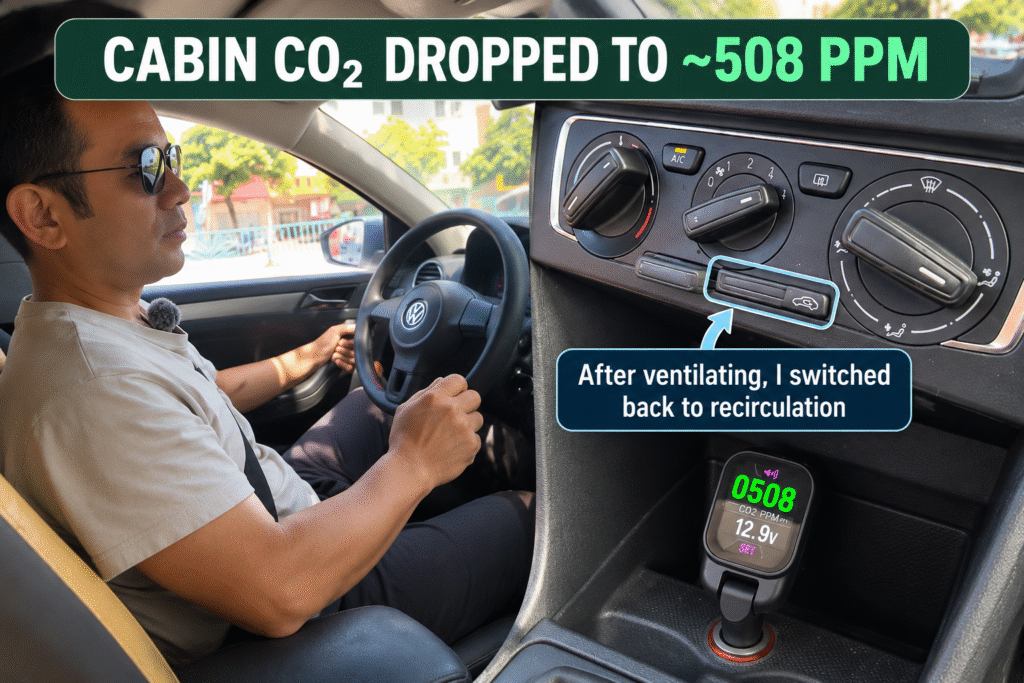
1,434 → 1,394 → 1,354 → 1,314 → 963 → 634 → 532 → 518 → 508 ppm
Once the cabin had returned to roughly the outdoor-background range shown in this test, I switched back to recirculation.
Shortly afterward, the reading began rising again and reached approximately 589 ppm in the recorded sequence.
That simple test changed the way I personally use my car’s ventilation system.
Why I Started Testing This
Before I began measuring CO₂, I normally treated the recirculation button as just another air-conditioning control.
If I wanted the cabin to cool faster, I used recirculation.
If I wanted fresh air, I switched it off.
But once I started putting a CO₂ monitor in the car, I could see something I could not feel or smell.
When the car remained in recirculation mode, the CO₂ reading gradually moved upward.
That made me think differently about the HVAC controls.
Instead of choosing one mode and leaving it there, I began asking:
Can I use recirculation for efficiency, but periodically introduce fresh air when the cabin CO₂ becomes elevated?
That is what I tested in this video.
Watch My Real Driving Test
The video below shows my actual car, the HVAC controls, the EVO-CO2V display, and the CO₂ changes I observed while switching between recirculation and outside-air ventilation.
These are readings I recorded in a real vehicle, not numbers generated by a simulation.
I am also not presenting this as a controlled laboratory experiment. Vehicle speed, weather, cabin leakage, HVAC settings and other conditions can influence the result.
What matters to me is the direction of the change I repeatedly observed.
What Happened When I Turned Recirculation On
At the beginning of the test, the meter was reading around 491 ppm.
I then selected recirculation.
The CO₂ concentration did not jump immediately.
It rose progressively.
Visible readings in my recording included:
| What I observed | Cabin CO₂ |
|---|---|
| Near the start | ~491 ppm |
| Rising | 722 ppm |
| Rising | 981 ppm |
| Rising | 995 ppm |
| Rising | 1,009 ppm |
| Near the alert point | ~1,450 ppm |
This makes sense to me physically.
I was still breathing inside the cabin, but the HVAC system was reusing more of the existing cabin air instead of continuously replacing it with outside air.
Research on vehicle cabins has also found that recirculation can allow occupant-generated CO₂ to accumulate, and that ventilation setting is a major factor affecting that accumulation. vehicle cabin CO₂ study
What I Did When the Meter Reached 1,400 ppm
My EVO-CO2V has an audible alert above 1,400 ppm.
When I heard the alert during this test, I treated it as a reminder:
Time to bring in some outside air.
This is important:
I am not claiming that 1,400 ppm is a universal health limit.
It is the alert point used by my monitor and a practical reference point for how I personally run this experiment.
ASHRAE specifically cautions against treating one indoor CO₂ value as a universal boundary for overall air quality. CO₂ is useful for understanding ventilation, but it does not describe every contaminant or every aspect of indoor air quality. ASHRAE guidance on indoor CO₂
So my thinking is not:
“1,399 ppm is safe and 1,400 ppm is dangerous.”
My thinking is much simpler:
The rising trend tells me that exhaled CO₂ is accumulating, so this is a useful time for me to increase outside-air ventilation.
What Happened After I Switched to Fresh Air
After I moved the ventilation control from recirculation to outside-air mode, the trend reversed.
The readings I could see in the recording included:
1,434 → 1,394 → 1,354 → 1,314 ppm
Then the decline became much more obvious:
963 → 634 → 532 → 518 → 508 ppm
To me, this is the most useful part of the whole test.
I did not need to guess whether the ventilation change was doing anything.
I could see the effect directly on the meter.
The exact speed of the decline will obviously differ between cars.
Cabin size, blower setting, vehicle speed, outside-air intake, leakage and passenger count can all change the result.
But in my car, under the conditions shown in the video, switching to outside air was followed by a large drop in cabin CO₂.
Why I Switched Back to Recirculation
Once the reading had fallen to approximately 508 ppm, I switched the system back to recirculation.
Why?
Because I do not think fresh-air mode and recirculation need to be treated as enemies.
Recirculation has advantages too.
It allows the HVAC system to condition air that is already closer to the desired cabin temperature instead of continuously heating or cooling outside air.
Research on vehicle HVAC systems supports the underlying principle that greater use of recirculated air can reduce climate-control energy demand. One electric-vehicle study, for example, found meaningful HVAC energy savings from recirculation under its modeled conditions. electric-vehicle HVAC energy study
But there is an important distinction between that research and my test:
I did not measure fuel consumption or electrical energy consumption in this video.
So I am not claiming:
“My method saves X% fuel.”
That would go beyond what I actually measured.
My personal reasoning is simply that I would rather use recirculation when it makes sense, while still watching CO₂ so I know when the cabin needs more outside air.
The Part That Surprised Me
After I switched back to recirculation near the end of the test, the CO₂ reading did not stay around 500 ppm.
It started moving upward again.
The video later showed approximately:
589 ppm
That was a useful confirmation for me.
Nothing mysterious had happened to the CO₂.
The direction of change followed what I was doing with the ventilation system.
Recirculation favored accumulation.
Outside-air ventilation favored dilution.
That is the practical lesson I took from the test.
My Current Way of Using Recirculation and Fresh Air
After doing these tests, I no longer think in terms of:
Recirculation = bad
or
Fresh air = good
I think of them as two tools.
When cabin CO₂ is relatively low and I want the HVAC system to maintain cabin temperature efficiently, I may use recirculation.
If I see CO₂ steadily climbing and the monitor reaches my chosen alert point, I introduce outside air.
Once the cabin CO₂ has dropped substantially, I can decide whether to return to recirculation depending on the driving conditions.
This is my operating habit based on my own measurements.
It is not a universal rule for every driver or every vehicle.
There Is Another Trade-Off: Outside Pollution
CO₂ is not the only thing that matters inside a car.
If I am driving behind diesel trucks, through smoke, dust or heavily polluted traffic, bringing in outside air may also bring outside contaminants into the cabin.
Studies involving real vehicles have found this trade-off very clearly:
Recirculation can reduce incoming particulate pollution, while at the same time allowing cabin CO₂ to increase. vehicle cabin air-quality study
That is another reason I do not believe there is one ventilation setting that should be used all the time.
Sometimes I may care more about limiting polluted outside air.
At another point in the same trip, I may care more about accumulated cabin CO₂.
For me, having an actual measurement makes that decision much easier.
Why I Prefer Watching the Trend
A single number is useful, but I have learned more from watching the trend.
If the display shows:
700 → 900 → 1,100 → 1,300 ppm
I know the cabin concentration is building.
If I switch to outside air and then see:
1,400 → 1,200 → 900 → 600 ppm
I know the ventilation change is having a measurable effect.
That is more useful to me than treating any one number as a magic boundary.
CO₂ monitoring is also consistent with broader ventilation guidance: changes in CO₂ can provide useful information about occupancy and outdoor-air ventilation, although CO₂ cannot by itself describe overall air quality. CDC/NIOSH ventilation guidance
What This Test Does Not Prove
I want to be clear about the limitations of my experiment.
I did not measure:
- fuel consumption,
- HVAC electrical power,
- outside PM2.5 or ultrafine particles,
- VOCs,
- airflow rate,
- cabin air-exchange rate.
I also did not run the experiment in a laboratory with every variable controlled.
What I did measure was much simpler:
real-time cabin CO₂ while I changed the car between recirculation and fresh-air ventilation.
And under the conditions in my video, the pattern was clear.
CO₂ rose during recirculation.
It fell after I introduced outside air.
When I returned to recirculation, it began rising again.
That is the observation I am comfortable standing behind.
CO₂ Is Not Carbon Monoxide
One more distinction matters.
The EVO-CO2V measures:
carbon dioxide — CO₂
It does not measure:
carbon monoxide — CO
These are different gases.
A vehicle CO₂ monitor should never be presented as a replacement for a carbon-monoxide detector.
Related Real-World Tests I Have Done
This is not the only car CO₂ test I have recorded.
In another experiment, I compared recirculation directly with fresh-air ventilation and watched cabin CO₂ drop from roughly 2,158 ppm to 497 ppm.
See my real recirculation vs fresh-air CO₂ driving test.
I also physically demonstrated where outside air enters the vehicle HVAC system using paper strips near the outside-air intake.
See my real HVAC fresh-air intake demonstration.
And I tested how quickly cabin CO₂ reached the same reference concentration with one to five occupants.
See my 1–5 occupant car CO₂ buildup test.
These experiments have gradually changed the way I think about ventilation inside a car.
My Takeaway
The biggest thing I learned from this test is that I do not have to choose between recirculation and fresh air permanently.
I can use both.
For me, the CO₂ monitor turns the decision from a guess into something I can actually observe.
When CO₂ is low, I may use recirculation.
When I see it building, I can introduce outside air.
When the cabin has been ventilated, I can reassess.
I am still testing different vehicles, passenger loads and driving conditions, but this has become the ventilation habit that makes the most sense to me based on what I have measured so far.
And that is really why I started these tests in the first place:
I wanted to understand what was actually happening inside the cabin instead of simply assuming the air was fresh because the air conditioner was running.
Leave a Reply