
A passenger car is a relatively small enclosed space. When people sit inside and outside-air exchange is limited, the carbon dioxide they exhale can accumulate surprisingly quickly.
But how much difference does the number of people inside the car actually make?
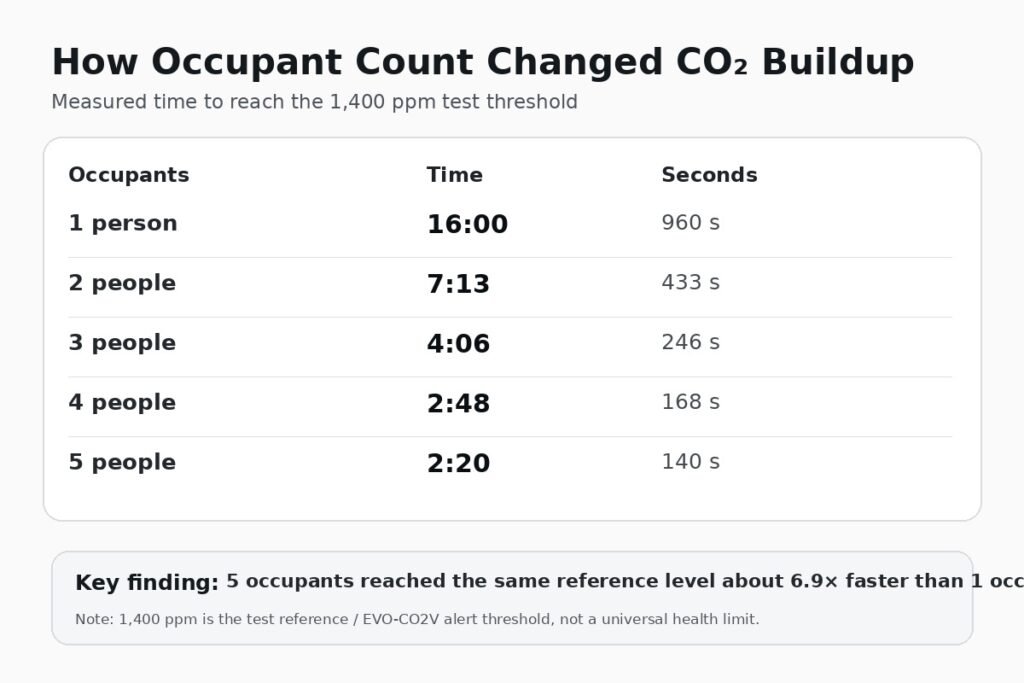
We tested this in a real passenger vehicle using the EVO-CO2V car CO₂ monitor. Separate tests were carried out with one, two, three, four, and five occupants, and we recorded how long it took the cabin CO₂ concentration to reach 1,400 ppm.
The result was clear: as the number of occupants increased, the same CO₂ concentration was reached much faster.
Quick Answer
In our real-world vehicle test, cabin CO₂ reached 1,400 ppm in the following times:
| Occupants | Reference Level | Time | Seconds |
|---|---|---|---|
| 1 person | 1,400 ppm | 16:00 | 960 |
| 2 people | 1,400 ppm | 7:13 | 433 |
| 3 people | 1,400 ppm | 4:06 | 246 |
| 4 people | 1,400 ppm | 2:48 | 168 |
| 5 people | 1,400 ppm | 2:20 | 140 |
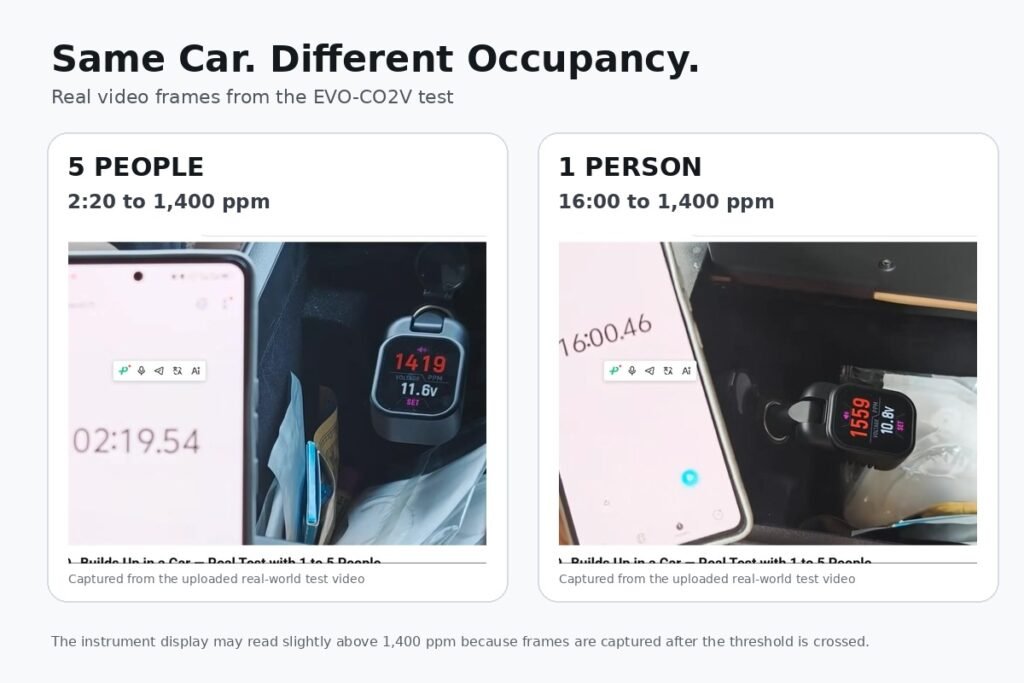
Under the conditions of this test, the five-person cabin reached the same 1,400 ppm reference concentration about 6.9 times faster than the one-person cabin.
Measured another way, increasing occupancy from one person to five reduced the time required to reach the same CO₂ concentration by approximately 85%.
Important: 1,400 ppm was used as a consistent reference point in this experiment and is also the EVO-CO2V high-CO₂ alert threshold. It should not be interpreted as a universal health or safety limit.
Watch the Real Test
The video below shows the actual vehicle, EVO-CO2V display, occupants, and stopwatch used during the experiment.
The measurements shown in this article came from the real vehicle test rather than from a theoretical calculation or computer simulation.
The Main Result: More Occupants, Faster CO₂ Buildup
The strongest pattern in the experiment was the relationship between occupant count and the time required to reach the same CO₂ concentration.
With one occupant, the cabin reached 1,400 ppm in approximately 16 minutes.
Adding a second person reduced that time to 7 minutes 13 seconds.
With three occupants, the same concentration was reached in 4 minutes 6 seconds.
With four occupants, the measured time fell to 2 minutes 48 seconds.
With five occupants, it took only 2 minutes 20 seconds.
The difference between the one-person and five-person tests was especially large. In the same vehicle experiment, the five-person cabin reached the reference concentration in less than one-sixth of the time measured with one person.
Why Does Passenger Count Affect Car CO₂?
People continuously produce carbon dioxide through respiration.
Inside a vehicle, cabin CO₂ therefore reflects a balance between the CO₂ being added by the occupants and the CO₂ being removed as cabin air is replaced by outside air.
Adding another occupant increases the rate at which CO₂ is introduced into the cabin, while the physical volume of the cabin remains essentially unchanged.
If outside-air exchange does not increase enough to compensate, the CO₂ concentration can rise more quickly.
This general relationship is also consistent with published vehicle research. A study in Science of the Total Environment identified ventilation setting, number of occupants, driving conditions, trip duration, and vehicle characteristics as factors affecting in-vehicle CO₂ accumulation.
How We Ran the Test
The purpose of this experiment was not to determine a universal CO₂ buildup rate for every vehicle.
Instead, we wanted to answer one specific question:
How does the number of occupants affect the time required for cabin CO₂ to reach the same concentration?
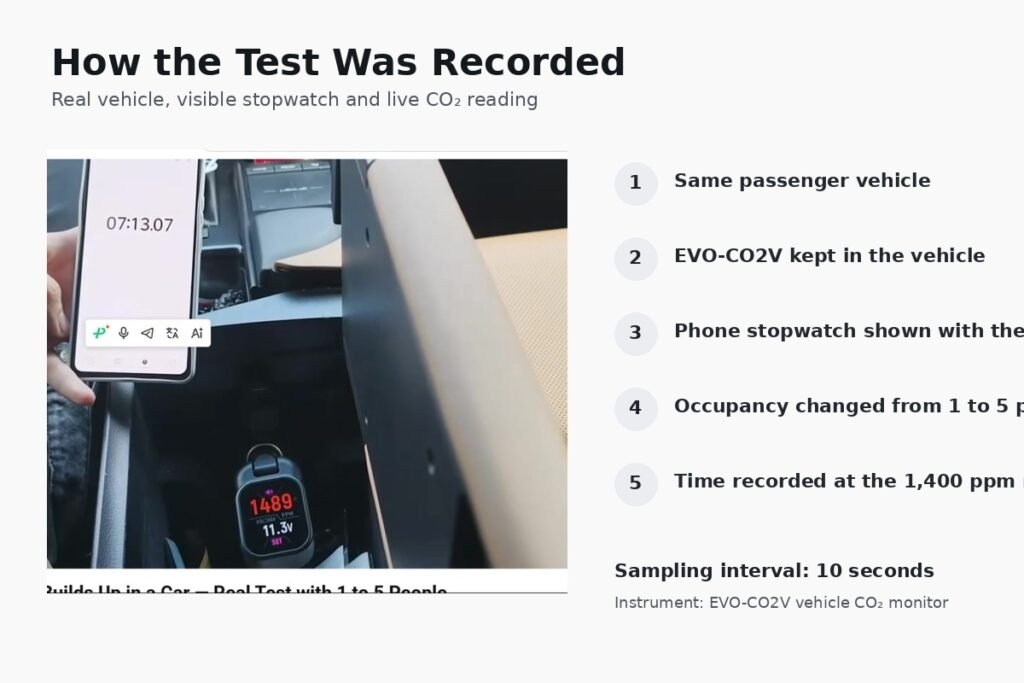
The same passenger vehicle and EVO-CO2V monitor were used for the experiment. Separate runs were conducted with one to five occupants.
During each run, the EVO-CO2V displayed the current CO₂ concentration while a smartphone stopwatch recorded elapsed time. We then recorded the time when the displayed CO₂ concentration reached approximately 1,400 ppm.
The EVO-CO2V samples CO₂ every 10 seconds, so the measured times should be interpreted with that sampling interval in mind.
Instrument: EVO-CO2V vehicle CO₂ monitor
Measurement: Carbon dioxide concentration
Sampling interval: 10 seconds
Environment: Passenger vehicle
Variable tested: Number of occupants
Reference concentration: 1,400 ppm
This structure makes it easier to distinguish the measured results from broader conclusions about vehicle air quality.
Why Ventilation Matters
Occupant count is only one factor affecting CO₂ inside a vehicle.
Ventilation can substantially change the result.
When fresh outside air enters the cabin, occupant-generated CO₂ is diluted and removed. When the vehicle relies more heavily on recirculated air, less outside air may enter, allowing exhaled CO₂ to accumulate more readily.
Published vehicle research has found ventilation mode to be an important determinant of in-cabin CO₂ accumulation, particularly when several occupants are present.
This is why the exact times measured in our experiment should not be treated as universal predictions for every vehicle.
A different ventilation setting, fan speed, vehicle size, window position, or driving condition could produce a different CO₂ curve.
What Does 1,400 ppm Mean?
For this experiment, 1,400 ppm is a reference concentration.
Using the same reference point for all five tests makes it possible to compare how occupant count changed the time required to reach that level.
It is also the high-CO₂ alert threshold used by EVO-CO2V.
However, this article does not define 1,400 ppm as a universal boundary between safe and unsafe air.
ASHRAE’s current position document on indoor carbon dioxide explains that CO₂ measurements must be interpreted in context and discusses their relationship with ventilation, occupancy, indoor air quality, sensor performance, and other factors. ASHRAE specifically addresses the risk of oversimplifying the meaning of a single indoor CO₂ concentration.
CDC/NIOSH likewise notes that CO₂ monitoring can provide useful information about ventilation but cautions that a single concentration target is not necessarily appropriate for every type of space and occupancy.
For this experiment, the important comparison is therefore not whether 1,400 ppm represents a universal limit.
The important result is how much the time to the same concentration changed as the number of occupants increased.
CO₂ Is Not Carbon Monoxide
Carbon dioxide and carbon monoxide are different gases.
CO₂ means carbon dioxide.
CO means carbon monoxide.
EVO-CO2V measures carbon dioxide (CO₂).
It does not measure carbon monoxide and should not be used as a substitute for a certified carbon monoxide detector or alarm.
This distinction is particularly important when searching for vehicle air-quality instruments because terms such as “CO₂ detector for car” and “CO detector for car” may look similar while referring to completely different measurements.
Why Measure CO₂ Instead of Guessing?
Carbon dioxide is colorless and odorless, so occupants cannot directly determine its concentration by smell.
A cabin may feel normal while the measured CO₂ concentration is changing.
A real-time CO₂ monitor makes those changes visible numerically.
For vehicle use, the trend over time can often be more useful than a single isolated reading.
For example, measurements can be compared when the number of passengers changes, when the HVAC system switches between fresh-air and recirculation modes, when windows are opened or closed, or when a short journey becomes a much longer trip.
CDC/NIOSH recognizes CO₂ monitoring as a useful source of information about ventilation, while also emphasizing that CO₂ alone does not describe every aspect of indoor air quality.
Why We Used EVO-CO2V for This Test
EVO-CO2V was designed specifically for vehicle CO₂ monitoring.
It plugs directly into a compatible 12V/24V vehicle socket, so it does not require an internal rechargeable battery or a separate charging cable.
The monitor samples CO₂ every 10 seconds and displays the current concentration on a color screen. The display angle can be adjusted for different vehicle console positions.
It also displays vehicle voltage and provides an audible high-CO₂ alert when the reading exceeds 1,400 ppm.
For repeated vehicle measurements, a fixed vehicle-powered design also makes it easier to keep the monitor in a relatively consistent position between tests.
What This Test Does — and Does Not — Show
This experiment provides original real-world measurements from one passenger vehicle under the conditions shown in the video.
It demonstrates a clear relationship between occupant count and the rate of CO₂ buildup in that particular experiment.
It does not mean every vehicle will reach 1,400 ppm in exactly the same amount of time.
Actual CO₂ buildup can vary with cabin volume, air leakage, HVAC mode, fan speed, window position, driving speed, starting CO₂ concentration, outdoor CO₂, occupant number, occupant size, activity level, and other environmental conditions.
Two vehicles carrying the same number of passengers can therefore produce substantially different CO₂ curves.
The useful conclusion from this experiment is more specific:
When other test conditions are similar, increasing the number of occupants can substantially shorten the time required for cabin CO₂ to reach the same concentration.
Key Findings
In this real-world test, five occupants reached the 1,400 ppm reference concentration in 2 minutes 20 seconds, compared with 16 minutes for one occupant.
Under the conditions of this experiment, the five-person cabin reached the same reference concentration approximately 6.9 times faster.
The measured time decreased from 960 seconds with one occupant to 140 seconds with five occupants, an approximately 85% reduction.
These measured times are specific to the test conditions and should not be treated as universal rates for all vehicles.
Frequently Asked Questions
How fast can CO₂ build up inside a car?
There is no single rate that applies to every car because cabin size, ventilation, driving conditions, and occupant count all affect CO₂ buildup.
In our test, the same vehicle reached 1,400 ppm in 16 minutes with one occupant and 2 minutes 20 seconds with five occupants.
Does having more people in a car increase CO₂ faster?
Under similar ventilation conditions, more occupants generally increase the amount of CO₂ being added to the cabin because each person exhales carbon dioxide.
In our test, the time required to reach the same CO₂ concentration decreased progressively as occupancy increased from one to five people.
Does recirculation increase CO₂ inside a car?
It can.
Recirculation reduces outside-air exchange. Because occupants continue producing CO₂, restricting the amount of outside air entering the vehicle can allow cabin CO₂ to accumulate more quickly.
Vehicle research has identified ventilation mode as a major factor affecting cabin CO₂ accumulation.
Is 1,400 ppm CO₂ dangerous?
This experiment does not define 1,400 ppm as a universal danger threshold.
It was selected as a consistent reference concentration for comparing the five occupancy tests and is also the alert threshold used by EVO-CO2V.
The interpretation of a CO₂ reading depends on its context, including occupancy, ventilation, outdoor CO₂, measurement location, and the purpose of the measurement.
Can a CO₂ monitor detect carbon monoxide?
No.
A CO₂ monitor measures carbon dioxide. Carbon monoxide is a different gas and requires a dedicated CO detector.
EVO-CO2V does not detect carbon monoxide.
Where should a CO₂ monitor be placed in a car?
For comparative measurements, keeping the monitor in a consistent location helps make different tests easier to compare.
Avoid deliberately breathing directly onto the sensing area or placing the sensor directly in strong airflow from an HVAC outlet, because highly localized airflow can influence the reading.
Conclusion
Our real-world test showed a strong relationship between the number of occupants inside a vehicle and the rate at which cabin CO₂ increased.
Using the same 1,400 ppm reference concentration, the measured times were:
| Occupants | Time to 1,400 ppm |
|---|---|
| 1 person | 16:00 |
| 2 people | 7:13 |
| 3 people | 4:06 |
| 4 people | 2:48 |
| 5 people | 2:20 |
Increasing occupancy from one person to five reduced the measured time from 960 seconds to 140 seconds.
These results should not be interpreted as a universal timetable for every vehicle.
Instead, they illustrate a practical point:
Cabin CO₂ is dynamic, and the number of people inside the vehicle can substantially change how quickly it rises.
Measuring CO₂ makes that change visible instead of relying only on how the cabin feels.
Measure CO₂ in Your Own Vehicle
EVO-CO2V is designed for continuous vehicle CO₂ monitoring with 10-second sampling, direct 12V/24V vehicle power, no internal rechargeable battery, an adjustable color display, vehicle-voltage monitoring, and an audible alert above 1,400 ppm.
Explore EVO-CO2V →
References
ASHRAE — Position Document on Indoor Carbon Dioxide, Ventilation and Indoor Air Quality. Revised February 2025. The document addresses the interpretation and measurement of indoor CO₂ and its relationship to ventilation and indoor air quality.
CDC / NIOSH — Ventilation FAQs. Guidance explaining how CO₂ measurements can provide information about ventilation and why a single CO₂ target may not be appropriate for every space and occupancy.
Jung et al. — Carbon dioxide accumulation inside vehicles: The effect of ventilation and driving conditions. Science of the Total Environment, 2018. The study investigated how factors including ventilation and occupancy influence in-vehicle CO₂ accumulation.
Leave a Reply