Switching a car from recirculation to fresh-air mode does not necessarily tell us how much outside air is actually moving through the cabin.
Fan speed may matter too.
We wanted to see what would happen with four people in the same car, while keeping the HVAC system in outside-air mode but changing the blower setting.
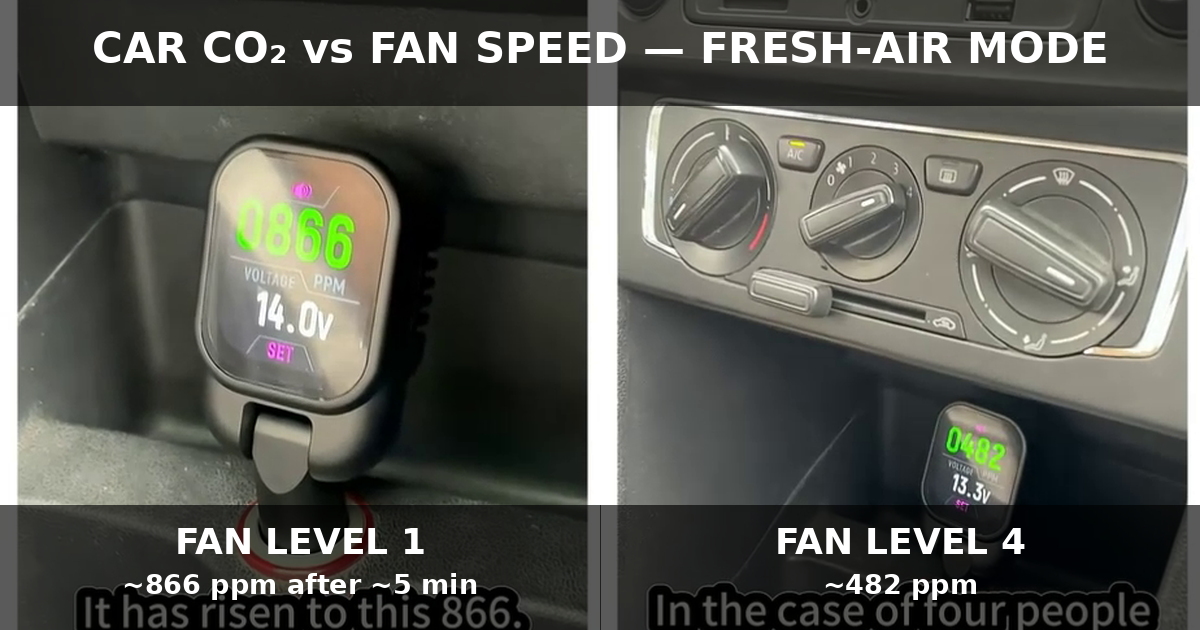
During our test, we observed a very different CO₂ trend at fan level 1 compared with fan level 4.
Quick Answer
In our real-world test with four occupants:
| Test condition | Starting CO₂ | Later CO₂ |
|---|---|---|
| Outside air, fan level 1 | ~524 ppm | ~866 ppm after about 5 min |
| Outside air, fan level 4 | ~512 ppm | ~462–482 ppm during the later segment |
At the lowest fan setting, CO₂ rose by roughly 340 ppm in about five minutes.
At the highest fan setting, the reading instead remained near outdoor-background levels and even dipped below the starting value during the segment shown in our video.
This does not prove that every vehicle will behave the same way. But in our car, under these conditions, fan speed clearly coincided with a very different cabin CO₂ trend.
Watch Our Real Fan-Speed CO₂ Test
The video below shows our actual vehicle, four occupants, the HVAC settings, and the live CO₂ readings during our fan level 1 and fan level 4 fresh-air tests.
These measurements were recorded by our team during a real-world driving test. We observed CO₂ rising from about 524 ppm to 866 ppm at fresh-air fan level 1, while readings stayed around the high-400 ppm range at fan level 4.
Why We Wanted to Test Fan Speed
We had already seen in our previous tests that changing from recirculation to outside air can dramatically affect cabin CO₂.
But that led us to another question:
If outside-air mode is already selected, does blower speed still matter?
A ventilation system can be in fresh-air mode while moving only a relatively small volume of air at a low fan setting.
With multiple people continuously exhaling CO₂, that airflow may or may not be enough to keep up with the CO₂ being generated inside the cabin.
So we tested the lowest and highest blower settings.
Test 1: Outside Air With Fan Level 1
We first selected outside-air ventilation and set the blower to level 1.
There were four people in the vehicle.
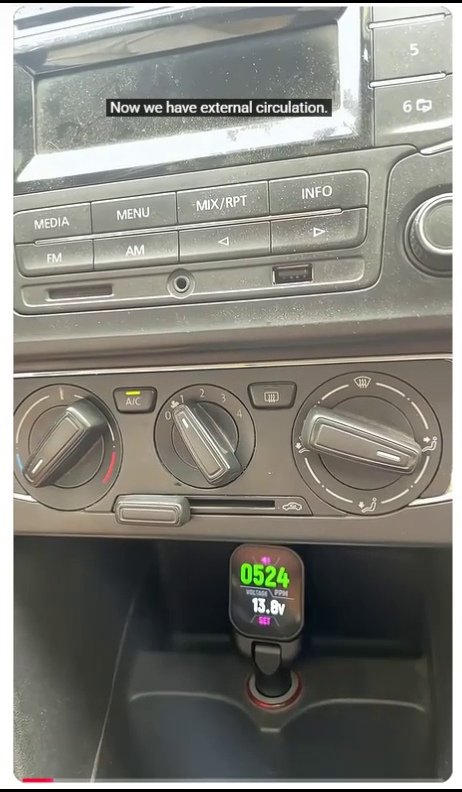
At the beginning of this part of the test, our CO₂ monitor showed approximately:
524 ppm
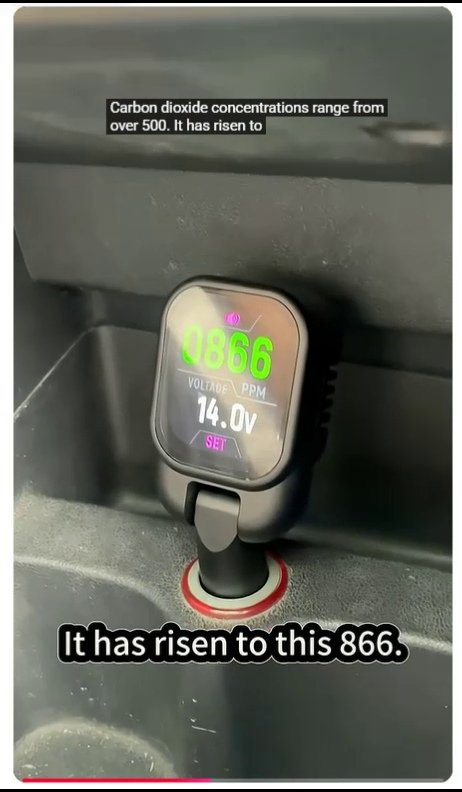
After roughly five minutes, the display had risen to approximately:
866 ppm
That is an increase of about:
342 ppm
Even though outside-air mode was selected, cabin CO₂ still increased under our test conditions.
That is the key observation from the first part of the experiment.
Test 2: Outside Air With Fan Level 4
We then tested the same general situation with the blower set to its highest level:
Fan level 4
At the beginning of the segment shown in our video, CO₂ was around:
512 ppm
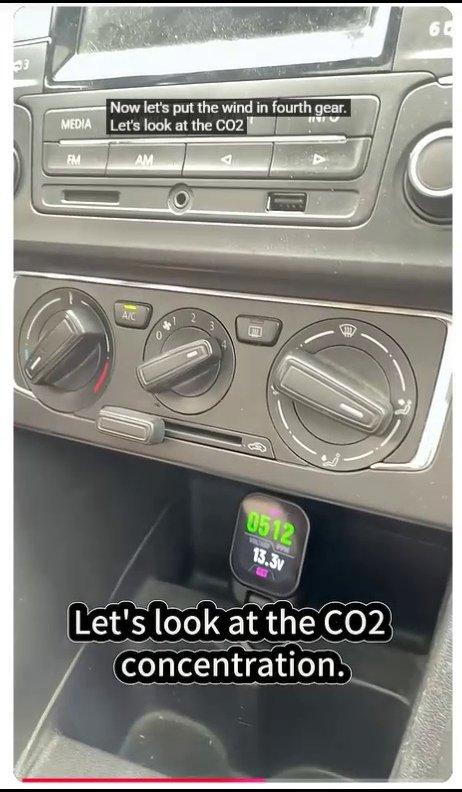
Later readings were in approximately the:
462–482 ppm range
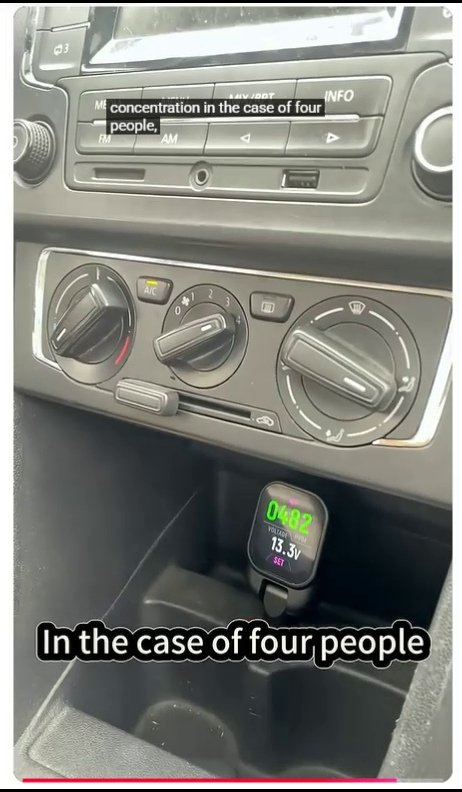
Instead of climbing toward the levels we observed at fan level 1, the CO₂ concentration stayed near the high-400 ppm range.
What We Actually Measured
The important point is not simply that one number was lower than another.
We observed two different CO₂ trends while outside-air mode was selected:
Low fan speed: CO₂ increased from roughly 524 to 866 ppm.
High fan speed: CO₂ remained around the high-400 ppm range during the later segment.
That suggests that simply selecting fresh-air mode may not tell the whole story.
The amount of air actually being supplied to the cabin can matter.
Why Could Fan Speed Affect Cabin CO₂?
A straightforward explanation is dilution.
Four occupants continuously add exhaled CO₂ to the cabin.
If the ventilation system brings in outside air faster than CO₂ accumulates, the cabin concentration can remain relatively low.
If outside-air delivery is too low relative to occupant CO₂ generation, the concentration can still rise.
Published vehicle research supports the broader principle that cabin air exchange depends on factors including the ventilation setting, fan speed and vehicle operating conditions. One vehicle cabin air-exchange study measured air-exchange rates under different low- and high-fan settings, while a multi-vehicle ventilation and fan-speed study found that ventilation settings and fan speed were important variables in explaining cabin air exchange and pollutant behavior.
But We Did Not Measure Airflow Directly
This limitation is important.
Our EVO-CO2V measured CO₂ concentration.
It did not measure:
- outside-air flow rate;
- cubic meters of air per hour;
- air changes per hour;
- HVAC duct pressure.
So we should not claim from this test alone that fan level 4 delivered a specific amount of additional outside air.
What we can say is:
Under our test conditions, the higher blower setting coincided with a much lower cabin CO₂ trend.
That is a direct observation from our test.
Does Fresh-Air Mode Always Keep CO₂ Low?
Our test suggests the answer can depend on more than just whether the fresh-air button is selected.
With four people in the car, outside-air mode plus fan level 1 was not enough to prevent CO₂ from rising during the roughly five-minute observation period.
With fan level 4, we observed readings remaining much closer to approximately 500 ppm.
Different cars may behave differently because HVAC systems, cabin volume, outside-air flap position, fan calibration, vehicle speed and cabin leakage all vary.
Research on vehicle ventilation has likewise found substantial differences in air-exchange rates among vehicles and operating conditions. PubMed
Why Four Occupants Matter
The number of people in the cabin matters because every occupant is continuously exhaling CO₂.
We previously tested five people under recirculation, where cabin CO₂ climbed much more rapidly.
See our five-person car CO₂ recirculation test.
That test and this one look at different variables:
- the five-person test focused mainly on recirculation;
- this test focuses on blower speed while outside-air mode is already selected.
Together they help show that cabin CO₂ is affected by more than one HVAC setting.
What Happens When We Switch From Recirculation to Fresh Air?
In another real driving test, we recorded cabin CO₂ falling from roughly 2,150 ppm toward 500 ppm after switching from recirculation to outside-air ventilation.
See our real recirculation vs fresh-air CO₂ test.
The new test adds another piece of information:
Fresh-air mode itself may not be the only setting worth paying attention to. Blower speed can also influence what happens inside the cabin.
How Different Can Cabin Air Be From Outside Air?
We also directly compared CO₂ inside and outside the same car.
In that test, we measured approximately:
1,500 ppm inside
versus:
450 ppm outside
See our real inside-vs-outside car CO₂ test.
That comparison helps explain why increasing outside-air exchange can have such a noticeable effect when cabin CO₂ has accumulated.
CO₂ Is Not Carbon Monoxide
As with our other vehicle tests, this article is about:
Carbon dioxide — CO₂
It is not a measurement of:
Carbon monoxide — CO
The EVO-CO2V used in our test measures CO₂ concentration and vehicle voltage. It is not a carbon-monoxide detector.
What This Test Does Not Prove
We do not think one drive should be used to claim that:
“Fan level 4 will always keep every car below 500 ppm.”
Our test does not establish a universal CO₂ threshold or a universal blower setting.
Traffic, driving speed, outside CO₂, cabin size, HVAC design, number of occupants, weather and many other factors can affect the result.
A stronger future experiment would repeat both fan settings several times on the same route and record vehicle speed, outside CO₂ and elapsed time for every run.
That is something we may test next.
Our Takeaway
The simplest conclusion from our test is:
Fresh-air mode and fan speed are not necessarily the same thing.
With four people in our car and outside-air ventilation selected:
- at fan level 1, CO₂ rose from about 524 ppm to 866 ppm in roughly five minutes;
- at fan level 4, CO₂ remained around the high-400 ppm range during the segment we recorded.
We do not treat this as a universal specification for every vehicle.
But for us, it demonstrates why watching the actual cabin CO₂ reading can be more informative than relying on the HVAC mode icon alone.
Leave a Reply