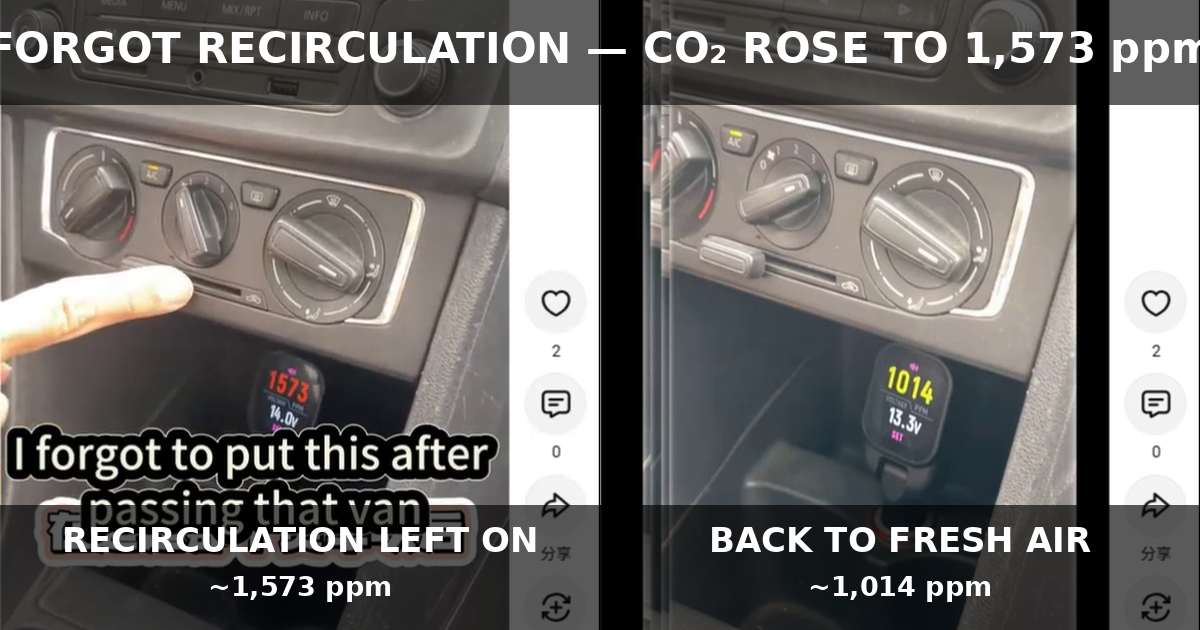
Sometimes we use recirculation for a very practical reason.
During this drive, we approached a truck with a strong outside odor. We did not want to immediately pull that outside air into the cabin, so we temporarily switched our HVAC system from fresh-air mode to recirculation.
That part worked as intended for our immediate purpose.
The problem was that we forgot to switch back.
Later, our EVO-CO2V sounded its CO₂ alert.
The display showed approximately:
1,573 ppm CO₂
We then switched the ventilation system back to outside-air mode.
In the sequence shown in our video, the reading subsequently fell to approximately:
1,420 ppm
and then:
1,014 ppm
This was a simple real-world reminder for us: recirculation can be useful temporarily, but leaving it on also changes how much outside air enters the cabin.
Quick Answer
In our test sequence:
| What we did | CO₂ reading shown |
|---|---|
| Before switching to recirculation | ~507 ppm |
| Later, after recirculation had been left on | ~1,573 ppm |
| After switching back to fresh air | ~1,420 ppm |
| Later in the fresh-air sequence | ~1,014 ppm |
The video is edited, so we are not claiming that these changes occurred over the apparent on-screen video duration.
What we can say directly from our test is that cabin CO₂ rose substantially while recirculation had been left on, and it began falling after we returned to outside-air ventilation.
Watch Our Real Driving Test
The video below shows our actual driving sequence, the truck we were following, our temporary switch to recirculation, the CO₂ alert, and the readings after we returned to fresh-air mode.
These readings were recorded by our team during a real-world drive. Cabin CO₂ later reached about 1,573 ppm after recirculation had been left on, then fell to about 1,420 ppm and 1,014 ppm after we switched back to fresh-air mode.
Why We Switched to Recirculation
As we approached the truck, we noticed a strong outside odor.
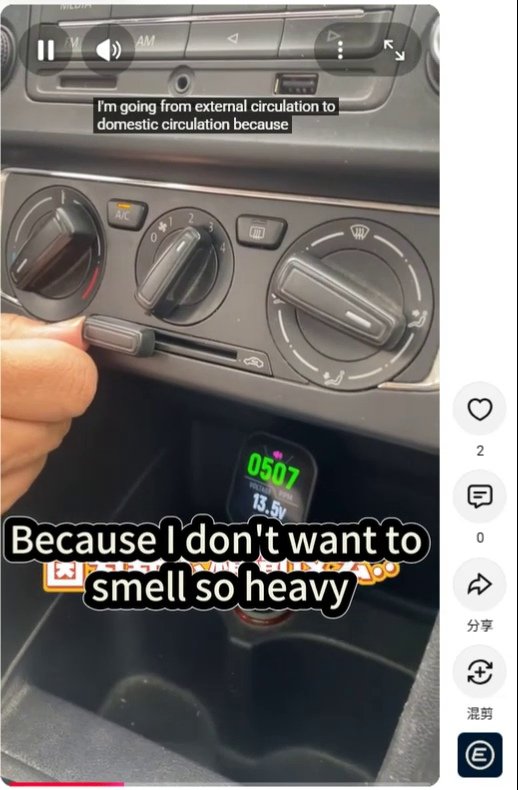
We temporarily switched from outside-air ventilation to recirculation because we wanted to reduce how much outside air was being drawn into the cabin at that moment. At that point, our monitor showed about 507 ppm CO₂.
That is an important distinction.
We are not saying that recirculation makes a vehicle immune to exhaust gases, VOCs or other roadside pollutants.
Our EVO-CO2V was measuring CO₂, not the truck’s exhaust composition.
The short-term ventilation choice and the later cabin CO₂ measurement are two different parts of the story.
What Happened After We Forgot to Switch Back
Earlier in the sequence, our monitor showed approximately:
507 ppm CO₂
After recirculation had remained selected, the EVO-CO2V later showed:
1,573 ppm CO₂
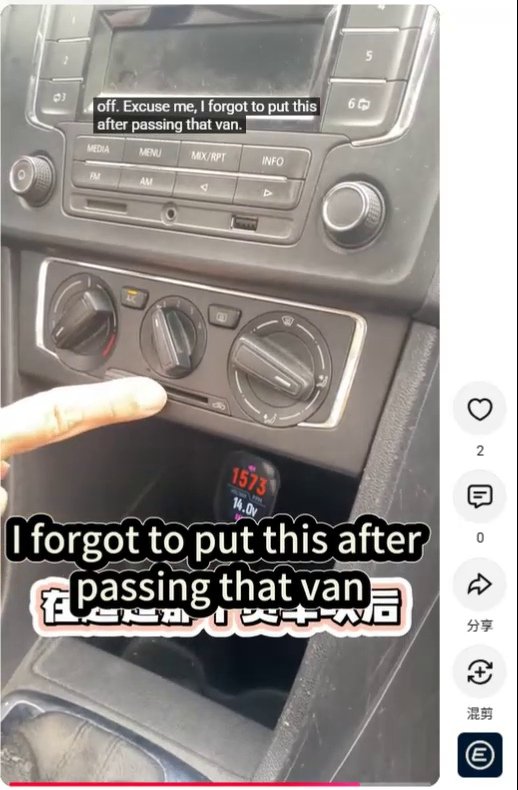
and its audible alert was activated.
That caught our attention.
We realized that after passing the truck, we had forgotten to return the HVAC system to outside-air mode.
We then switched back to fresh air.
What Happened After We Returned to Fresh Air
After changing from recirculation back to outside-air ventilation, the CO₂ reading shown in our video began decreasing.
We recorded approximately:
1,420 ppm
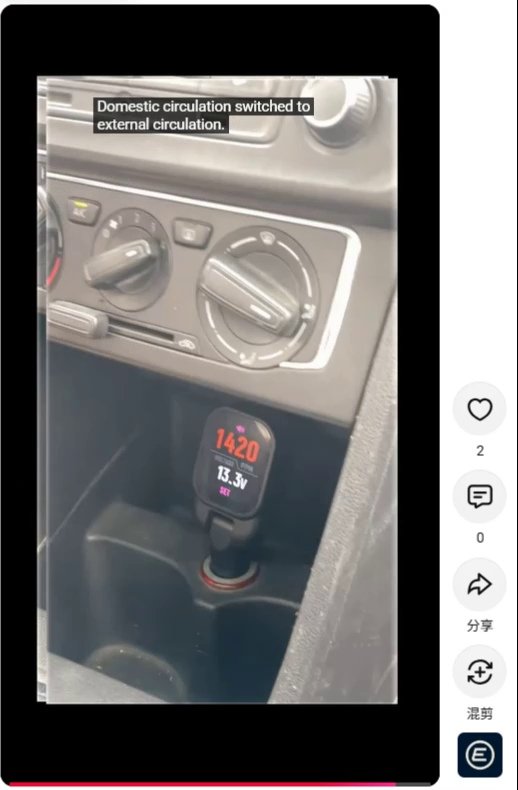
followed later by:
1,014 ppm
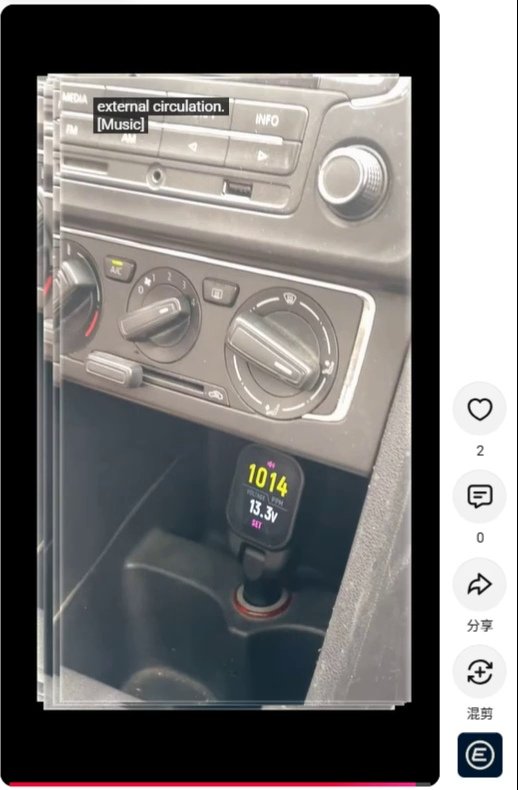
We would not use this edited video to calculate an exact CO₂ removal rate or an exact number of seconds required for fresh air to reduce the concentration.
But the direction of change was clear in our test:
After outside-air ventilation was restored, the cabin CO₂ reading fell.
Why Can Recirculation Be Useful Near Outside Pollution?
There is a real trade-off here.
Vehicle research has found that recirculation can reduce infiltration of some outside particulate pollution. A 2026 real-world passenger-car study found substantially lower PM₂.₅ infiltration under recirculation, but also much lower air-exchange rates; cabin CO₂ rose substantially under those test conditions. Fresh-air mode greatly increased air exchange and kept CO₂ lower, while allowing more outside pollutants into the cabin. PubMed
Other vehicle research has found the same broader trade-off: stronger recirculation can reduce particle exposure but allow occupant-generated CO₂ to accumulate, while introducing some fresh air can lower cabin CO₂. PubMed
So for us, the question is not simply:
“Is recirculation good or bad?”
The more useful question is:
When is recirculation useful, and when should we bring fresh air back in?
Recirculation Does Not Mean the Cabin Is Sealed
A car in recirculation mode is not a perfectly sealed chamber.
Outside air can still enter through vehicle leakage, door seals and other pathways, and HVAC systems vary substantially between vehicles.
A real-world study across 92 vehicle models found major differences between vehicles, while also observing that recirculation generally reduced outside ultrafine-particle infiltration but allowed cabin CO₂ to rise. PubMed
That is another reason we prefer to measure what is actually happening inside our own vehicle rather than assume every car behaves the same way.
Why Did Our CO₂ Alert Activate?
Our EVO-CO2V is configured to sound an audible warning when the CO₂ reading reaches approximately:
1,400 ppm
During this test, the display eventually showed approximately:
1,573 ppm
which was above that configured alert point.
The alarm reminded us that recirculation was still selected.
That 1,400 ppm value is our monitor’s alert setting, not a universal boundary between “safe” and “unsafe” air.
We use it as a practical reminder to pay attention to ventilation.
CO₂ Is Not Carbon Monoxide or Truck Exhaust
This distinction is especially important in this test.
We measured:
Carbon dioxide — CO₂
We did not measure:
- carbon monoxide (CO);
- nitrogen dioxide (NO₂);
- particulate matter;
- VOCs;
- the chemical responsible for the odor from the truck.
The EVO-CO2V is therefore not an exhaust-gas detector or carbon-monoxide detector.
A lower or higher CO₂ reading does not tell us that those other pollutants are absent.
Why We Would Not Simply Leave Recirculation Off All the Time
Our test does not lead us to the conclusion that we should never use recirculation.
There are situations where temporarily reducing outside-air intake can be useful—for example, when passing a strong odor or encountering heavily polluted outside air. Published vehicle research also shows that recirculation can reduce infiltration of outside particles. PubMed
The issue in our test was different:
We forgot to switch back after the temporary reason for using recirculation had passed.
That allowed us to observe the other side of the trade-off: cabin CO₂ accumulation.
What This Test Does Not Prove
This was one real driving sequence in one vehicle.
We are not claiming that every car will rise from 507 ppm to 1,573 ppm at the same rate.
The result can depend on:
- number of occupants;
- vehicle cabin volume;
- HVAC design;
- fan setting;
- cabin leakage;
- vehicle speed;
- outside-air conditions;
- how long recirculation remains selected.
We also did not measure the actual airflow rate during this drive.
So our conclusion stays narrow:
In our test, CO₂ became substantially elevated after recirculation remained on, and the reading fell after we restored outside-air ventilation.
Related Test: What Happens When We Deliberately Switch From Recirculation to Fresh Air?
We previously ran a more controlled driving comparison specifically focused on recirculation and fresh-air ventilation.
In that test, cabin CO₂ fell from roughly 2,150 ppm toward 500 ppm after we switched to outside air.
Related Test: When Do We Personally Switch Back to Fresh Air?
We have also tested the way we use these HVAC modes in everyday driving.
See how we decide when to switch from recirculation back to fresh air.
Related Test: How Different Is the Air Inside and Outside the Same Car?
In another measurement, we recorded approximately:
1,500 ppm inside the car
versus:
450 ppm immediately outside
Our Takeaway
The most useful lesson from this drive was not that recirculation should always be avoided.
It was this:
A temporary HVAC choice can easily become a forgotten setting.
We switched to recirculation for a practical reason while passing a strong-smelling truck.
Later, our cabin CO₂ reached approximately 1,573 ppm.
The monitor alerted us, we realized recirculation was still on, and we switched back to outside air.
The subsequent readings shown in our video fell to approximately 1,420 ppm and then 1,014 ppm.
For us, that is why continuous cabin CO₂ monitoring can be useful: it gives us feedback about what is actually happening inside the vehicle instead of relying only on whether we remember which HVAC mode we selected.
Leave a Reply