So in our test, the open water did not prevent cabin CO₂ from continuing to rise.
Quick Answer
Our real test showed:
Test stage
Cabin CO₂
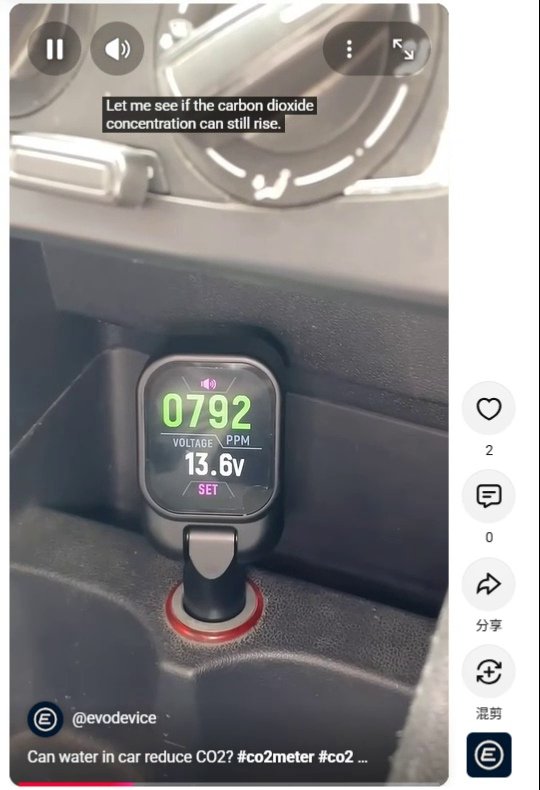
Early reading
~792 ppm
Later
~818 ppm
Later
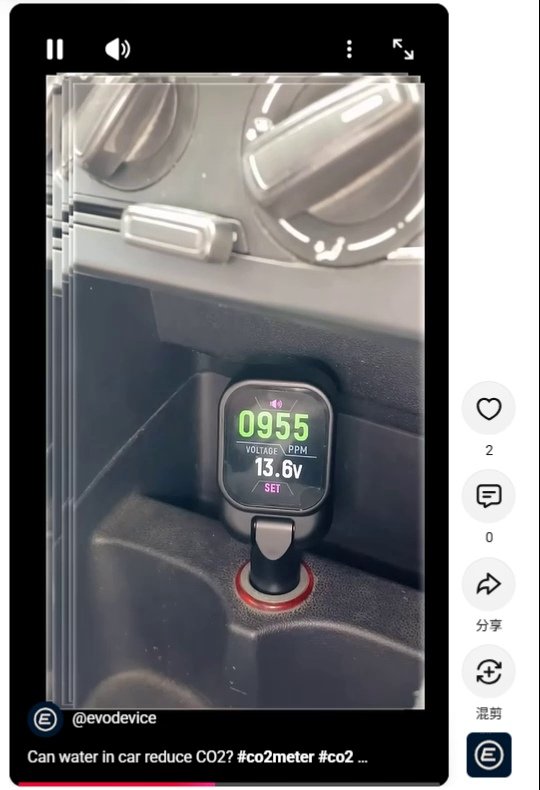
~955 ppm
Later
~1,194 ppm
Later
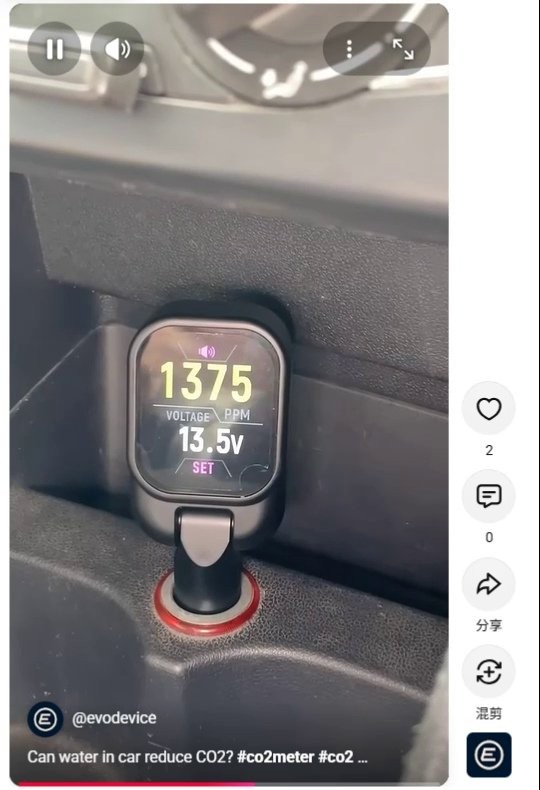
~1,375 ppm
Later
~1,417 ppm
Later
~1,464 ppm
Highest reading shown
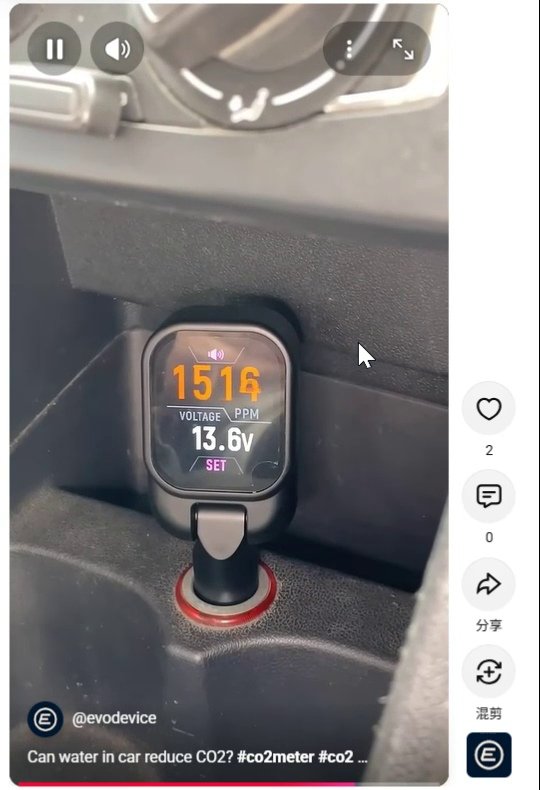
~1,516 ppm
We are not saying that water cannot absorb carbon dioxide.
It can.
Our observation is narrower:
A large open container of ordinary water did not stop cabin CO₂ from increasing under the conditions of our test.
Watch Our Real Water-and-CO₂ Test
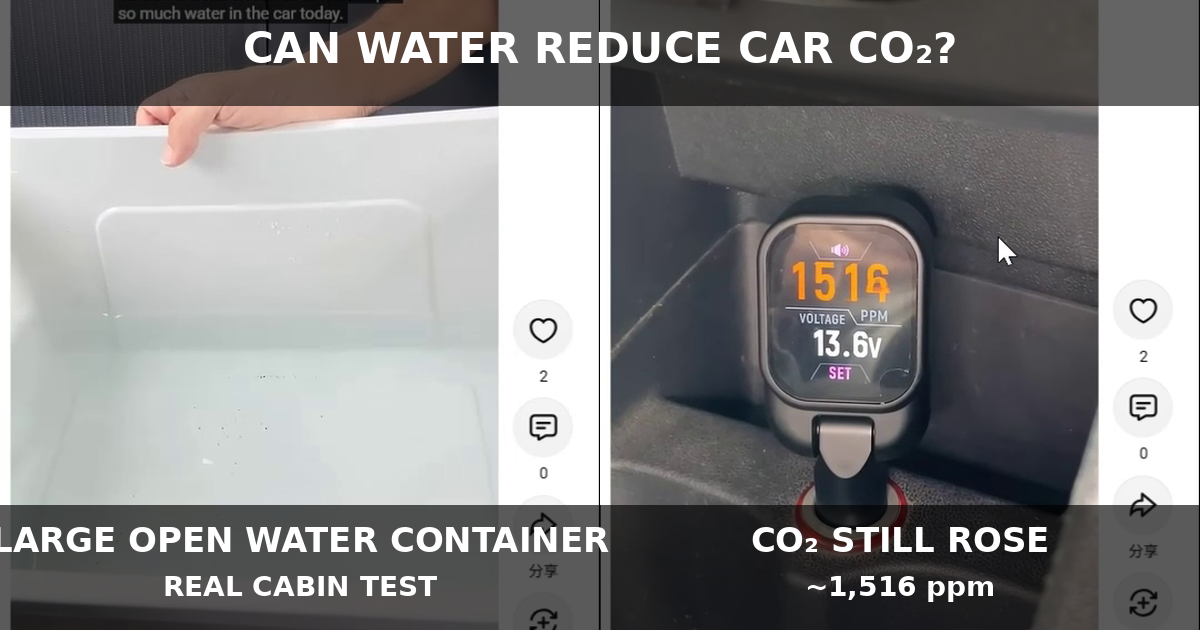
The video below shows the actual open container of water inside our vehicle and the live EVO-CO2V readings as cabin CO₂ continued to rise.
These measurements were recorded by our team during a real-world test. Despite the large open container of water, cabin CO₂ rose from about 792 ppm to about 1,516 ppm during the sequence shown.
Why We Tried This Experiment
We know that carbon dioxide can dissolve in water.
That raises an intuitive idea:
If we increase the amount of water inside a confined cabin, perhaps some of the CO₂ in the air will dissolve into it.
Chemically, the first part is correct.
CO₂ does transfer between air and water.
But the more practical question is:
Can an ordinary tub of water absorb enough CO₂, quickly enough, to make a meaningful difference inside an occupied vehicle?
That is what we wanted to explore.
How We Ran the Test
We placed a large open container of water inside the car.
We then monitored the cabin CO₂ concentration with the EVO-CO2V while remaining in the vehicle.
An early reading shown in the video was approximately:
792 ppm
At the beginning of our water-and-CO₂ test, the monitor showed about 792 ppm CO₂.
The concentration subsequently continued upward.
Later readings included:
818 ppm
then:
955 ppm
As the test continued, our monitor showed about 955 ppm CO₂ with the open water container still inside the car.
then:
1,194 ppm
then:
1,375 ppm
Later in the test, our monitor showed about 1,375 ppm CO₂ while the open water container remained inside the car.
and eventually:
1,516 ppm
By the later stage of our test, the monitor showed about 1,516 ppm CO₂ even with the large open container of water still inside the car.
The video is edited, so we do not use the apparent video length to calculate an exact ppm-per-minute rise.
Our conclusion is based on the direction and values of the readings shown.
What We Actually Observed
The result was straightforward.
Even with a substantial open surface of water in the cabin, the CO₂ concentration did not stabilize at the initial level.
Instead, it continued rising.
From approximately:
792 ppm
to approximately:
1,516 ppm
That is an increase of roughly:
724 ppm
during the measurement sequence shown.
Again, this does not mean that zero CO₂ entered the water.
It means that any absorption occurring was not sufficient to prevent the cabin-air concentration from rising under our test conditions.
Henry’s Law means that, at equilibrium, the amount of dissolved gas depends partly on the gas’s partial pressure above the liquid.
So as the CO₂ concentration in cabin air rises, somewhat more CO₂ can dissolve into the water.
But that does not automatically mean that an open tub of water becomes an effective CO₂ removal system.
Why the Amount Dissolved Can Still Be Small
We can use the NIST Henry’s Law value to make an illustrative estimate.
At about 25°C, if we simplify the situation and treat the water as plain water at equilibrium:
air at 792 ppm CO₂ corresponds to roughly 1.2 mg of dissolved molecular CO₂ per liter of water;
air at 1,516 ppm CO₂ corresponds to roughly 2.3 mg/L.
The difference is only around:
1.1 mg of additional dissolved molecular CO₂ per liter of water
for that change in gas-phase concentration.
This is only an idealized calculation—it does not include all pH, alkalinity and carbonate chemistry—but it helps explain the scale.
An ordinary tub of water may absorb some CO₂, but that is very different from continuously removing the CO₂ being generated inside an occupied cabin.
Surface Area and Mixing Also Matter
Gas does not instantly equilibrate with all the water in a container.
CO₂ first has to cross the air-water interface.
How quickly that happens depends on factors such as:
exposed water surface area;
air movement;
water movement;
water temperature;
CO₂ partial pressure;
time.
A deep container holding more water does not automatically mean all of that water is immediately available to absorb CO₂ at the same rate.
That is another reason why simply placing a large volume of still water inside the cabin is very different from an engineered gas absorber.
Why Industrial CO₂ Absorption Is Different
There are real systems that remove CO₂ using liquids.
But they generally improve gas-liquid contact or use chemical solutions that react with CO₂.
For example, industrial scrubbers may use:
packed columns;
sprays;
forced gas flow;
alkaline solutions;
amine solutions;
high pressure.
Our test used none of those things.
We simply put ordinary open water inside a passenger vehicle.
So our result should not be interpreted as:
“Water cannot absorb CO₂.”
A better interpretation is:
Ordinary standing water was not an effective substitute for ventilation in our car test.
Why Cabin CO₂ Can Still Rise
People inside a vehicle continuously exhale carbon dioxide.
In a confined cabin, CO₂ can accumulate when its production exceeds the rate at which it is removed.
Vehicle research has found that ventilation settings are a major determinant of cabin CO₂ accumulation, particularly when outside-air exchange is restricted. vehicle cabin CO₂ and ventilation study
That is fundamentally different from relying on passive absorption by a container of water.
Fresh-air ventilation continuously replaces some cabin air with outdoor air.
A bowl or tub of water does not do that.
Water Is Not a Substitute for Fresh-Air Ventilation
This is probably the most useful practical takeaway from our experiment.
If cabin CO₂ is increasing, placing water in the vehicle should not be treated as a substitute for increasing air exchange.
We have directly observed the effect of ventilation in several of our other tests.
Related Test: Recirculation vs Fresh Air
In one real driving test, cabin CO₂ dropped from approximately 2,150 ppm toward 500 ppm after we switched from recirculation to outside-air ventilation.
Leave a Reply