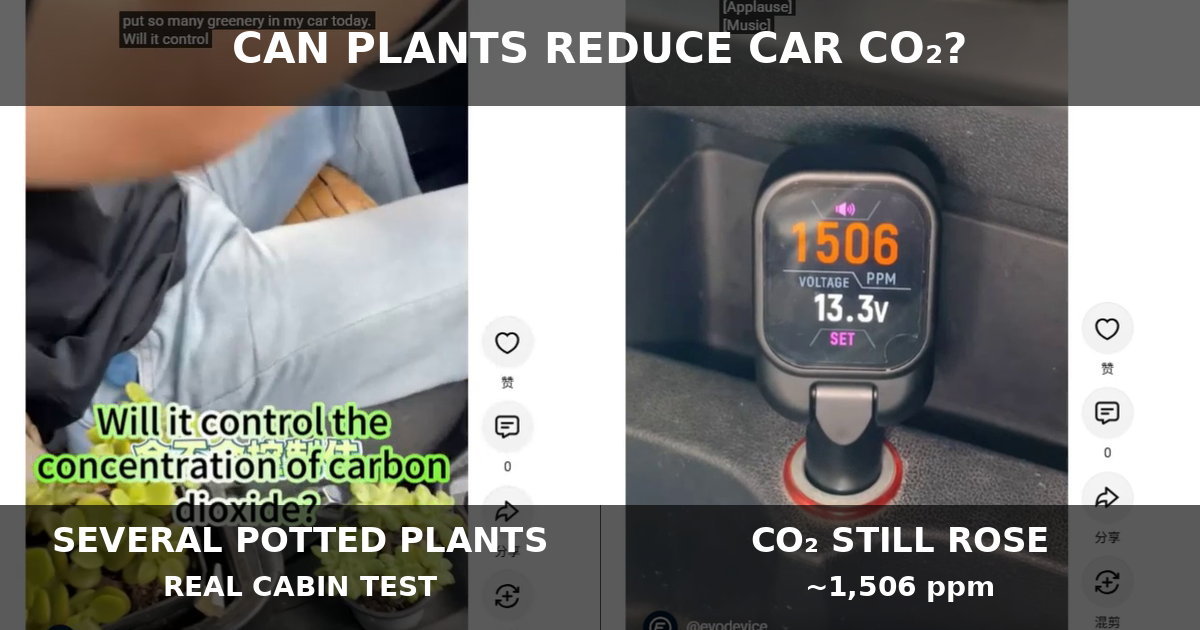
Plants absorb carbon dioxide during photosynthesis.
That made us curious about a very practical question:
If we put several green plants inside a car, could they noticeably reduce cabin CO₂?
We decided to test it ourselves.
We placed multiple potted plants inside the vehicle and monitored cabin CO₂ with our EVO-CO2V.
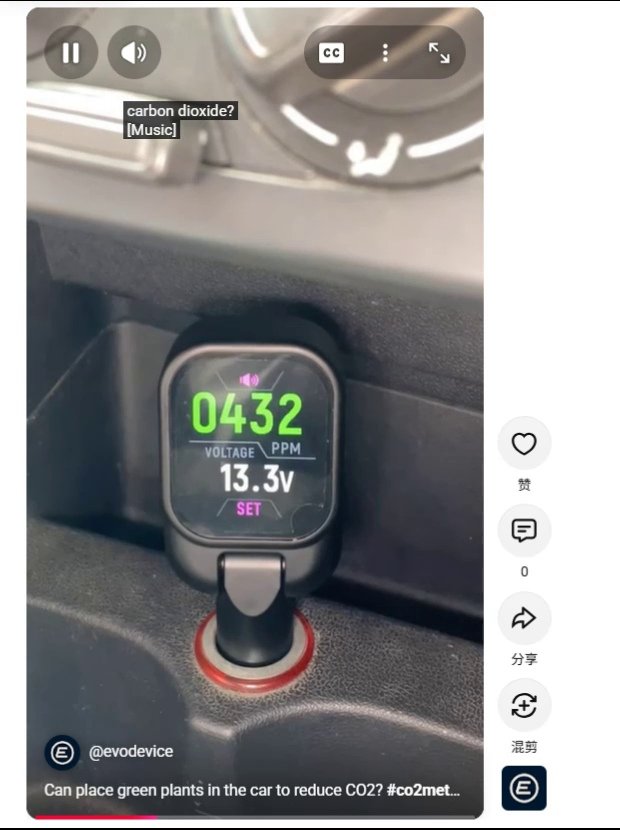
An early reading shown in our test was approximately:
432 ppm CO₂
As the test continued, the monitor showed approximately:
471 → 543 → 669 → 897 → 1,255 → 1,506 ppm
So under the conditions of our test, the plants did not prevent cabin CO₂ from continuing to rise.
Quick Answer
In our real-world test:
| Test stage | Cabin CO₂ |
|---|---|
| Early reading | ~432 ppm |
| Later | ~471 ppm |
| Later | ~543 ppm |
| Later | ~669 ppm |
| Later | ~897 ppm |
| Later | ~1,255 ppm |
| Highest reading shown | ~1,506 ppm |
The difference between the early and highest readings shown was approximately:
1,074 ppm
This does not mean the plants absorbed zero CO₂.
What we can say directly from our measurements is:
The amount of CO₂ being removed by the plants was not enough to stop the cabin concentration from rising during our test.
Watch Our Real Plants-and-CO₂ Test
The video below shows the actual plants inside our vehicle and the live EVO-CO2V readings during the experiment.
These measurements were recorded by our team during a real-world cabin test. With several potted plants inside the vehicle, CO₂ still rose from about 432 ppm to about 1,506 ppm during the sequence shown.
Why We Tried This Experiment
The idea seems reasonable.
Green plants use carbon dioxide during photosynthesis and convert carbon into plant biomass.
So we wondered:
Could putting enough plants inside a small vehicle noticeably offset the CO₂ being produced by people inside the cabin?
Rather than assume the answer, we put several plants in the vehicle and watched the CO₂ reading directly.
How We Ran the Test
We placed several potted green plants inside the car.
We then monitored cabin CO₂ using the same EVO-CO2V vehicle CO₂ monitor we use in our other driving experiments.
An early reading was approximately:
432 ppm
The concentration later increased to approximately:
471 ppm
then:
543 ppm
then:
669 ppm
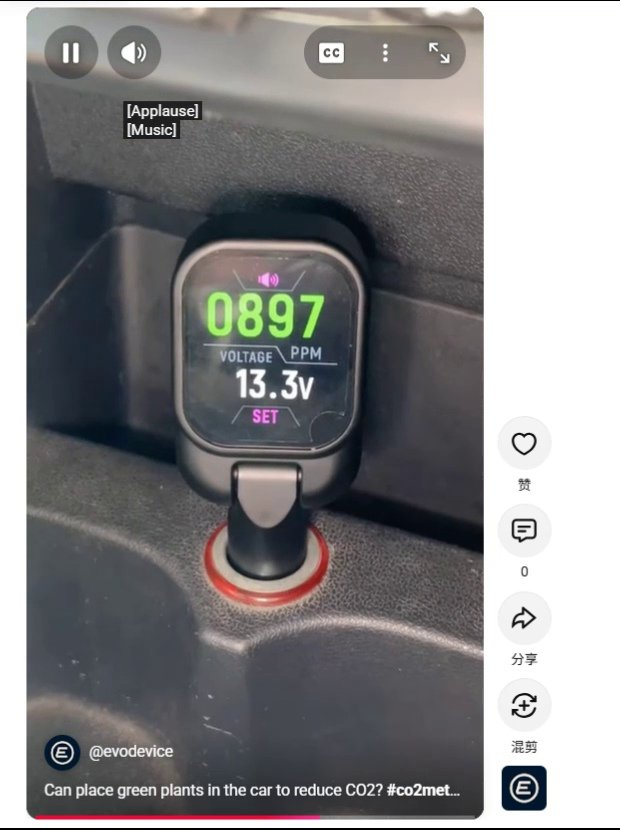
then:
897 ppm
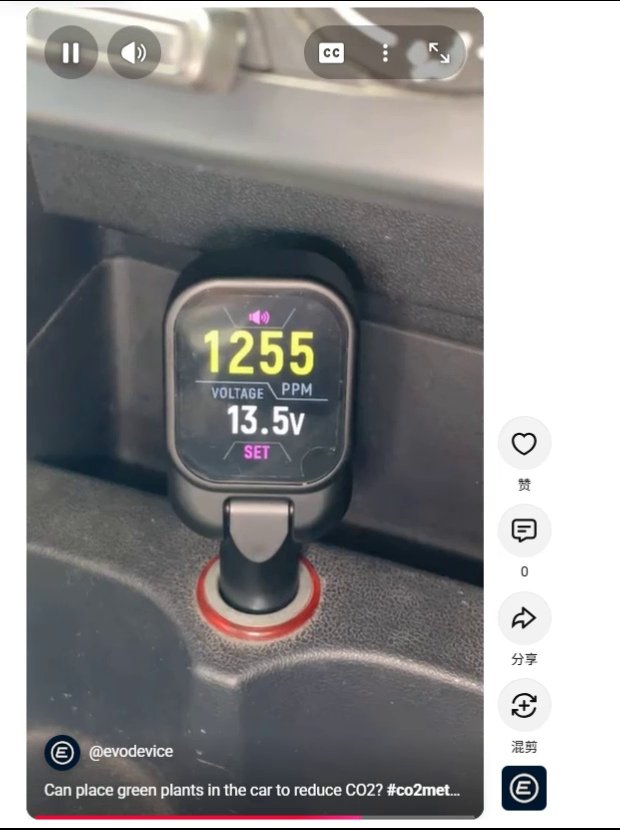
then:
1,255 ppm
and eventually:
1,506 ppm
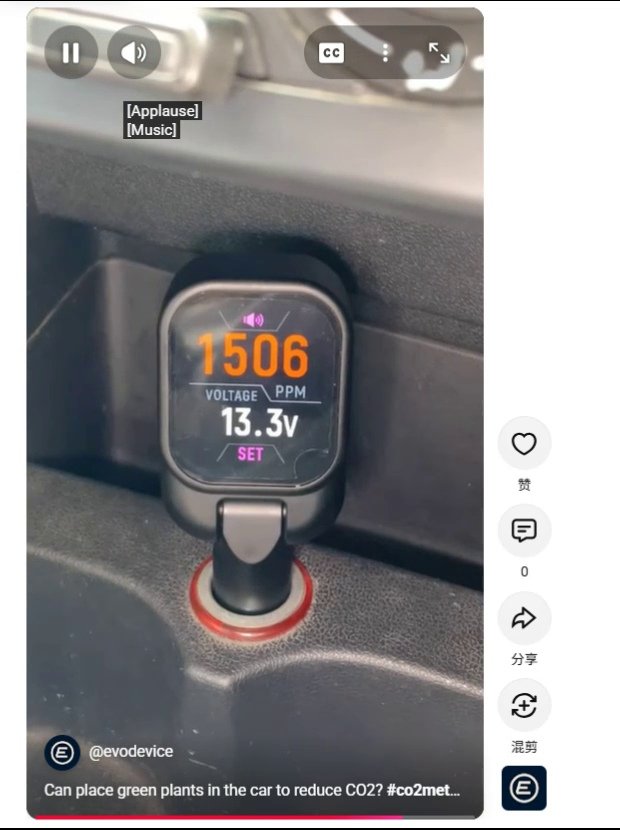
The video is edited, so we do not use the apparent video duration to calculate an exact CO₂ increase per minute.
Our conclusion is based on the actual readings shown.
What We Actually Observed
Despite having several plants inside the vehicle, the cabin CO₂ concentration continued to rise.
From approximately:
432 ppm
to approximately:
1,506 ppm
That is an increase of roughly:
1,074 ppm
during the measurement sequence shown.
This tells us something useful about scale.
Plants can absorb CO₂.
But in this particular car test, their CO₂ uptake was not sufficient to offset the net CO₂ accumulation occurring inside the cabin.
Plants Really Can Absorb CO₂
Yes.
We do not want this experiment to be interpreted as saying otherwise.
Plants absorb atmospheric CO₂ through photosynthesis when environmental conditions support net photosynthesis.
A 2025 controlled study tested 40 common ornamental plant species under bright light and elevated CO₂ conditions. All of the tested plants reduced CO₂ in the small sealed experimental chamber, although their performance varied considerably by species and leaf area. controlled study of CO₂ removal by ornamental plants
Another experimental study found that the CO₂ assimilation rate of indoor plants increased as light intensity increased. indoor plant CO₂ assimilation and light-intensity study
So the question is not:
“Can plants absorb CO₂?”
They can.
The more useful question is:
Can a practical number of passive potted plants remove CO₂ fast enough to balance what is being produced inside an occupied car?
Our test suggests that, under our particular conditions, they did not.
Light Matters
Photosynthesis requires light.
Research on indoor plants has shown that lighting conditions can have a major effect on whether a plant is a net CO₂ absorber at a particular moment. Under stronger lighting, net CO₂ uptake can increase; under poor lighting, net CO₂ removal can be much smaller and, depending on the plant and conditions, respiration can become significant relative to photosynthesis. controlled study of CO₂ removal by ornamental plants
We did not measure:
- PPFD at the plant leaves;
- lux at each plant;
- individual plant photosynthetic rate;
- leaf area;
- plant species-specific CO₂ uptake.
Therefore, we cannot calculate how much CO₂ the plants actually absorbed during our car test.
More Plants Does Not Automatically Mean Enough CO₂ Removal
The amount of CO₂ a group of plants can absorb depends on more than simply counting pots.
Relevant factors include:
- total leaf area;
- plant species;
- light intensity;
- plant health;
- temperature;
- CO₂ concentration;
- length of exposure;
- leaf orientation;
- photosynthetic pathway.
The 2025 controlled study found that total leaf area was strongly related to overall CO₂ removal capacity. indoor plant CO₂ assimilation and light-intensity study
That helps explain why several small plants should not automatically be assumed to function like a high-capacity CO₂ removal system.
Human CO₂ Production Is Continuous
People inside a car continuously exhale carbon dioxide.
A vehicle cabin is relatively small.
If occupant-generated CO₂ is entering the cabin air faster than plants, ventilation and other processes remove it, the concentration will rise.
That is exactly what our monitor showed during this experiment.
The presence of plants does not change the basic mass balance:
CO₂ produced − CO₂ removed = net change in cabin CO₂
During our test, the net change was strongly positive.
But We Did Not Run a No-Plant Control
This is one of the most important limitations of our experiment.
We cannot say:
“The plants made no difference.”
To establish that, we would need a matched comparison.
For example:
Test A: Same vehicle, same occupants and same conditions, with no plants.
Test B: Same conditions, with the plants.
Then we could compare the CO₂ curves.
It is possible that the plants absorbed some CO₂ and slightly slowed the rate of increase.
Our current test cannot quantify that effect.
What it does show is simply that:
Even with the plants present, cabin CO₂ still rose substantially.
Plants Are Not a Substitute for Vehicle Ventilation
For practical cabin CO₂ control, ventilation operates at a very different scale.
Fresh-air ventilation physically replaces part of the cabin air with outside air.
We have directly observed this in our other experiments.
In one test, cabin CO₂ fell from roughly 2,150 ppm toward 500 ppm after we switched from recirculation to outside-air mode.
Related Test: Can Water Reduce Cabin CO₂?
We also tested another intuitive idea: placing a large open container of water inside the car.
CO₂ does dissolve in water, but in that experiment our cabin reading still rose from approximately 792 ppm to 1,516 ppm.
These two experiments make an interesting pair:
Water: physically capable of dissolving CO₂.
Plants: biologically capable of absorbing CO₂.
But in both of our real vehicle experiments, cabin CO₂ still increased substantially.
Related Test: Inside vs Outside the Same Car
In another experiment, we measured approximately:
1,500 ppm inside
versus:
450 ppm outside
beside the same vehicle.
This helps illustrate why ventilation can have such a strong effect: outside air may contain substantially less CO₂ than occupied cabin air.
CO₂ Is Not Carbon Monoxide
This experiment measured:
Carbon dioxide — CO₂
It did not measure:
Carbon monoxide — CO
The EVO-CO2V is a vehicle CO₂ monitor.
It does not tell us whether CO, NO₂, VOCs or particulate pollution are present.
About the 1,400 ppm Alert
During the experiment, the reading eventually exceeded the EVO-CO2V’s configured alert level of approximately:
1,400 ppm
That value is the device’s alert setting.
We are not presenting 1,400 ppm as a universal “safe/unsafe” boundary.
We use the alert as a practical reminder that cabin CO₂ has become elevated relative to the conditions we normally want to maintain.
What This Test Does Not Prove
Our experiment does not establish:
- the exact CO₂ absorption rate of the plants;
- the effect of each individual plant;
- whether the plants slowed the increase;
- how the result would change under stronger sunlight;
- how many plants would be required to offset one occupant;
- whether another plant species would perform differently.
We also did not directly measure the vehicle’s air-exchange rate.
So our conclusion remains narrow:
Under the conditions of our real cabin test, several potted plants did not prevent CO₂ from rising from approximately 432 ppm to approximately 1,506 ppm.
How We Would Improve the Experiment
A stronger follow-up experiment would use two matched runs:
Run 1 — No plants
Same vehicle, same occupants, same HVAC setting, same starting CO₂ and similar environmental conditions.
Run 2 — Plants present
Repeat the test with the same number and type of plants.
We would also record:
- plant species;
- total leaf area;
- PPFD at the leaves;
- outside CO₂;
- cabin temperature;
- ventilation mode;
- fan level;
- elapsed time.
Then we could directly compare the CO₂ rise curves.
That would answer a better question:
How much did the plants actually change the rate of cabin CO₂ buildup?
Our Takeaway
The science is real:
Plants can absorb CO₂ through photosynthesis.
But our real vehicle test also showed the practical limitation.
With several plants inside the car, our monitor still increased from approximately:
432 ppm
to:
1,506 ppm
So our conclusion is not that plants are useless.
It is:
A practical number of passive potted plants did not replace ventilation as a way to control cabin CO₂ in our test.
For us, measuring cabin CO₂ directly remains much more useful than assuming that the presence of greenery is enough to keep the air well ventilated.
Leave a Reply