We sometimes hear a question that sounds reasonable at first:
“If carbonated drinks contain carbon dioxide, why should we worry about breathing elevated CO₂ inside a car?”
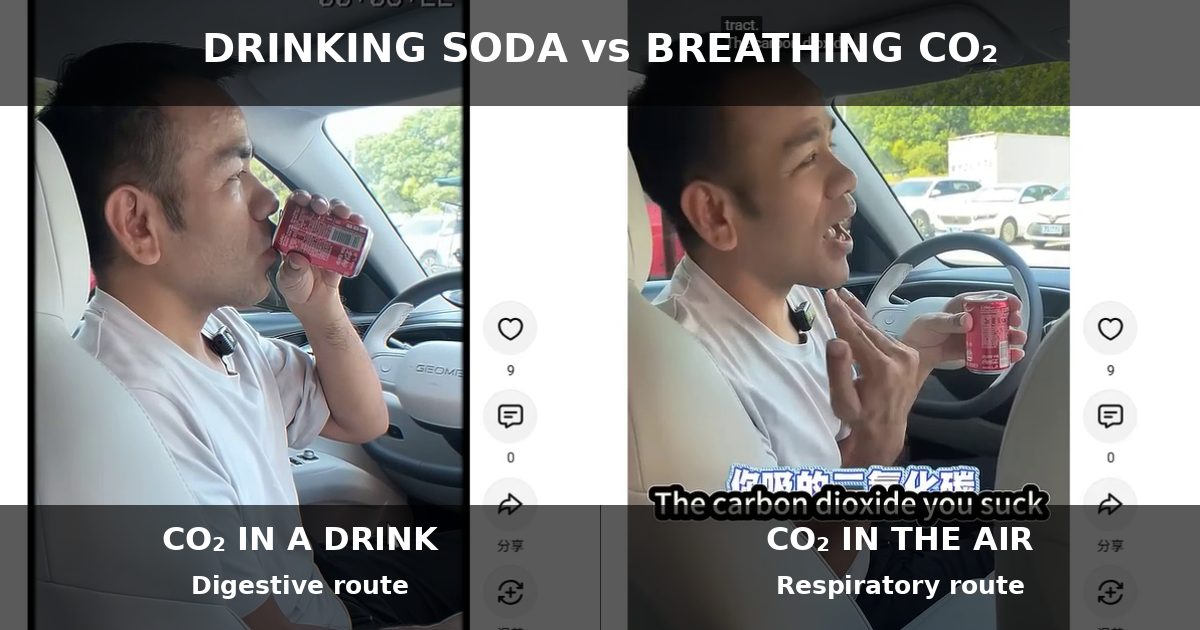
We addressed that question in our video while drinking a carbonated beverage.
The short answer is:
Drinking CO₂ dissolved in a beverage and breathing CO₂ in the air are not the same type of exposure.
The carbon dioxide enters the body through different routes, interacts with different organs first, and should not be compared simply because both involve the same molecule.
Quick Answer
| Carbonated drink | Elevated CO₂ in cabin air |
|---|---|
| CO₂ is dissolved in a liquid | CO₂ is present in the air we breathe |
| First interacts mainly with the mouth, esophagus and stomach | Enters directly through the respiratory system |
| Often produces carbonation sensation, gastric gas and belching | Continuously participates in gas exchange in the lungs while we breathe |
| Does not tell us anything about cabin ventilation | Cabin CO₂ can provide useful information about occupant-generated CO₂ and air exchange |
So drinking a bottle of soda is not equivalent to sitting in a poorly ventilated vehicle with elevated cabin CO₂.
Watch Our Video
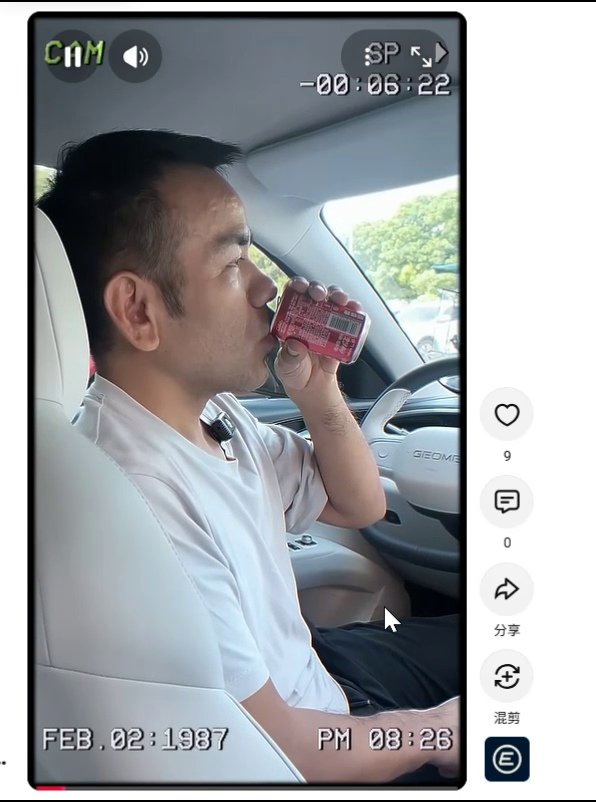
The video below shows how we explain this distinction in a simple everyday example.
In this video, we use a carbonated drink to explain why CO₂ in a beverage should not be confused with CO₂ concentration in the air we continuously breathe inside a vehicle.
What Happens When We Drink a Carbonated Beverage?
Carbonated beverages contain carbon dioxide dissolved under pressure.
When we open the container, the pressure falls and some of that dissolved CO₂ escapes as bubbles.
When we drink the beverage, the carbon dioxide primarily interacts with the gastrointestinal system.

A scientific review of carbonated beverages notes that the main physiological interactions of beverage carbonation occur in the mouth, esophagus and stomach. Carbonation can also increase gastric volume and contribute to sensations such as fullness or belching. review of carbonated beverages and the gastrointestinal system
review of carbonated beverages and the gastrointestinal system
Can CO₂ From a Drink Enter the Blood?
Some CO₂ from the gastrointestinal tract can be absorbed.
That still does not make drinking a carbonated beverage equivalent to inhaling elevated CO₂.

Carbon dioxide is a normal part of human metabolism. Our bodies continuously produce CO₂, transport it in the blood in several chemical forms, and eliminate it through the lungs.
The important distinction is the route and exposure pattern.
With a carbonated beverage, CO₂ is introduced into the gastrointestinal tract as part of a liquid.
When breathing elevated cabin CO₂, however, every breath repeatedly exposes the respiratory system to an elevated concentration in the surrounding air.
What Happens When We Breathe CO₂?
The lungs continuously exchange gases between inhaled air and the blood.
Normally, the air we inhale contains much less CO₂ than the air we exhale.
When the concentration in the surrounding air rises, the gradient involved in removing CO₂ through breathing changes.

That is fundamentally different from temporarily swallowing dissolved CO₂ in a drink.
Inside an occupied car, the CO₂ concentration can rise because people continuously exhale CO₂ into a relatively small space.
If outside-air exchange is limited, that exhaled CO₂ can accumulate.
That is exactly what we have measured repeatedly in our vehicle experiments.
Does 1,000 or 1,500 ppm CO₂ Automatically Cause Cognitive Decline?
We would not make that claim.
One frequently cited controlled study exposed 22 participants to approximately 600, 1,000 and 2,500 ppm CO₂ for 2.5-hour periods. The researchers reported reductions in several measures of decision-making performance as CO₂ increased. controlled CO₂ and decision-making study
controlled CO₂ and decision-making study
But the evidence is not completely settled.
A later critical review examined 37 experimental studies and concluded that findings about CO₂ and cognitive performance were inconsistent across studies. critical review of indoor CO₂ and cognitive function
critical review of indoor CO₂ and cognitive function
That is why we would not write:
“1,500 ppm CO₂ causes cognitive decline.”
A more accurate statement is:
Some controlled studies have reported changes in certain cognitive or decision-making measures at elevated indoor CO₂ concentrations, but results across the research literature are not fully consistent.
Concentration, exposure duration, ventilation, other indoor pollutants and study design all matter.
CO₂ Is Also a Useful Ventilation Indicator
For the type of vehicle testing we do, this is especially important.
People continuously exhale CO₂.
When cabin CO₂ rises substantially above the outside level, that often tells us that occupant-generated air is accumulating faster than it is being diluted by outside air.
That is why we find continuous CO₂ monitoring useful.
We are not using one CO₂ number as a medical diagnosis.
We are using the trend to understand what is happening with cabin ventilation.
We Have Seen This Directly in Our Car Tests
In one of our real tests, we measured approximately:
1,500 ppm inside the car
and only:
450 ppm outside
beside the same vehicle.
In another test, cabin CO₂ fell from roughly 2,150 ppm toward 500 ppm after we switched from recirculation to outside-air ventilation.
Those experiments tell us much more about vehicle ventilation than whether someone happens to be drinking a carbonated beverage.
Drinking Soda Does Not Raise the Cabin CO₂ in the Same Way
This is another useful distinction.
The CO₂ inside a sealed soda bottle is contained in the beverage and headspace.
Simply having a bottle of cola in the vehicle is not equivalent to several people continuously exhaling CO₂ into the cabin.
Once we drink the beverage, the carbonation primarily enters the gastrointestinal tract.
By contrast, every person in the vehicle continuously adds metabolically produced CO₂ to the cabin through exhaled breath.
Those are completely different processes.
What About Burping?
Carbonated drinks can obviously cause belching.
That can release some CO₂ into the surrounding air.
But the important question is scale.
The continuous CO₂ source inside an occupied vehicle is primarily the occupants’ respiration over time, not the occasional release of carbonation from a beverage.
We therefore would not use “someone drank Coke” as an explanation for the type of sustained cabin CO₂ buildup we observe in our vehicle tests.
CO₂ Is Not Carbon Monoxide
Another distinction matters even more:
CO₂ is carbon dioxide.
CO is carbon monoxide.
They are different gases.
Our EVO-CO2V measures carbon dioxide concentration.
It does not detect:
- carbon monoxide;
- nitrogen dioxide;
- VOCs;
- particulate matter;
- vehicle exhaust composition.
A CO₂ reading therefore should not be interpreted as evidence that those pollutants are present or absent.
About Our 1,400 ppm Alert
The EVO-CO2V is configured to sound an alert at approximately:
1,400 ppm CO₂
We use that as a practical reminder to pay attention to cabin ventilation.
It is not a universal medical safety threshold, and we do not describe everything below it as “safe” or everything above it as “dangerous.”
The number is an alert setting on our monitor.
Why This Comparison Matters
The phrase “CO₂ is in Coke, so CO₂ cannot matter” mixes together two very different questions.
The first is:
What happens when we ingest a carbonated beverage?
The second is:
What happens when the air we continuously breathe contains an elevated CO₂ concentration?
They involve the same chemical molecule.
But they do not represent the same route, dose, timing or physiological exposure.
That is why we do not think carbonated drinks are a useful argument against monitoring cabin CO₂.
Our Takeaway
We can drink a carbonated beverage while still caring about the CO₂ concentration in the air around us.
There is no contradiction.
Carbonated drinks deliver dissolved CO₂ mainly through the gastrointestinal tract. Research on carbonation focuses heavily on effects in the mouth, esophagus and stomach. review of carbonated beverage physiology
Cabin CO₂ monitoring, on the other hand, tells us about the concentration of CO₂ in the air we are breathing continuously.
And when we use our EVO-CO2V, that is exactly what we are trying to understand:
What is happening to the air inside the vehicle right now?
Leave a Reply