We had a simple question:
If two people inside a car are both wearing masks, will cabin CO₂ still rise?
We decided to test it ourselves.
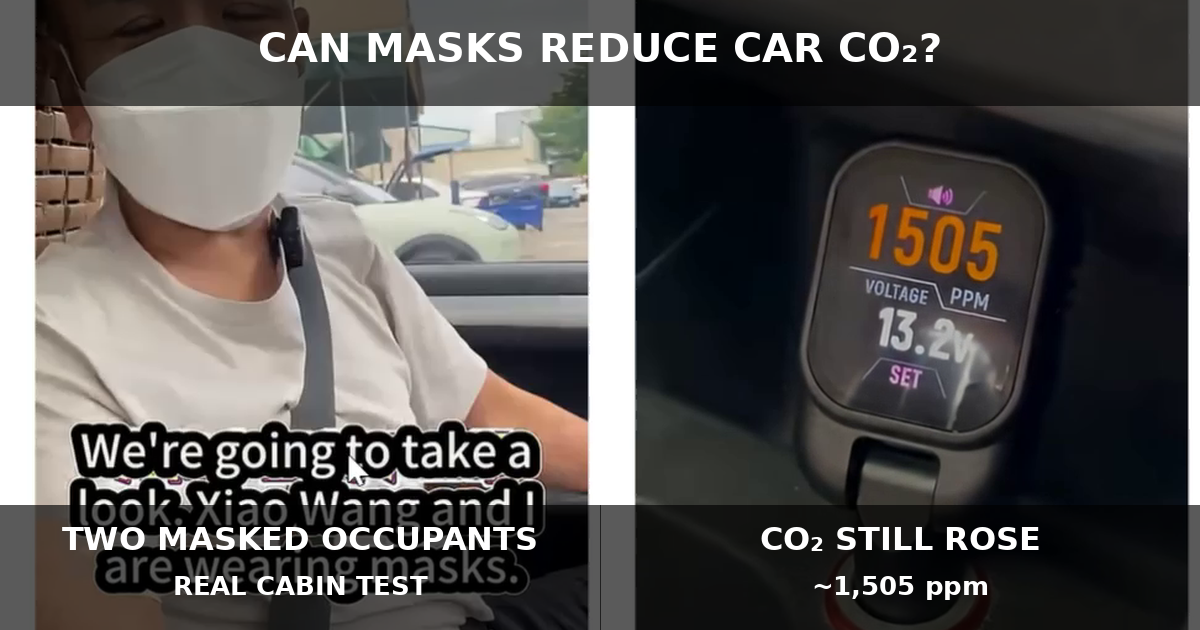
During the experiment, both of us were wearing face masks while we monitored the cabin with our EVO-CO2V.
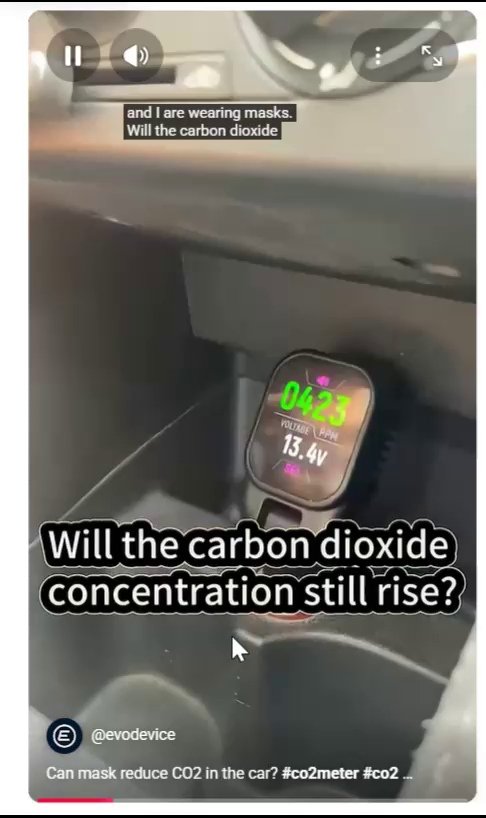
An early reading shown in our video was approximately:
423 ppm CO₂
As the test continued, the monitor showed approximately:
428 → 434 → 449 → 783 → 1,291 → 1,464 → 1,505 ppm
So under the conditions of our test, wearing masks did not prevent cabin CO₂ from continuing to rise.
Quick Answer
In our real-world test with two masked occupants, cabin CO₂ increased from approximately:
423 ppm
to:
1,505 ppm
That is an increase of roughly:
1,082 ppm
during the sequence shown.
This does not prove that masks caused the CO₂ increase.
Our narrower observation is:
The masks did not stop occupant-generated CO₂ from accumulating in the cabin under our test conditions.
Watch Our Real Mask-and-CO₂ Test
The video below shows both occupants wearing masks and the live EVO-CO2V readings as cabin CO₂ increased.
These measurements were recorded by our team during a real-world cabin test. With both occupants wearing masks, CO₂ still rose from about 423 ppm to about 1,505 ppm during the sequence shown.
Why We Tried This Experiment
Face masks cover the nose and mouth.
That can make it seem intuitive that perhaps some of the carbon dioxide we exhale might remain inside the mask instead of entering the cabin.
So we wanted to see what happened to the ambient CO₂ concentration inside the vehicle while both occupants were masked.
The distinction between these two things is important:
CO₂ immediately behind a mask is not the same measurement as CO₂ in the cabin air.
Our EVO-CO2V was measuring the cabin environment, not the tiny airspace between a person’s face and mask.
How We Ran the Test
Two people were inside the vehicle.
Both of us were wearing masks.
We monitored cabin CO₂ with the EVO-CO2V.
An early reading was approximately:
423 ppm
The concentration then increased gradually through readings including:
428 ppm
then:
434 ppm
then:
449 ppm
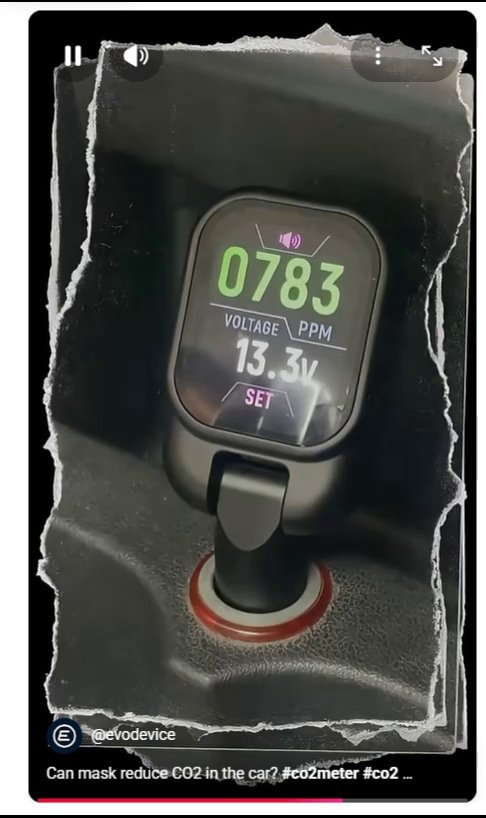
Later, the increase became much clearer:
783 ppm
then:
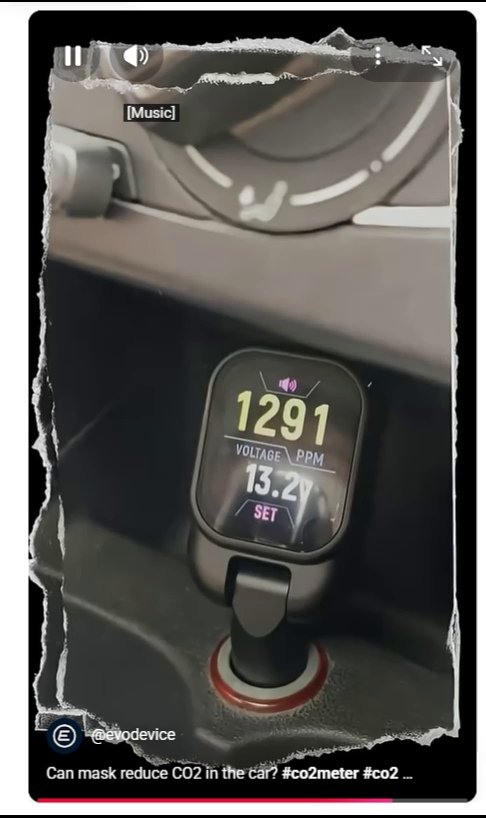
1,291 ppm
then:
1,464 ppm
and eventually:
1,505 ppm
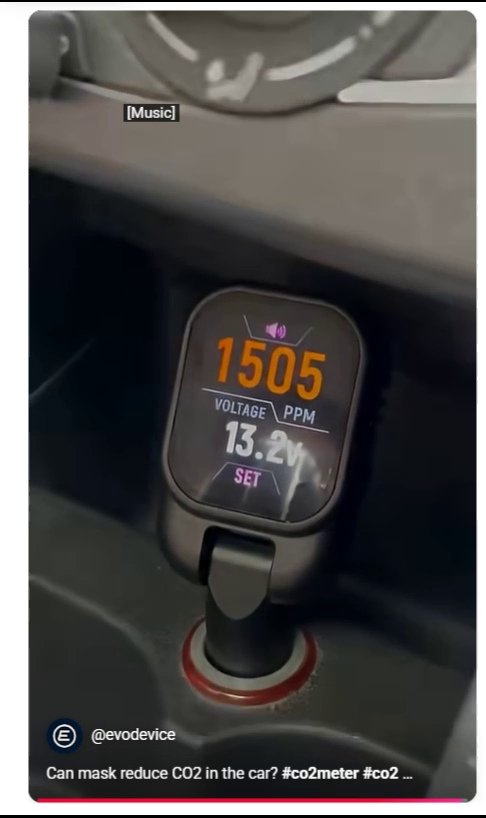
The video is edited, so we do not use the apparent video duration to calculate a precise ppm-per-minute rise.
Our conclusion is based on the actual readings shown.
What We Actually Observed
Both occupants were wearing masks.
Yet cabin CO₂ still increased from roughly:
423 ppm
to:
1,505 ppm
So the masks did not act as a meaningful CO₂-removal system for the cabin.
That makes sense when we consider what ordinary masks and particulate respirators are designed to do.
Masks Filter Particles—CO₂ Is a Gas
NIOSH explains that filtering facepiece respirators such as N95s are designed primarily to remove airborne particles.
They do not provide protection against gases or vapors. NIOSH guidance on filtering facepiece respirators
Carbon dioxide is a gas.
So we should not think of a normal face mask as a filter that captures exhaled CO₂ and prevents it from entering the surrounding cabin air.
Exhaled air still moves through and around the mask.
That means the CO₂ produced by breathing can still become part of the air inside the vehicle.
What About CO₂ Behind the Mask?
This is a different question.
Some studies have measured higher CO₂ concentrations in the small airspace immediately behind a mask compared with the surrounding air. One study of 261 mask users, for example, found higher measurements behind masks than in front of them. study of CO₂ levels behind face masks
But that does not mean the mask removes CO₂ from the cabin.
It means the local breathing microenvironment near the face can differ from the room or vehicle air.
For our experiment, we were interested in:
What happens to the CO₂ concentration in the car itself?
And our cabin monitor showed a clear rise.
Does Wearing a Mask Cause Dangerous CO₂ Buildup in the Body?
That is also not what our experiment tested.
Research on the physiological effects of mask wearing is mixed depending on mask type, activity level and measurement method.
A 2024 systematic review and meta-analysis of 29 studies found no significant overall difference between wearing no mask and wearing surgical or N95 masks in the CO₂ outcomes it analyzed. systematic review and meta-analysis of mask-related CO₂ outcomes
A broader 2025 evidence review also concluded that many reported physiological changes were small, while the certainty of evidence for several outcomes remained limited. evidence review of physiological effects of face masks
So we would not use our car experiment to make claims about blood CO₂, oxygen saturation or the medical safety of mask wearing.
We measured cabin air CO₂ only.
Why Did Cabin CO₂ Keep Rising?
People continuously produce carbon dioxide through metabolism and exhale it with every breath.
Inside a relatively small car cabin, the CO₂ concentration depends heavily on the balance between:
CO₂ generated by occupants
and:
CO₂ removed through ventilation and air exchange
The masks did not eliminate the CO₂ being exhaled into the cabin.
If ventilation is not removing CO₂ quickly enough, the concentration can still rise.
That is exactly what we observed.
Masks and Ventilation Solve Different Problems
This is one of the most useful lessons from this experiment.
A face mask and a ventilation system are doing different jobs.
A mask can reduce exposure to certain particles or droplets depending on its type, filtration and fit. NIOSH specifically describes N95-style filtering facepiece respirators as particle filters. NIOSH guidance on filtering facepiece respirators
Fresh-air ventilation does something different:
It replaces some of the cabin air with outside air.
That is why wearing masks should not be treated as a substitute for adequate cabin ventilation when the question is CO₂ accumulation.
Related Test: What Happens With More Occupants?
We have previously tested how quickly cabin CO₂ rose with between one and five occupants.
That experiment showed how strongly occupancy can influence CO₂ buildup under the particular conditions we tested.
Related Test: Recirculation vs Fresh Air
In another real driving test, we saw cabin CO₂ fall from approximately:
2,150 ppm
toward:
500 ppm
after changing from recirculation to outside-air ventilation.
That test illustrates why ventilation can have a much larger effect on cabin CO₂ than simply whether occupants are wearing masks.
Related Test: Fan Speed in Fresh-Air Mode
We also tested four occupants with outside-air mode selected at different fan levels.
At fan level 1, CO₂ rose from about:
524 ppm to 866 ppm
while at fan level 4, later readings remained around the high-400 ppm range.
Together, these tests suggest that air exchange and occupancy matter greatly when interpreting vehicle CO₂.
CO₂ Is Not Carbon Monoxide
This experiment measured:
Carbon dioxide — CO₂
It did not measure:
Carbon monoxide — CO
The EVO-CO2V is a vehicle CO₂ monitor.
It does not detect:
- CO;
- NO₂;
- VOCs;
- particulate matter;
- pathogens.
A CO₂ reading therefore does not tell us whether those other substances are present or absent.
About the 1,400 ppm Alert
During the later part of the test, cabin CO₂ moved above the EVO-CO2V’s configured alert level of approximately:
1,400 ppm
That is why readings such as 1,464 ppm and 1,505 ppm appear in the alert range.
The 1,400 ppm setting is our monitor’s practical alert point.
We do not present it as a universal medical boundary between “safe” and “unsafe.”
What This Test Does Not Prove
Our experiment does not prove that:
- masks cause cabin CO₂ to rise;
- masks increase the rate of cabin CO₂ buildup;
- wearing no mask would have produced a different cabin curve;
- mask use is medically harmful;
- every vehicle will reach 1,500 ppm at the same speed.
We did not run a matched no-mask control under identical conditions.
A stronger future experiment would compare:
Run A — two occupants without masks
with:
Run B — the same occupants wearing masks
while keeping ventilation, fan speed, route and starting CO₂ as similar as possible.
Only then could we examine whether mask wearing measurably changed the cabin CO₂ curve.
Our current result supports a narrower conclusion:
Wearing masks did not prevent cabin CO₂ from rising in our car test.
Our Takeaway
Our test began around:
423 ppm
and eventually reached approximately:
1,505 ppm
even though both occupants were wearing masks.
For us, the practical takeaway is simple:
Masks and vehicle ventilation are not substitutes for one another.
A mask may serve a particle- or droplet-related purpose depending on its design.
But when we want to understand CO₂ accumulation in the cabin, we still need to pay attention to actual air exchange and the CO₂ reading itself.
Leave a Reply