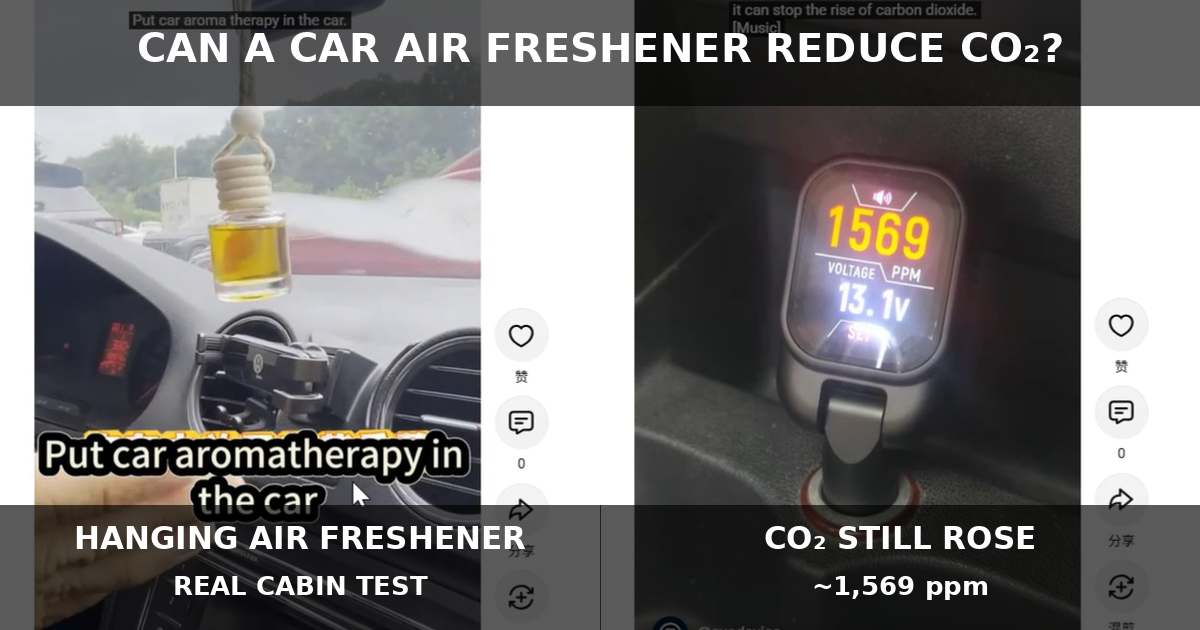
A car air freshener can make the cabin smell different.
But can it actually affect the amount of carbon dioxide in the air?
We wanted to test that question ourselves.
We hung a liquid car fragrance inside the vehicle and monitored cabin CO₂ using our EVO-CO2V.
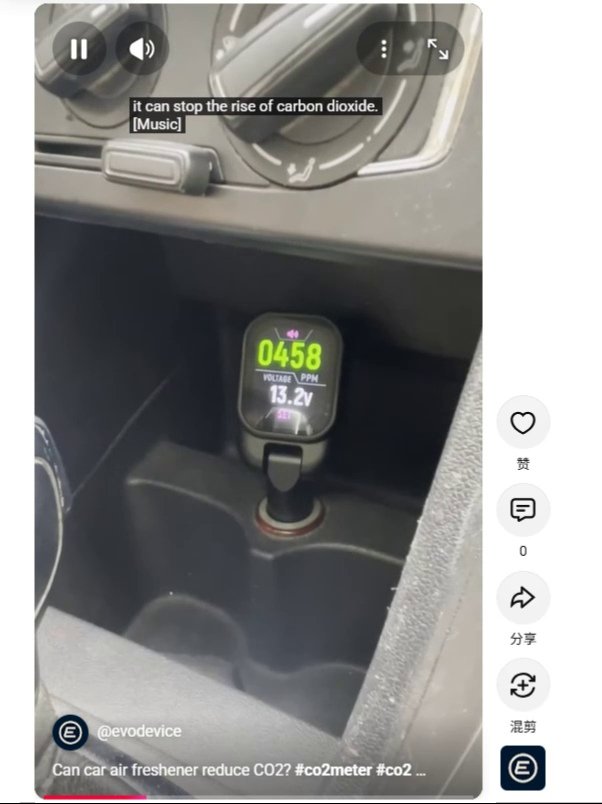
An early reading in our test was approximately:
458 ppm CO₂
As the test continued, the monitor showed approximately:
463 → 600 → 640 → 982 → 1,164 → 1,274 → 1,535 → 1,569 ppm
So under the conditions of our test, the car air freshener did not prevent cabin CO₂ from continuing to rise.
Quick Answer
In our real-world test:
| Test stage | Cabin CO₂ |
|---|---|
| Early reading | ~458 ppm |
| Later | ~463 ppm |
| Later | ~600 ppm |
| Later | ~640 ppm |
| Later | ~982 ppm |
| Later | ~1,164 ppm |
| Later | ~1,274 ppm |
| Later | ~1,535 ppm |
| Highest reading shown | ~1,569 ppm |
The difference between the early and highest readings shown was approximately:
1,111 ppm
Our conclusion is narrow:
The car air freshener did not stop cabin CO₂ from rising during our test.
We are not claiming that every fragrance product has identical chemistry or behavior.
Watch Our Real Air-Freshener-and-CO₂ Test
The video below shows the actual hanging car fragrance and the live EVO-CO2V readings during our experiment.
These measurements were recorded by our team during a real-world cabin test. With the car air freshener hanging inside the vehicle, CO₂ still rose from about 458 ppm to about 1,569 ppm during the sequence shown.
Why We Tried This Experiment
A car fragrance can make the cabin smell fresher.
That can create an intuitive impression that the air itself has somehow become “fresher.”
We wanted to separate those two ideas.
Does changing the smell of cabin air also reduce its CO₂ concentration?
Instead of judging by smell, we measured the CO₂ directly.
How We Ran the Test
We placed a hanging liquid car air freshener inside the cabin.
We then monitored the cabin with our EVO-CO2V.
An early reading shown in the video was approximately:
458 ppm
A later reading was approximately:
463 ppm
The concentration then continued increasing:
600 ppm
then:
640 ppm
then:
982 ppm
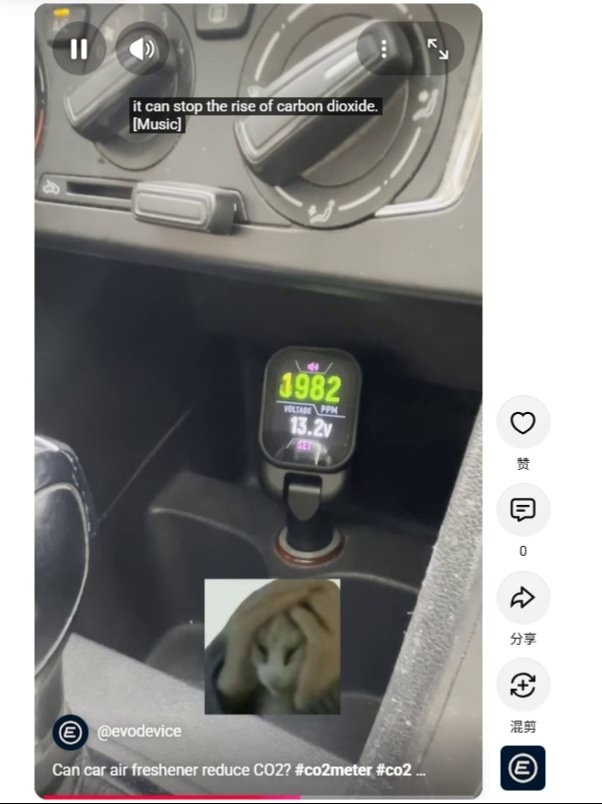
then:
1,164 ppm
then:
1,274 ppm
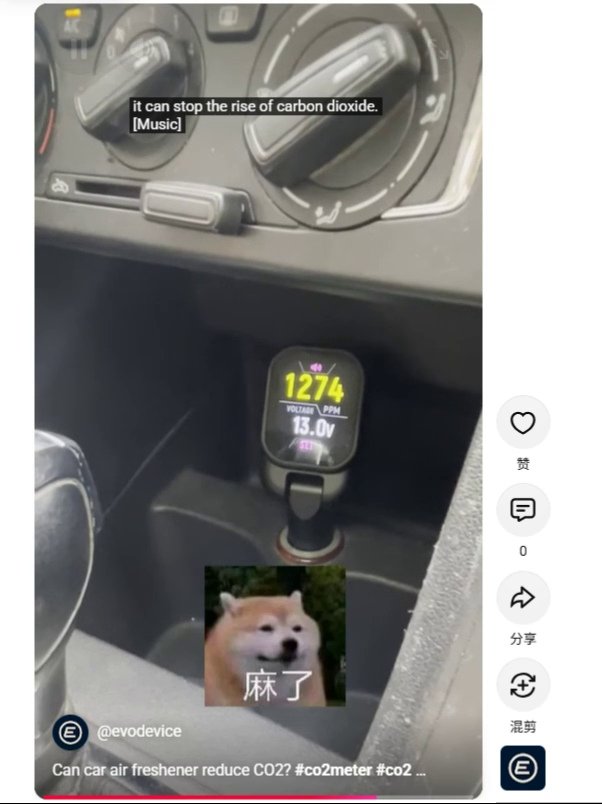
and later:
1,535 ppm
before reaching approximately:
1,569 ppm
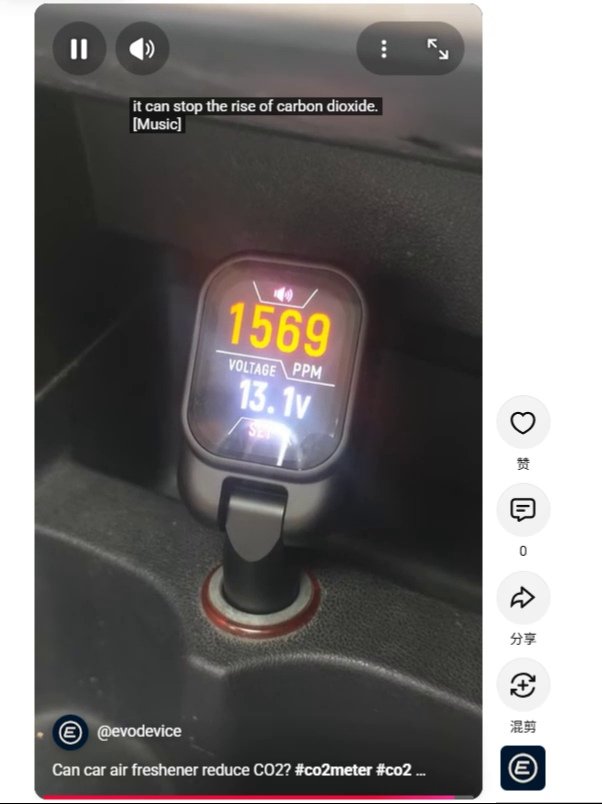
The video is edited, so we do not use its apparent running time to calculate an exact ppm-per-minute increase.
We base our conclusion only on the actual readings shown.
What We Actually Observed
The presence of the air freshener did not stabilize cabin CO₂.
Instead, the monitor increased from roughly:
458 ppm
to:
1,569 ppm
during the sequence shown.
That is an increase of approximately:
1,111 ppm
So whatever the air freshener was doing to the cabin odor, it was not removing CO₂ fast enough to prevent the concentration from increasing in our experiment.
Smell and CO₂ Are Different Things
This is probably the most useful lesson from the test.
An air freshener mainly changes what we smell.
CO₂ is a different gas and cannot be judged reliably by how pleasant or unpleasant the cabin smells.
A cabin may smell pleasant while CO₂ is still increasing.
Likewise, a cabin can have an unpleasant odor even when its CO₂ level is relatively low.
That is why we prefer to measure CO₂ rather than use smell as a substitute.
An Air Freshener Does Not Create Fresh-Air Ventilation
Fresh-air ventilation physically brings outside air into the cabin and allows some cabin air to leave.
A hanging fragrance does not perform that function.
EPA notes that indoor CO₂ measurements can provide useful information about ventilation when interpreted in context. Occupant respiration is an important indoor CO₂ source, so increasing outdoor-air exchange can dilute accumulated CO₂. EPA guidance on indoor CO₂ and ventilation
This is fundamentally different from simply adding a scented product to the cabin.
Air Fresheners Can Also Be a Source of Other Compounds
There is another important distinction.
Some air fresheners and fragrance products can release volatile organic compounds, or VOCs. EPA lists air fresheners among indoor sources of VOCs and notes that the composition and effects of individual VOCs vary considerably. EPA guidance on VOCs and air fresheners
EPA guidance on VOCs and air fresheners
But we did not measure VOCs in this experiment.
So we cannot say anything about the VOC concentration produced by the specific fragrance shown in our video.
Our EVO-CO2V was measuring CO₂ only.
A Pleasant Smell Does Not Tell Us the Ventilation Rate
This matters because our senses can be misleading.
After putting an air freshener in a vehicle, the cabin may immediately smell different.
But that change does not tell us:
- how much outside air is entering;
- how many air changes are occurring;
- how much CO₂ is present;
- whether VOCs are present;
- whether other pollutants have increased or decreased.
For us, fragrance and ventilation are therefore two separate questions.
Why Did CO₂ Continue to Rise?
People inside a vehicle continuously produce CO₂ through metabolism and release it through exhaled breath.
Inside a relatively small cabin, the concentration depends on the balance between:
CO₂ generated by occupants
and:
CO₂ removed through ventilation and other processes
If removal is slower than generation, cabin CO₂ rises.
EPA similarly notes that exhaled breath from occupants is an important indoor source of CO₂ and that CO₂ measurements can, under appropriate conditions, provide information about ventilation. EPA indoor air quality guidance on CO₂ and ventilation
Our air freshener did not change that basic balance enough to prevent the rise we recorded.
Related Test: Can Plants Reduce Cabin CO₂?
We have tested another intuitive idea: placing several green plants inside the car.
Plants really do absorb CO₂ through photosynthesis.
But in our test, cabin CO₂ still rose from approximately:
432 ppm to 1,506 ppm
Related Test: Can Water Reduce Cabin CO₂?
CO₂ can also dissolve in water.
So we placed a large open container of water inside the vehicle.
In that experiment, our reading still rose from approximately:
792 ppm to 1,516 ppm
Related Test: What Actually Happens When We Bring in Fresh Air?
We have also tested an approach that directly changes the cabin air exchange.
In one real driving test, cabin CO₂ fell from approximately:
2,150 ppm
toward:
500 ppm
after we changed from recirculation to outside-air ventilation.
This illustrates the difference between changing the smell of the air and actually replacing some of the air.
CO₂ Is Not VOC
This distinction is especially important in an air-freshener experiment.
Our EVO-CO2V measured:
Carbon dioxide — CO₂
It did not measure:
- VOCs;
- fragrance chemicals;
- formaldehyde;
- particulate matter;
- carbon monoxide;
- nitrogen dioxide.
Therefore, a rising CO₂ value does not tell us whether VOCs increased or decreased.
And a pleasant fragrance does not tell us whether CO₂ increased or decreased.
They are different measurements.
CO₂ Is Also Not Carbon Monoxide
CO₂ and CO are different gases.
The EVO-CO2V is a carbon dioxide monitor.
It is not a carbon-monoxide detector.
Nothing in this test should be interpreted as measuring CO or vehicle exhaust gases.
About the 1,400 ppm Alert
Toward the end of our test, readings such as:
1,535 ppm
and:
1,569 ppm
were above the EVO-CO2V’s configured alert point of approximately:
1,400 ppm
That value is our monitor’s practical alert setting.
We do not present it as a universal medical dividing line between “safe” and “unsafe.”
What This Test Does Not Prove
Our experiment does not establish that:
- every car air freshener behaves identically;
- the fragrance absorbed zero CO₂;
- the fragrance caused CO₂ to increase;
- the product increased or reduced VOCs;
- the same vehicle would reach 1,569 ppm at the same rate every time.
We did not run a matched control test without the fragrance.
So we cannot determine whether the fragrance changed the rate of CO₂ buildup by a very small amount.
Our direct observation is simpler:
With the air freshener present, cabin CO₂ still rose substantially from about 458 ppm to about 1,569 ppm.
How We Would Improve This Experiment
A stronger follow-up experiment would compare two matched runs:
Run A — No air freshener
Same vehicle, occupants, HVAC setting and starting CO₂.
Run B — Air freshener present
Repeat under as similar conditions as possible.
We would record:
- number of occupants;
- ventilation mode;
- fan level;
- outside CO₂;
- cabin temperature;
- elapsed time;
- vehicle speed.
If we wanted to study the fragrance itself, we would also need a separate instrument capable of measuring relevant VOCs.
That would answer two different questions:
Does the fragrance affect cabin CO₂ buildup?
and:
What compounds does the fragrance add to the cabin air?
Our current experiment only addresses the first one observationally.
Our Takeaway
The car smelled different after we added the fragrance.
But the CO₂ reading told a different story.
During our test, cabin CO₂ rose from about:
458 ppm
to about:
1,569 ppm
So for us, the lesson is simple:
A fresher smell is not the same thing as fresher ventilation.
If we want to know what is happening with cabin CO₂, we would rather measure the gas directly than judge the air by smell.
Leave a Reply