Car air purifiers are designed to make the air inside a vehicle feel cleaner.
Depending on the model, they may target particles, odors, microorganisms, or certain gases.
But we wanted to test a different question:
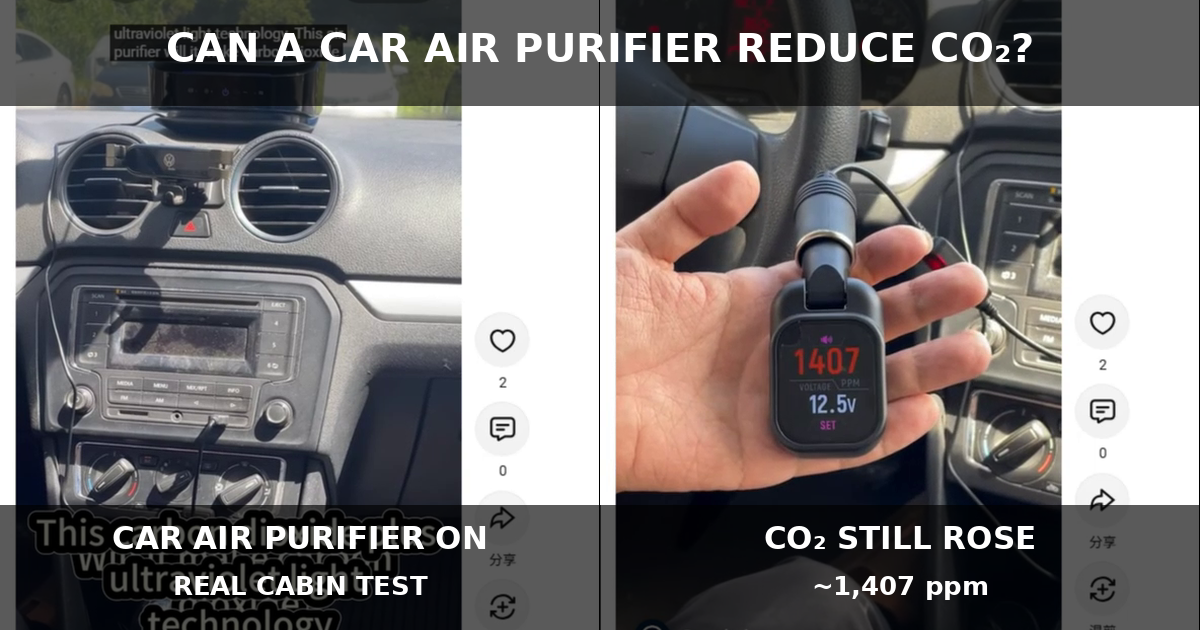
Can a car air purifier keep cabin CO₂ from rising?
We placed a compact air purifier inside the vehicle and monitored cabin carbon dioxide with our EVO-CO2V.
During the recorded test, the readings increased from approximately:
735 ppm
to approximately:
1,407 ppm
So under the conditions of our test, the air purifier did not prevent cabin CO₂ from continuing to rise.
Quick Answer
During the sequence shown in our video, we recorded approximately:
| Test stage | Cabin CO₂ |
|---|---|
| Early reading | 735 ppm |
| Later | 834 ppm |
| Later | 896 ppm |
| Later | 967 ppm |
| Later | 1,058 ppm |
| Later | 1,164 ppm |
| Later | 1,230 ppm |
| Later | 1,304 ppm |
| Later | 1,360 ppm |
| Highest reading shown | 1,407 ppm |
The difference between the early and highest readings shown was approximately:
672 ppm
Our conclusion is deliberately narrow:
This car air purifier did not stop cabin CO₂ from rising during our test.
That does not mean every possible air-cleaning system behaves the same way.
Watch Our Real Car-Air-Purifier-and-CO₂ Test
The video below shows the air purifier running inside the vehicle and the live EVO-CO2V readings.
These measurements were recorded by our team during a real-world cabin test. With the car air purifier operating, cabin CO₂ still rose from about 735 ppm to about 1,407 ppm during the sequence shown.
Why We Tried This Experiment
The term “air purifier” can easily create the impression that the machine cleans everything in the air.
But indoor air contains many different types of contaminants.
Some are particles.
Some are gases.
Some are microorganisms.
CO₂ is a gas, and removing it requires a process that actually captures, reacts with, or replaces that gas.
So we wanted to see what happened to cabin CO₂ while this purifier was operating.
How We Ran the Test
We operated the car air purifier inside the cabin.
At the same time, we monitored carbon dioxide with our EVO-CO2V.
An early reading visible in the video was approximately:
735 ppm
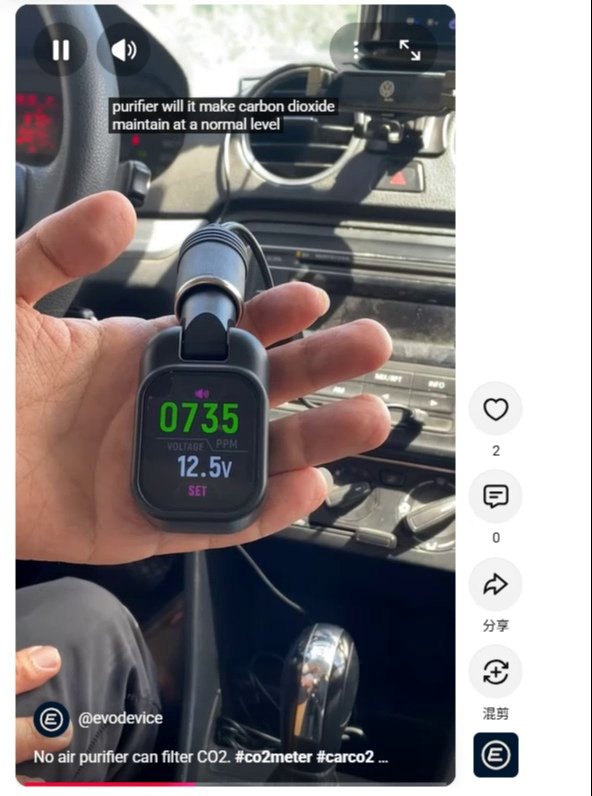
The reading then increased to approximately:
834 ppm
then:
896 ppm
then:
967 ppm
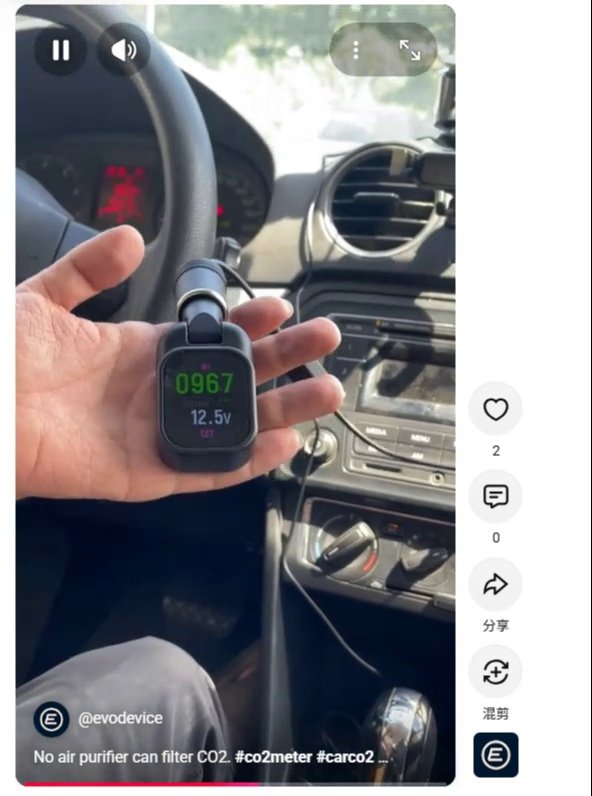
and later:
1,058 ppm
followed by:
1,164 ppm
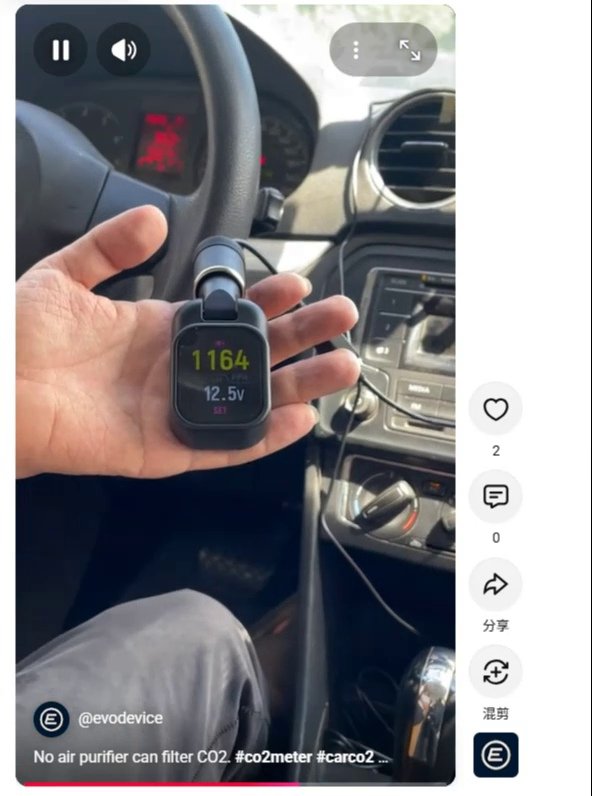
then:
1,230 ppm
then:
1,304 ppm
then:
1,360 ppm
before reaching approximately:
1,407 ppm
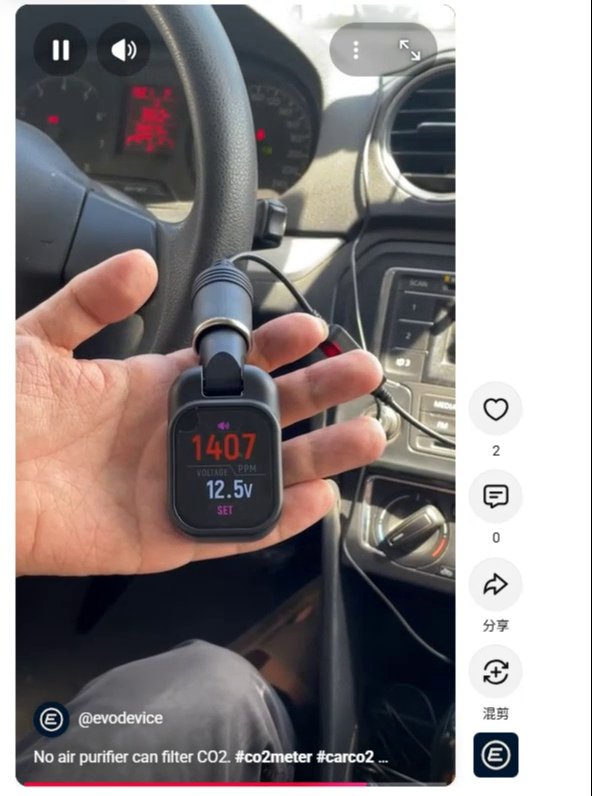
The video is edited, so we do not use its apparent playback time to calculate an exact CO₂ increase per minute.
Our conclusion is based on the readings actually shown.
What We Observed
The air purifier was operating, but the cabin CO₂ concentration still increased substantially.
The recorded sequence went from roughly:
735 ppm
to:
1,407 ppm
That is an increase of about:
672 ppm
Therefore, under the conditions of this experiment, the purifier did not remove CO₂ fast enough to prevent cabin accumulation.
Air Purifiers Do Not All Remove the Same Pollutants
This distinction is important.
EPA explains that most air-cleaning filters are designed either for particles or for gases. Gas-removal filters must be designed for the particular gases they are intended to capture, and their effectiveness depends on the media and operating conditions. EPA guide to air cleaners and gas filtration
That is much more accurate than saying:
“Every air purifier removes gases.”
or:
“No air purifier can ever remove CO₂.”
Neither statement is sufficiently precise.
What About UV Technology?
The purifier shown in our video was discussed as using air-cleaning technology that included UV.
UV technology may be useful for certain biological contaminants, depending on the design.
But UV light by itself should not automatically be interpreted as a CO₂-removal mechanism.
EPA notes that UVGI systems are primarily intended to inactivate microorganisms, and it also states that research has not shown UV, plasma, or photocatalytic technologies to effectively remove gases in typical portable residential air cleaners. EPA guidance on UV and portable air cleaners
We did not independently analyze the internal filter media or chemistry of the specific purifier in this video.
So our test evaluates only what happened to cabin CO₂ while the device was operating.
Filtering Particles Is Different From Removing CO₂
A particle filter works by capturing suspended material as air passes through it.
Examples include:
- dust;
- pollen;
- smoke particles;
- some airborne biological particles.
CO₂ is different.
It is a gas made of individual molecules dispersed throughout the air.
A standard particle filter is therefore not the same thing as a CO₂ scrubber.
EPA similarly distinguishes particle filtration from gas-phase filtration. US EPA
Specialized CO₂ Removal Systems Do Exist
This is why we should avoid the absolute statement:
“No air purifier can filter CO₂.”
Specialized systems can use chemical sorbents, reactive materials, or other processes specifically designed to remove carbon dioxide.
These systems are used in applications very different from a typical small consumer car purifier.
Our test therefore does not establish that CO₂ can never be removed from air.
It shows something much more specific:
The car air purifier we tested did not prevent cabin CO₂ from rising from about 735 ppm to about 1,407 ppm under our test conditions.
Why Did Cabin CO₂ Continue to Rise?
People continuously produce CO₂ through metabolism and release it in exhaled breath.
Inside a relatively small enclosed vehicle cabin, CO₂ concentration depends on the balance between:
CO₂ entering the cabin air from occupants
and
CO₂ leaving through ventilation or being removed by another process
If generation is greater than removal, the concentration rises.
An air purifier that recirculates cabin air does not necessarily bring outside air into the vehicle.
That is an important distinction.
Air Cleaning and Ventilation Are Different
An air purifier can circulate and treat air already inside a space.
Ventilation exchanges indoor air with outside air.
Those are not the same process.
EPA describes source control and ventilation with clean outdoor air as key methods for improving indoor air quality, while filtration can serve as an additional tool. US EPA
This is especially relevant for cabin CO₂.
If people are continuously adding CO₂ to the cabin, replacing some cabin air with outside air can directly change the CO₂ balance.
Related Test: Recirculation vs Fresh Air
In another driving test, we measured cabin CO₂ at approximately:
2,150 ppm
before switching toward outside-air ventilation.
The reading later fell toward:
500 ppm
Related Test: Does Fan Speed Matter?
We also tested four occupants while the HVAC system was using outside-air mode.
At fan level 1, CO₂ rose from approximately:
524 ppm to 866 ppm
while at fan level 4, readings remained around the high-400 ppm range during the observed sequence.
Related Test: Can an Air Freshener Reduce CO₂?
We also tested a hanging car fragrance.
During that experiment, cabin CO₂ rose from approximately:
458 ppm
to:
1,569 ppm
CO₂ Is Not the Same as Particulate Matter
Our EVO-CO2V measured:
Carbon dioxide — CO₂
It did not measure:
- PM2.5
- PM10
- pollen
- smoke particles
- bacteria
- viruses
- VOCs
- formaldehyde
Therefore, this test cannot tell us whether the air purifier reduced any of those pollutants.
The purifier could potentially affect another pollutant even while cabin CO₂ continued rising.
That is why we should not describe the purifier as “ineffective” overall based only on this CO₂ test.
CO₂ Is Also Not Carbon Monoxide
CO₂ and CO are different gases.
The EVO-CO2V measures:
CO₂
It is not a carbon-monoxide detector.
Nothing in this experiment should be interpreted as measuring CO, engine exhaust, or combustion safety.
About the 1,400 ppm Alert
Near the end of the video, the reading reached approximately:
1,407 ppm
That crossed the EVO-CO2V configured alert level of approximately:
1,400 ppm
This is our device’s practical notification setting.
We do not present 1,400 ppm as a universal medical boundary between “safe” and “unsafe.”
What This Test Does Not Prove
This experiment does not establish that:
- all air purifiers behave identically;
- the purifier removed zero CO₂ molecules;
- the purifier caused the CO₂ increase;
- the purifier failed to remove particles or other pollutants;
- UV technology is ineffective for every application;
- CO₂ cannot be removed using specialized equipment.
We also did not run a matched control test with the purifier turned off.
Therefore, we cannot determine whether operating the purifier changed the exact rate of CO₂ buildup.
What we directly observed was:
With the car air purifier operating, cabin CO₂ still increased from about 735 ppm to about 1,407 ppm.
How We Would Improve the Experiment
A stronger follow-up experiment would use two matched runs.
Run A — Air purifier OFF
Same vehicle, occupants, HVAC mode, fan setting and starting CO₂.
Run B — Air purifier ON
Repeat the same conditions as closely as possible.
We would also record:
- number of occupants;
- outside-air or recirculation mode;
- HVAC fan speed;
- outside CO₂;
- cabin temperature;
- elapsed time;
- vehicle speed.
This would allow us to compare whether operating the purifier measurably changed the rate of cabin CO₂ buildup.
Our Takeaway
The term “air purifier” does not mean that every substance in cabin air is being removed.
In our test, the purifier was operating while cabin CO₂ increased from about:
735 ppm
to about:
1,407 ppm
So the practical lesson from this experiment is:
Air purification and fresh-air ventilation are not the same thing.
For cabin CO₂, we prefer to measure the gas directly rather than assume that an operating air purifier is controlling it.
Leave a Reply