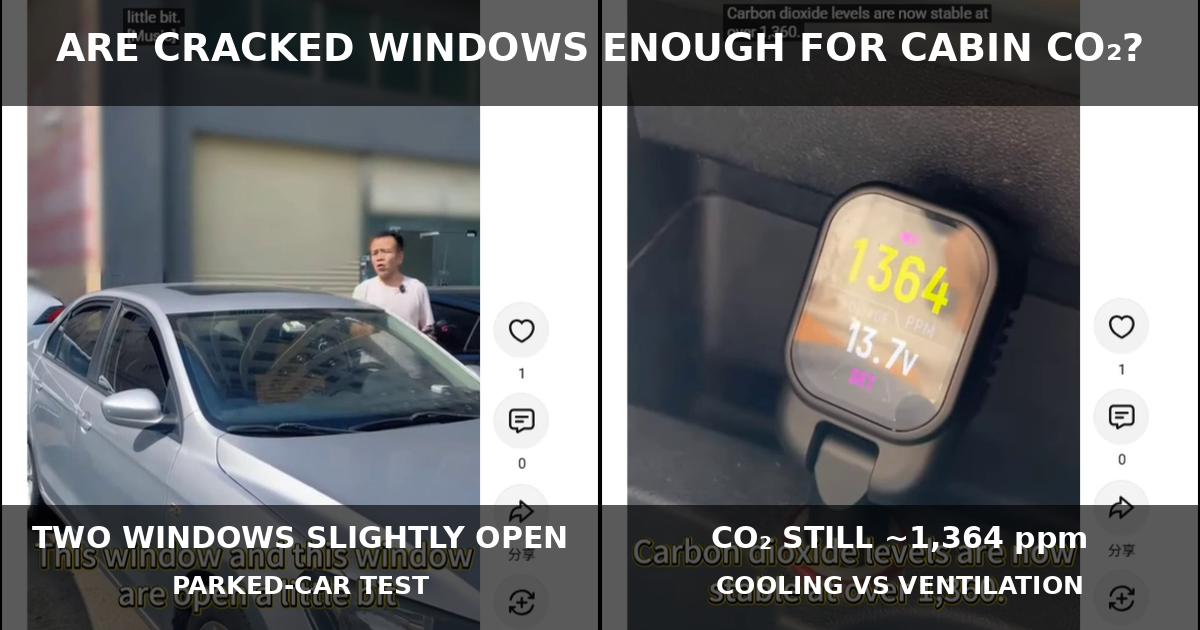
When sitting in a parked car for an extended period, opening the windows slightly seems like an obvious way to bring in fresh air.
But how much ventilation does a small window opening actually provide?
We tested this while using a parking air conditioner.
Two windows were left slightly open while we remained inside the parked vehicle.
After spending a long period in the cabin and talking, our EVO-CO2V showed approximately:
1,364 ppm CO₂
So under the conditions of our test, slightly opening two windows provided some connection with the outside air, but it did not keep cabin CO₂ close to outdoor levels.
Quick Answer
In our test:
- the vehicle was parked;
- a parking air conditioner was being tested;
- two windows were slightly open;
- one occupant remained inside for an extended period and talked during the test;
- cabin CO₂ eventually stabilized at roughly 1,360 ppm, with a visible reading of 1,364 ppm.
Our observation was therefore:
Small window openings provided ventilation, but cabin CO₂ still remained substantially above typical outdoor levels during our test.
This does not mean slightly opened windows are ineffective.
It means the amount of ventilation they provided under these specific conditions was not enough to keep CO₂ near the outdoor concentration.
Watch Our Real Parked-Car Ventilation Test
The video below shows the actual window openings, outdoor airflow measurement, parking air conditioner test, and EVO-CO2V reading.
Video published on YouTube: September 18, 2025
These measurements were recorded by our team during a real parked-car test. With two windows slightly open while the parking air conditioner was operating, cabin CO₂ was around the mid-1,300 ppm range, with the EVO-CO2V showing about 1,364 ppm.
Why We Ran This Test
When using a parking air conditioner, there is an obvious conflict.
Keeping the cabin closed helps retain cooled air.
Opening the windows improves natural air exchange, but it may also allow more warm outside air into the vehicle.
We wanted to see what happened when we tried a compromise:
Leave two windows slightly open instead of fully opening them.
Would that be enough to keep cabin CO₂ low while still preserving useful cooling?
How We Set Up the Test
Before getting into the vehicle, we measured the outdoor airflow with a handheld anemometer.
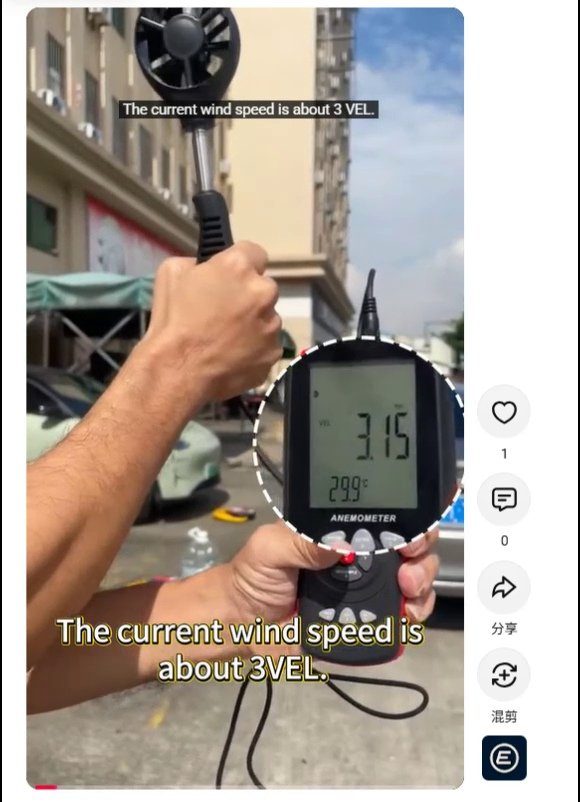
The display showed approximately:
3.15
Because the unit is not sufficiently clear in the recorded footage, we do not assign a unit to this value in our article.
We then left two car windows slightly open.

The vehicle remained parked while the parking air conditioner was operating.

We stayed inside for an extended period and talked during the test.
What We Measured Inside the Car
After we had been sitting and talking inside the vehicle for some time, the cabin CO₂ reading settled at a little above:
1,360 ppm
A close-up of the EVO-CO2V showed:
1,364 ppm CO₂
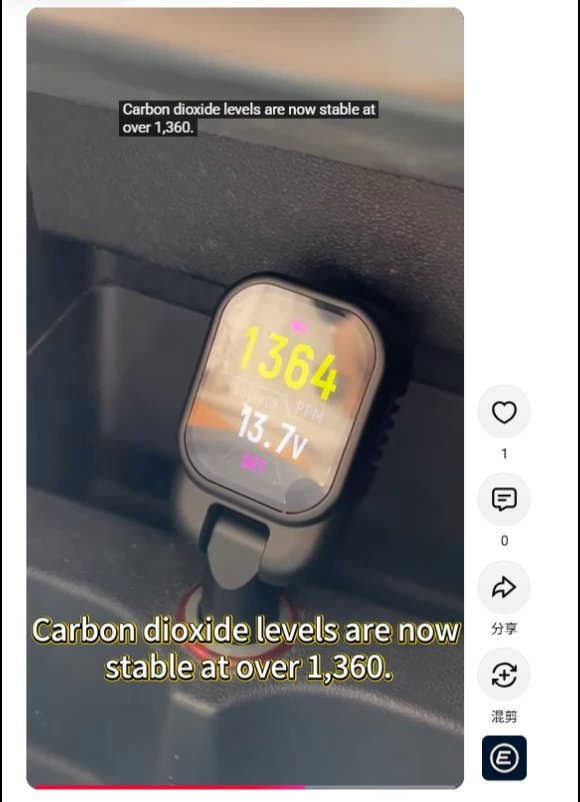
That was the key measurement in this experiment.
Unlike several of our earlier tests, this video was not primarily about how quickly CO₂ increased.
It was about the level that remained inside the parked cabin with limited window ventilation.
Slightly Open Windows Still Provide Ventilation
It would be incorrect to conclude that the small window openings were doing nothing.
Opening a window creates a path for air exchange.
EPA notes that indoor CO₂ can, when interpreted carefully, provide useful information about ventilation. EPA guidance on CO₂ and ventilation
Research performed directly in motor vehicles has also found that opening windows or operating ventilation fans can substantially affect cabin CO₂ concentrations. In one published vehicle study, CO₂ remained lower when windows were open and/or ventilation was operating compared with poorly ventilated conditions. vehicle cabin CO₂ and ventilation study
So our test should not be interpreted as:
“Cracking the windows does not work.”
The better interpretation is:
The small openings used in our test did not provide enough ventilation to keep cabin CO₂ near outdoor levels.
Why Window Opening Size Matters
A window is not simply either “open” or “closed.”
Air exchange can depend on:
- how far the window is opened;
- how many windows are open;
- which windows are open;
- outside wind;
- vehicle orientation;
- temperature differences;
- whether the vehicle is moving or parked.
Our vehicle was stationary.
That is important because a parked vehicle does not benefit from the airflow patterns created by normal driving speed.
We therefore should not assume that the same window opening would produce the same CO₂ result while driving.
Why Did CO₂ Remain Around 1,360 ppm?
The occupant inside the car continuously produced CO₂ through breathing.
Talking also continued during the test.
At the same time, outside air could enter through the partially opened windows.
The cabin CO₂ level therefore reflected a balance between:
CO₂ being added by the occupant
and
CO₂ being removed through air exchange
When those rates become similar, the concentration may stop climbing quickly and appear relatively stable.
In our video, the reading was sitting at a little over 1,360 ppm, including a clearly visible 1,364 ppm measurement.
We should not describe 1,364 ppm as a universal equilibrium value for cracked windows.
It was simply what we observed under this particular combination of vehicle, window openings, weather and occupant behavior.
Why Not Just Open the Windows More?
We tried that too.
Opening more windows increased the opportunity for outdoor air to enter the cabin.

But we immediately noticed another problem:
The cooling effect became much weaker.
That observation is subjective—we did not perform a controlled cooling-capacity measurement in this video.
So we should not claim an exact percentage loss in air-conditioning performance.
But it demonstrated the practical tradeoff we were interested in:
More ventilation can help air exchange, while larger openings can also make it harder to maintain a cool cabin.
Ventilation and Cooling Are Two Different Goals
This is the main lesson from the experiment.
A parking air conditioner is primarily designed to control temperature.
Ventilation controls the exchange of cabin air with outside air.
Those are not automatically the same function.
A system can cool recirculated cabin air very effectively without necessarily supplying enough outside air to control occupant-generated CO₂.
Likewise, opening windows can increase outside-air exchange but also increase the cooling load.
So the practical question is not simply:
“Should the windows be open or closed?”
It is:
How much outside-air exchange can we provide while still maintaining acceptable cabin comfort?
Opening More Windows Is Not Automatically Better in Every Situation
CO₂ is only one part of cabin air quality.
Opening windows also exposes the cabin more directly to outdoor conditions.
Vehicle studies have shown that window position can strongly influence the entry of outdoor particulate pollution and other contaminants. Open-window operation can reduce internally generated CO₂ while at the same time allowing more outdoor particles to enter, depending on the surrounding environment. vehicle window opening and cabin pollutant study
That means the best ventilation approach may depend on where the car is parked.
A quiet area with relatively clean outdoor air is different from:
- heavy traffic;
- a tunnel;
- a loading area;
- nearby idling vehicles;
- dusty roadside conditions.
Our video measured CO₂, not outdoor particulate pollution.
Related Test: Recirculation vs Fresh Air
In another test, we directly changed from recirculation to outside-air ventilation.
Cabin CO₂ fell from around:
2,150 ppm
toward:
500 ppm
Related Test: Does Fan Speed Matter?
We also tested four people with the HVAC system in fresh-air mode.
At low fan speed, CO₂ increased from approximately:
524 ppm to 866 ppm
while at the higher fan setting, readings remained around the high-400 ppm range during the observed sequence.
Related Test: How Fast Does CO₂ Rise With More Occupants?
We previously tested one to five people inside the same vehicle.
The time required to reach our 1,400 ppm reference level became progressively shorter as the number of occupants increased.
CO₂ Is Not a Complete Measure of Air Quality
The EVO-CO2V measured:
Carbon dioxide — CO₂
It did not measure:
- PM2.5;
- VOCs;
- carbon monoxide;
- nitrogen dioxide;
- humidity-related comfort;
- outside exhaust pollutants.
Therefore, lower CO₂ does not automatically mean every aspect of the cabin air is better.
Likewise, higher CO₂ does not tell us which other pollutants are present.
About the 1,400 ppm Alert
The measured value of approximately:
1,364 ppm
was close to the EVO-CO2V configured alert point of approximately:
1,400 ppm
That 1,400 ppm value is a practical alert setting used by our device.
We do not present it as a universal medical dividing line between “safe” and “unsafe.”
What This Test Does Not Prove
This experiment does not establish that:
- two cracked windows will always produce about 1,364 ppm;
- slightly opened windows are ineffective;
- 1,364 ppm is an equilibrium concentration for all parked cars;
- every parking air conditioner has the same ventilation characteristics;
- opening three windows reduces cooling by a specific percentage;
- the same result would occur in different wind conditions;
- the same result would occur with more occupants.
We tested one real-world configuration.
Our direct observation was simply:
With two windows slightly open while we occupied the parked vehicle, cabin CO₂ remained around the mid-1,300 ppm range during the later part of our test.
How We Would Improve This Experiment
A stronger follow-up would compare several matched configurations:
A — Windows fully closed
B — One window slightly open
C — Two windows slightly open
D — Two windows opened farther
E — Three or four windows partially open
For each condition, we would keep the same:
- occupant count;
- parking location;
- parking air conditioner setting;
- test duration;
- starting CO₂.
We would also record cabin temperature at the same time.
That would let us build two curves:
CO₂ vs window opening
and
Cabin temperature vs window opening
That would be much more useful for finding the practical balance between ventilation and cooling.
Our Takeaway
Our test showed why parked-car ventilation is not simply an “open or closed” question.
With two windows slightly open, the cabin was receiving some outside-air exchange.
But after we remained inside for an extended period and talked, the EVO-CO2V still showed approximately:
1,364 ppm CO₂
Opening more windows could improve air exchange, but in our test we also felt a clear reduction in cooling comfort.
So our takeaway is:
A small window opening can provide ventilation, but the opening needed to control cabin CO₂ may conflict with the amount of cooling you want to retain.
Leave a Reply