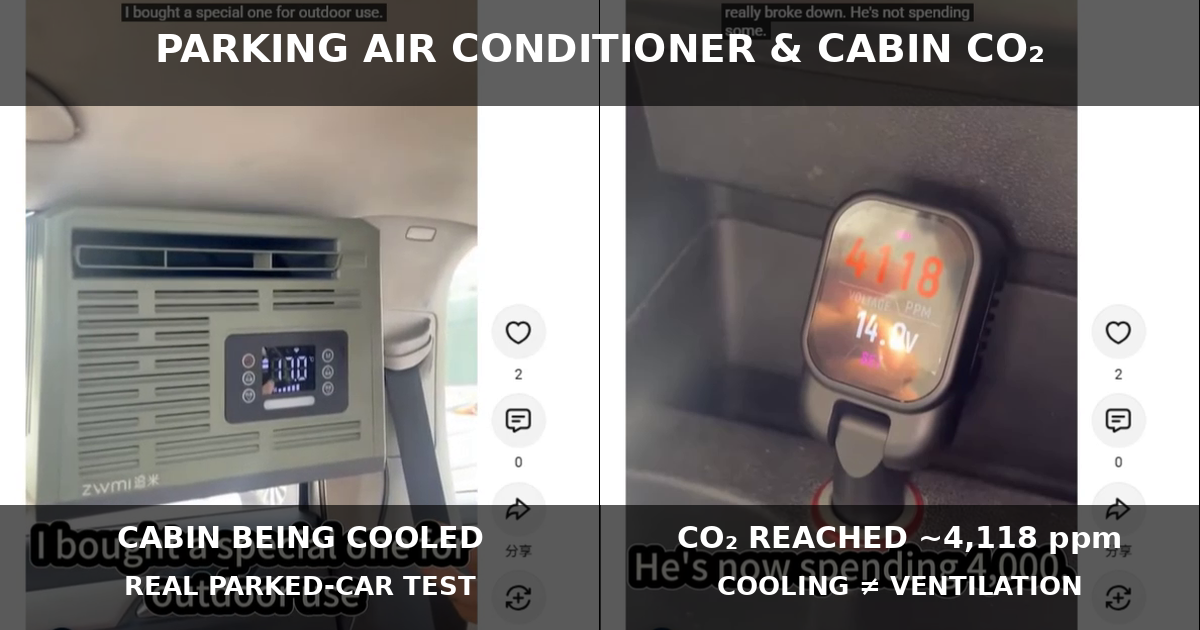
A parking air conditioner can make a parked vehicle much more comfortable in hot weather.
But cooling the cabin raises another question:
Does a parking air conditioner also provide enough fresh-air ventilation?
We tested this inside a parked vehicle while monitoring carbon dioxide with our EVO-CO2V.
During the test, one occupant fell asleep inside the cabin while the parking air conditioner continued operating.
When we checked the CO₂ monitor, the display visibly showed approximately:
When we checked the CO₂ monitor, the display visibly showed approximately:
3,458 ppm CO₂
Later in the same test, the EVO-CO2V showed an even higher reading of approximately:
4,118 ppm CO₂
The important observation was clear:
The cabin was being cooled, but CO₂ had still accumulated to several thousand ppm.
The important observation was clear:
The cabin was being cooled, but CO₂ had still accumulated to several thousand ppm.
Quick Answer
Our real-world test showed that a parking air conditioner can cool the interior without necessarily providing enough outside-air exchange to control occupant-generated CO₂.
The EVO-CO2V visibly showed approximately:
The EVO-CO2V visibly showed approximately 3,458 ppm, and later reached approximately 4,118 ppm CO₂ during the recorded sequence.
during the recorded sequence.
So our conclusion is:
Cooling and ventilation are two different functions.
We do not use this single test to claim that every parking air conditioner behaves identically.
Watch Our Real Parking-Air-Conditioner CO₂ Test
Video published on YouTube: September 19, 2025
During our parked-car test, the parking air conditioner continued cooling the cabin while the EVO-CO2V showed approximately 3,458 ppm CO₂ and later reached about 4,118 ppm.
Why We Ran This Test
A gasoline-powered vehicle presents a practical problem when parked.
If we do not want to keep the vehicle engine running simply to operate the original air-conditioning system, a separate parking air conditioner can provide cooling from another power source.
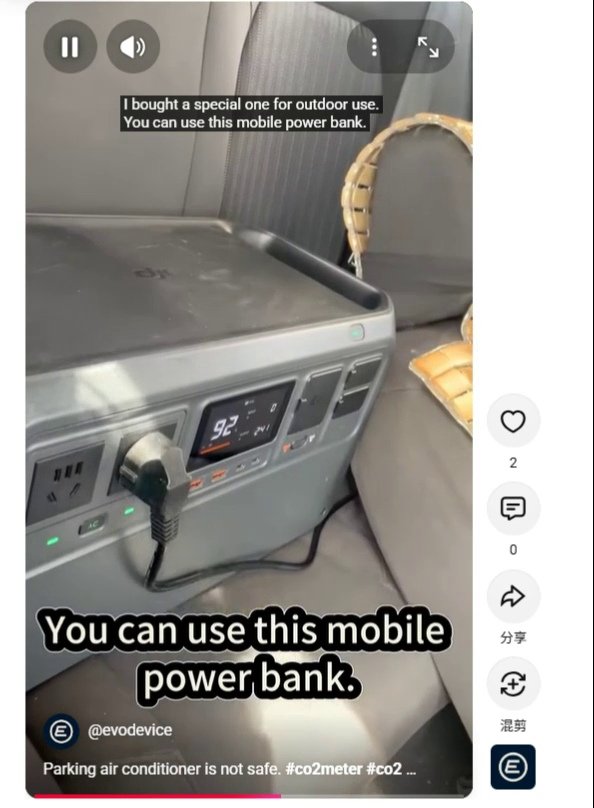
That is what we were testing.
The unit could cool the interior while the vehicle remained parked.
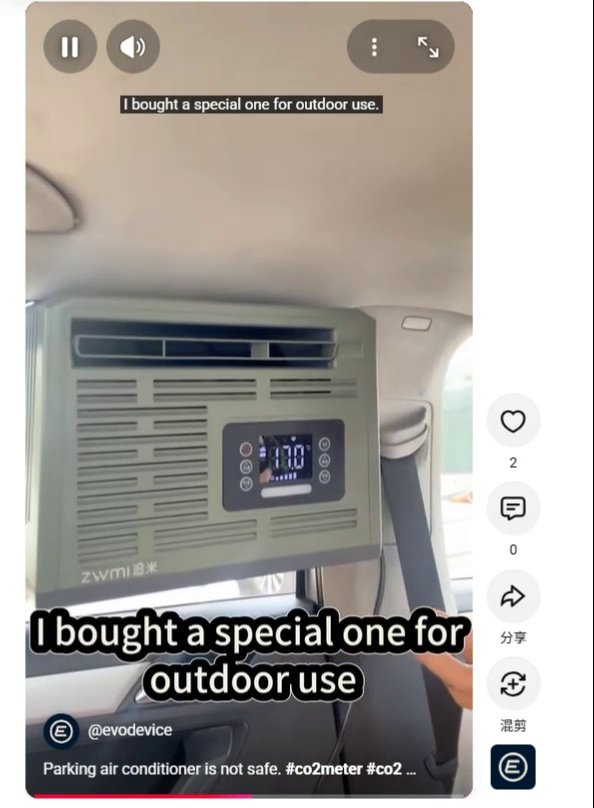
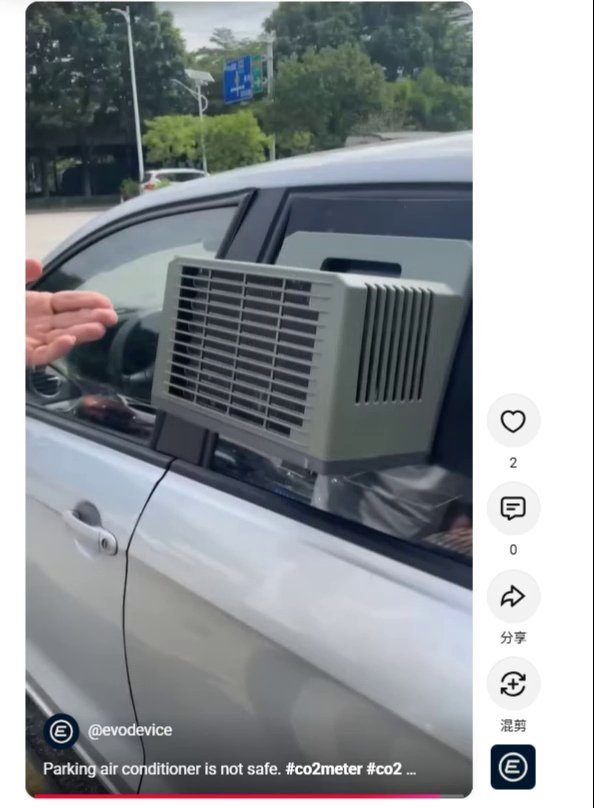
But after an occupant stayed inside long enough to fall asleep, we checked the cabin CO₂.
That produced a very different measurement from cabin temperature.
What the EVO-CO2V Showed
A close-up in the video clearly shows the EVO-CO2V at approximately:
3,458 ppm
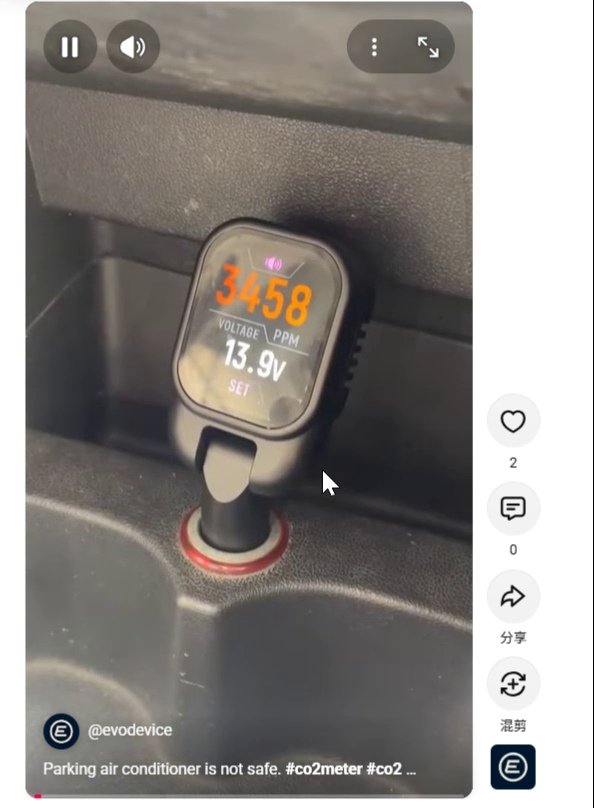
Later in the same video, the EVO-CO2V showed an even higher reading of approximately: 4,118 ppm
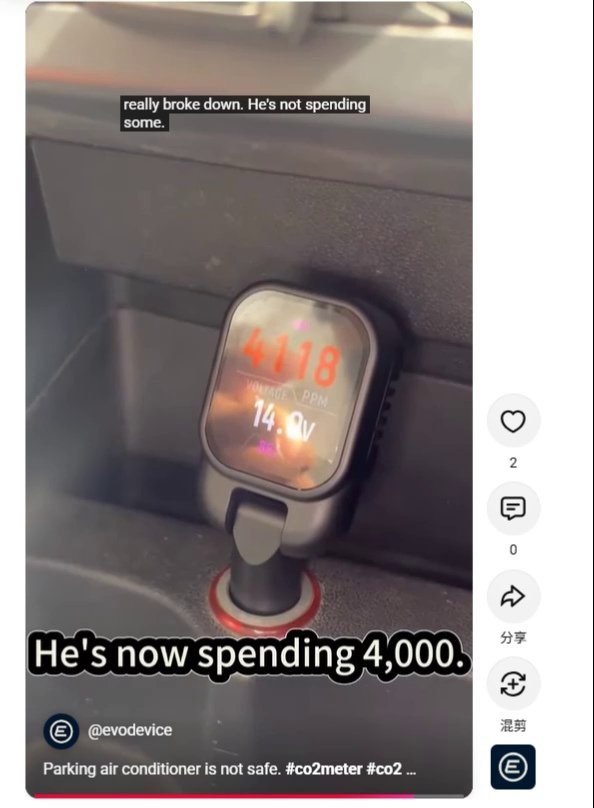
At that point, the cabin CO₂ concentration was already far above typical outdoor-background levels.
EPA notes that indoor CO₂ concentrations can provide useful information about ventilation when interpreted carefully. EPA guidance on CO₂ and ventilation
The important point for our experiment was not a particular medical threshold.
It was the difference between:
a cool cabin
and
a well-ventilated cabin
Why Can CO₂ Rise While the Air Conditioner Is Running?
People continuously release CO₂ through exhaled breath.
If a cooling system mainly recirculates cabin air instead of replacing enough of it with outside air, the temperature can fall while occupant-generated CO₂ continues accumulating.
Vehicle research has found that ventilation setting is a major factor controlling in-cabin CO₂ buildup, with recirculation conditions allowing much higher concentrations than outside-air ventilation. vehicle cabin CO₂ and ventilation study
So an air conditioner running does not automatically mean that fresh air is entering the cabin.
Cooling Is Not the Same as Ventilation
This is the central lesson from our test.
Cooling
A parking air conditioner is designed primarily to:
- remove heat from the cabin;
- lower air temperature;
- improve thermal comfort.
Ventilation
Ventilation does something different:
- introduces outside air;
- removes some cabin air;
- dilutes occupant-generated CO₂.
A system can perform the first job very well without necessarily performing the second.
EPA similarly explains that insufficient ventilation allows internally generated pollutants to accumulate because not enough outdoor air is being supplied to dilute them. US EPA
Does a Reading Around 4,100 ppm Mean an Immediate Emergency?
We would not make that conclusion from this test.
The visible values of approximately 3,458 ppm and later 4,118 ppm demonstrate elevated cabin CO₂ and limited ventilation.
But they should not automatically be described as an acute poisoning threshold.
For context, NIOSH lists a workplace recommended exposure limit of 5,000 ppm as an 8-hour time-weighted average, with much higher short-term limits. Those occupational limits are designed for workplace exposure and should not be treated as recommended targets for sleeping or comfort inside a vehicle. NIOSH carbon dioxide exposure limits
That is why our article focuses on the ventilation finding rather than labeling one number as universally “safe” or “dangerous.”
What About Falling Asleep?
In our video, one occupant had fallen asleep before the high reading was noticed.
That makes the test particularly interesting, but we need to be careful about causation.
We did not establish that the CO₂ level caused him to fall asleep.
People can fall asleep in a parked car simply because they are tired.
So the scientifically accurate statement is:
An occupant was asleep while we recorded elevated cabin CO₂.
Not:
The CO₂ made him fall asleep.
A controlled experiment would be required to establish that kind of causal relationship.
The Parking Air Conditioner Was Not Producing the CO₂
This distinction is also important.
Our test does not show that the parking air conditioner generated carbon dioxide.
The primary CO₂ source in an occupied cabin is the people breathing inside it.
The problem was the balance between:
CO₂ being produced by the occupant
and
CO₂ being removed through air exchange
If the second process is too slow, cabin concentration rises.
Why a Portable or Parking AC Can Be Misleading
The cabin may feel comfortable.
It may even feel cool enough to sleep.
That can create an impression that the cabin environment is fully controlled.
But temperature does not tell us the CO₂ concentration.
Our test showed a cabin that was being actively cooled while the CO₂ monitor simultaneously displayed more than:
3,400 ppm
That is why we consider temperature and ventilation to be separate measurements.
Related Test: Cracking Two Windows While Using Parking AC
In our previous parked-car experiment, we left two windows slightly open while the parking air conditioner was running.
During the later part of that test, the EVO-CO2V showed approximately:
1,364 ppm
That was substantially lower than the mid-3,000 ppm readings shown in this test.
However, these were not perfectly controlled matched experiments, so we should not calculate a precise percentage improvement from the two videos.
See our parked-car window ventilation and CO₂ test.
Related Test: Recirculation vs Fresh Air
In another driving experiment, cabin CO₂ fell markedly after we changed from recirculation toward outside-air ventilation.
See our real recirculation vs fresh-air CO₂ test.
Related Test: How Fast Does CO₂ Rise With More Occupants?
We also tested one to five occupants inside a vehicle.
As occupant count increased, the time required to reach our 1,400 ppm reference became much shorter.
See our real 1–5 person cabin CO₂ test.
CO₂ Is Not Carbon Monoxide
This is particularly important in an article about parked vehicles.
The EVO-CO2V measures:
Carbon dioxide — CO₂
It does not measure carbon monoxide — CO.
CO₂ accumulation from occupants and CO exposure from combustion are completely different issues.
Our experiment therefore cannot tell us anything about carbon-monoxide concentration.
If a combustion engine or other fuel-burning equipment is operating, a dedicated CO detector and appropriate safety practices are separate concerns.
What This Test Does Not Prove
Our experiment does not establish that:
- every parking air conditioner provides the same ventilation;
- the parking air conditioner caused CO₂ to increase;
- approximately 3,500 ppm caused the occupant to fall asleep;
- 4,118 ppm was a directly visible reading in our recorded test, but this single experiment does not establish a universal threshold or outcome.
- the same vehicle would reach the same value every time;
- all parked-car sleeping situations produce the same result.
The directly visible evidence is narrower:
The directly visible evidence is narrower:
While the parking air conditioner was operating, our EVO-CO2V visibly showed approximately 3,458 ppm CO₂ and later reached about 4,118 ppm inside the occupied parked vehicle.
These two readings are directly visible in our recorded test.
How We Would Improve This Experiment
A stronger follow-up test would compare:
A — Parking AC running, windows closed
B — Parking AC running, one window slightly open
C — Parking AC running, two windows slightly open
D — Parking AC plus controlled outside-air ventilation
For each condition, we would record:
- starting CO₂;
- occupant count;
- elapsed time;
- cabin temperature;
- outside temperature;
- window opening;
- outside CO₂;
- cooling performance.
That would allow us to compare both:
Cabin CO₂
and
Cabin temperature
at the same time.
Our Takeaway
The most important thing we learned was not that the parking air conditioner “failed.”
It was doing its primary job:
cooling the cabin.
But during our test, the EVO-CO2V still showed approximately:
3,458 ppm and later 4,118 ppm
while the cabin was occupied.
So our practical takeaway is:
A cool cabin is not necessarily a well-ventilated cabin.
For anyone studying parked-car comfort, we think it makes sense to consider temperature and fresh-air exchange as two separate variables.
Leave a Reply