Many modern cars have automatic climate-control functions.
That can create a reasonable expectation:
If cabin air becomes stale, will the car automatically bring in fresh outside air?
We wanted to see what happened in a real vehicle while cabin CO₂ was already high.
During our recorded test, the EVO-CO2V showed approximately:
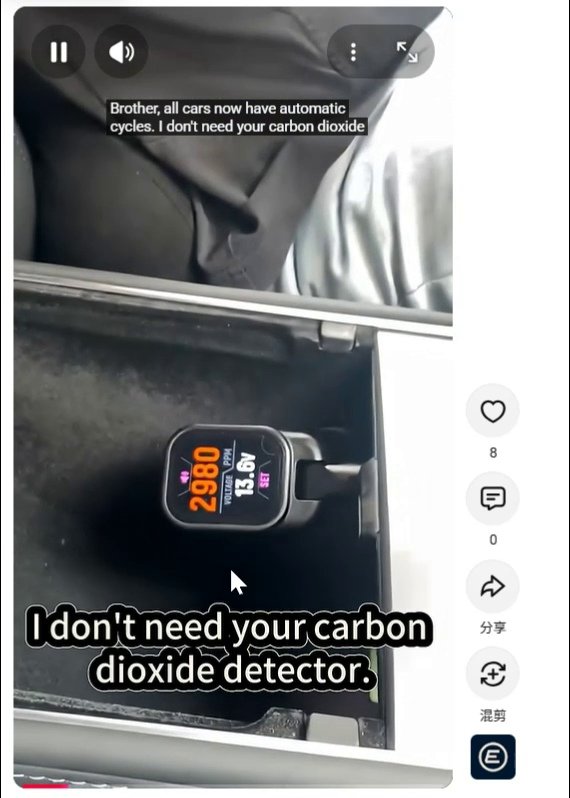
2,980 ppm
The reading then increased to:
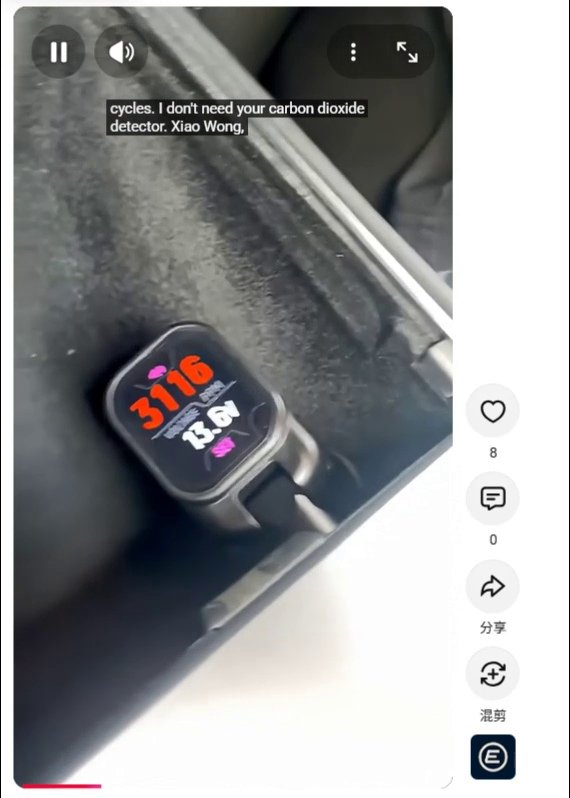
3,116 ppm
Later it reached:
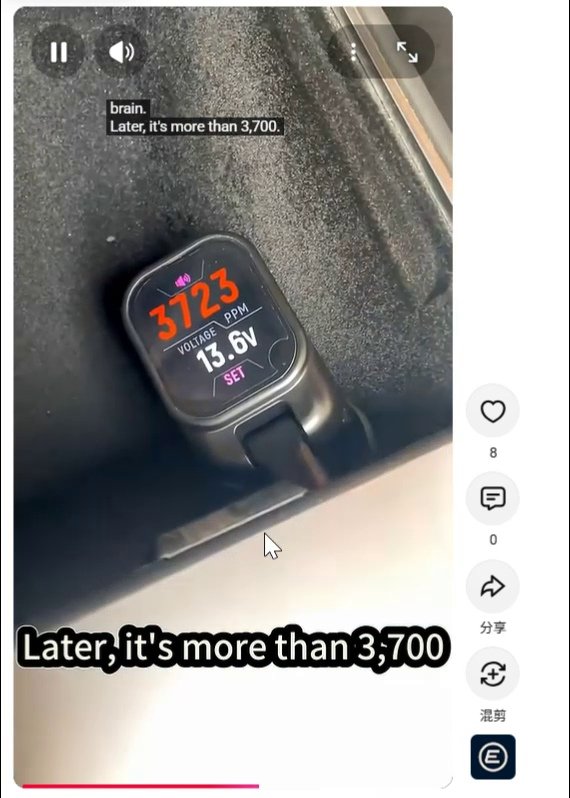
3,723 ppm
and finally:
3,813 ppm
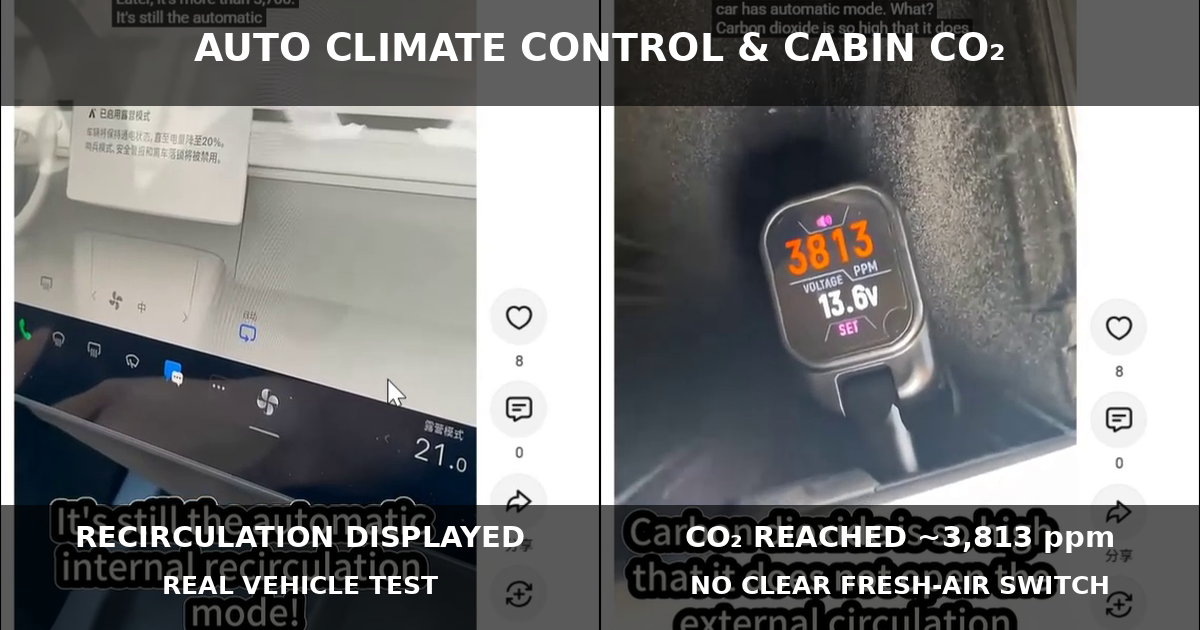
During the sequence shown in the video, the climate-control display still indicated recirculation rather than a clear switch to outside-air mode.
Quick Answer
These were the directly visible CO₂ readings in our video:
| Stage | Cabin CO₂ |
|---|---|
| Early reading | ~2,980 ppm |
| Later | ~3,116 ppm |
| Later | ~3,723 ppm |
| Highest reading shown | ~3,813 ppm |
The increase from the first to the highest visible reading was approximately:
833 ppm
Our direct observation was:
The displayed air-intake mode remained in recirculation during the recorded sequence while cabin CO₂ rose from about 2,980 ppm to 3,813 ppm.
We are not claiming that every automatic climate-control system behaves this way.
Watch Our Real Automatic-Climate-Control CO₂ Test
Video published on YouTube: September 30, 2025
During our real cabin test, the EVO-CO2V showed approximately 2,980 ppm CO₂ and later reached about 3,813 ppm. Throughout the recorded sequence, the climate-control display continued to show recirculation rather than a clear switch to outside-air mode.
Why We Ran This Test
One person in the video believed that a modern vehicle with automatic climate control would manage cabin-air intake automatically.
In other words, there should be no need to watch the CO₂ level separately.
That gave us a useful question to test:
Would the automatic climate system visibly switch away from recirculation when cabin CO₂ became high?
So instead of assuming what the car was doing, we looked at two things at the same time:
the EVO-CO2V reading and the vehicle’s climate-control display.
What the EVO-CO2V Showed
An early close-up showed approximately:
2,980 ppm CO₂
Shortly afterward, the monitor showed:
3,116 ppm
Later in the test, the reading was:
3,723 ppm
and near the end of the recorded sequence:
3,813 ppm
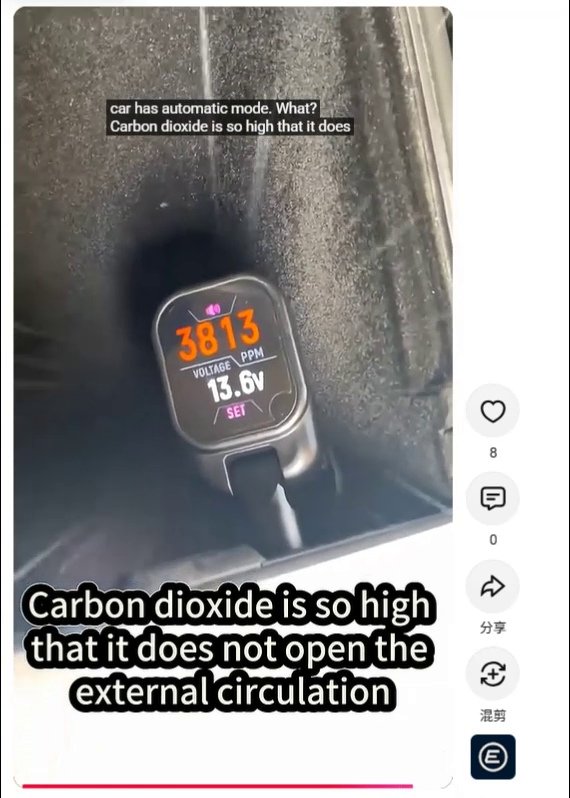
The trend was therefore clearly upward during the video.
What the Climate-Control Display Showed
At the same time, we checked the vehicle’s climate-control interface.
During the recorded sequence, the displayed intake state remained consistent with recirculation.
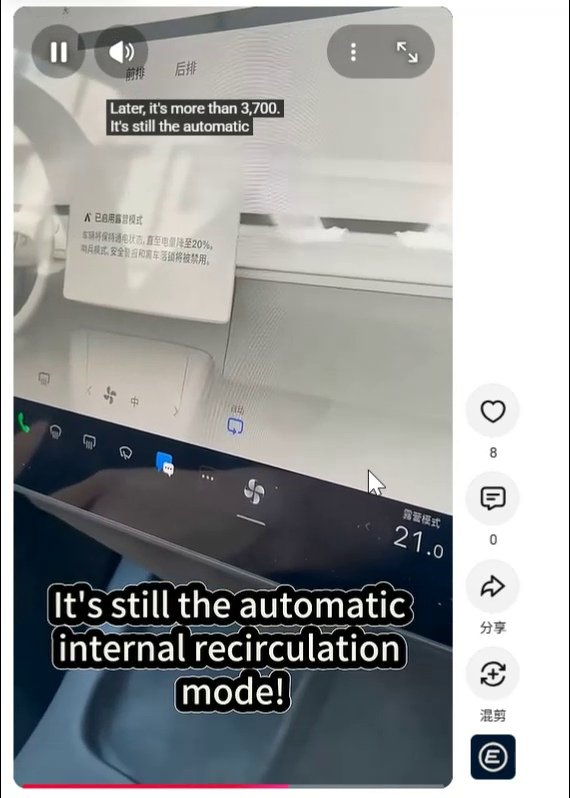
We did not observe a clear displayed change to outside-air mode while the monitor moved from approximately:
2,980 ppm → 3,813 ppm
That is the main finding from this experiment.
“AUTO” Does Not Necessarily Mean “CO₂-Controlled”
This distinction is important.
An automatic climate-control system may automatically manage functions such as cabin temperature, fan speed, airflow direction, dehumidification, and air-intake strategy.
But the word AUTO on a climate-control interface does not by itself prove that the vehicle is measuring cabin CO₂ or using CO₂ as the trigger for switching between recirculation and fresh air.
Different manufacturers use different control strategies.
For example, some vehicle systems automatically change intake mode for dehumidification or based on outside temperature. Hyundai documentation describes an automatic dehumidification function that can switch recirculation off after a period that depends on outside temperature. Mazda documentation similarly describes automatic recirculation behavior linked to outside temperature. Hyundai automatic climate-control documentation
We did not verify the sensor architecture or software logic of the vehicle in our video.
So we cannot say whether it had a cabin CO₂ sensor.
Why CO₂ Can Keep Rising in Recirculation Mode
People inside the cabin continuously add CO₂ through exhaled breath.
Recirculation sends much of the cabin air back through the HVAC system rather than replacing it with a large amount of outdoor air.
If occupant-generated CO₂ is being added faster than it is removed through leakage or fresh-air exchange, cabin CO₂ rises.
Research on vehicle ventilation has demonstrated this same basic tradeoff. A study of fractional recirculation found that full or high recirculation could allow CO₂ to rise substantially, while introducing even a portion of fresh air greatly reduced CO₂ concentration. vehicle fractional-recirculation and CO₂ study
A more recent real-world vehicle study reported CO₂ above 4,000 ppm under low-ventilation recirculation conditions, compared with less than 1,000 ppm during fresh-air operation. real-world vehicle ventilation and CO₂ study
Automatic Control May Be Optimizing More Than One Goal
There is another reason we should not assume that an automatic system will always maximize outside-air intake.
Vehicle HVAC systems have competing objectives.
Recirculation can improve cooling efficiency and reduce the entry of outside particles or odors.
Fresh-air ventilation can help dilute occupant-generated CO₂.
Those goals can conflict.
That is why automatic climate logic may consider temperature, humidity, windshield fogging, outside conditions, energy consumption, or other factors instead of using cabin CO₂ alone.
Our experiment cannot tell us which of those factors the tested vehicle was using.
CO₂ Is Useful as a Ventilation Indicator
EPA notes that indoor CO₂ measurements can provide information about ventilation when interpreted carefully. Higher indoor CO₂ relative to outdoor air often reflects occupant-generated CO₂ accumulating faster than ventilation removes it. EPA guidance on CO₂ and ventilation
That is how we use the EVO-CO2V in these vehicle experiments.
It is not telling us everything about cabin air quality.
It gives us a direct measurement of one important variable:
carbon dioxide concentration.
Does 3,813 ppm Mean the System Was “Unsafe”?
We would not make that conclusion from this experiment alone.
Our video demonstrates elevated cabin CO₂ and limited apparent fresh-air exchange during the recorded period.
It does not establish a universal medical threshold.
The main value of the measurement is that it shows the automatic climate setting did not visibly keep CO₂ near outdoor-background levels in this particular test.
What About the Comment That High CO₂ Was “Hurting My Brain”?
The video includes a casual comment about the high reading affecting the brain.
We do not use that comment as medical evidence.
We did not measure cognitive performance, blood CO₂, oxygen saturation, reaction time, or any other physiological endpoint.
Therefore, the article should not claim that the measured CO₂ caused a particular symptom or cognitive effect in the person shown.
The directly measured result was the cabin CO₂ concentration.
Related Test: Tesla Model 3 Automatic Intake Change
In another experiment, we monitored a Tesla Model 3 while using recirculation.
Cabin CO₂ increased from approximately 892 ppm toward 1,790 ppm, and during the sequence we observed a change in the vehicle’s air-intake state.
We did not claim that Tesla was responding directly to a CO₂ sensor, because we could not establish the trigger.
This comparison is useful because it shows why we should not assume that all automatic HVAC systems behave identically.
Related Test: Recirculation vs Fresh Air
We also directly tested what happened when we manually changed from recirculation to outside-air ventilation.
In that experiment, cabin CO₂ fell from roughly 2,150 ppm toward 500 ppm.
Related Test: Five People in Recirculation Mode
With five occupants inside one vehicle and recirculation operating, we recorded rapid CO₂ accumulation, eventually exceeding 2,000 ppm.
CO₂ Is Not Carbon Monoxide
The EVO-CO2V measures:
Carbon dioxide — CO₂
It does not measure:
Carbon monoxide — CO
Those are different gases.
Nothing in this experiment tells us the cabin CO concentration or whether combustion-related pollutants were present.
About the EVO-CO2V 1,400 ppm Alert
All of the principal readings in this video were already above the EVO-CO2V configured alert level of approximately:
1,400 ppm
That is our product’s practical alert setting.
We do not present 1,400 ppm as a universal medical boundary between “safe” and “unsafe.”
What This Test Does Not Prove
This experiment does not establish that every vehicle with automatic climate control will behave the same way.
It also does not prove that the tested vehicle lacks a CO₂ sensor, that its automatic system never switches to outside air, or that no fresh air was entering the cabin at all.
We did not measure actual air-change rate or inspect the physical HVAC intake damper.
Our directly visible evidence is narrower:
During the recorded sequence, cabin CO₂ rose from about 2,980 ppm to about 3,813 ppm while the climate-control display continued to indicate recirculation rather than a clear switch to outside-air mode.
How We Would Improve This Experiment
A stronger follow-up test would start near outdoor-background CO₂ and continuously record the vehicle climate screen and EVO-CO2V at the same time.
We would then keep the vehicle in automatic climate mode and record exactly when, or whether, the displayed intake state changed as CO₂ rose.
We would also record occupant count, fan setting, temperature setting, outside temperature, outside CO₂, elapsed time and actual airflow if possible.
That would make it possible to compare different vehicles under the same conditions.
Our Takeaway
The biggest lesson from this test was not that automatic climate control is “bad.”
It was that:
AUTO does not automatically mean CO₂-controlled fresh-air ventilation.
In our recorded test, cabin CO₂ rose from approximately:
2,980 ppm
to:
3,813 ppm
while the displayed air-intake state remained in recirculation.
So when we want to know what is actually happening with cabin CO₂, we prefer to measure it rather than assume what the automatic HVAC system is doing.
Leave a Reply