Many vehicles offer an automatic air-intake mode that can switch between recirculated cabin air and outside air.
But what happens when cabin CO₂ becomes very high?
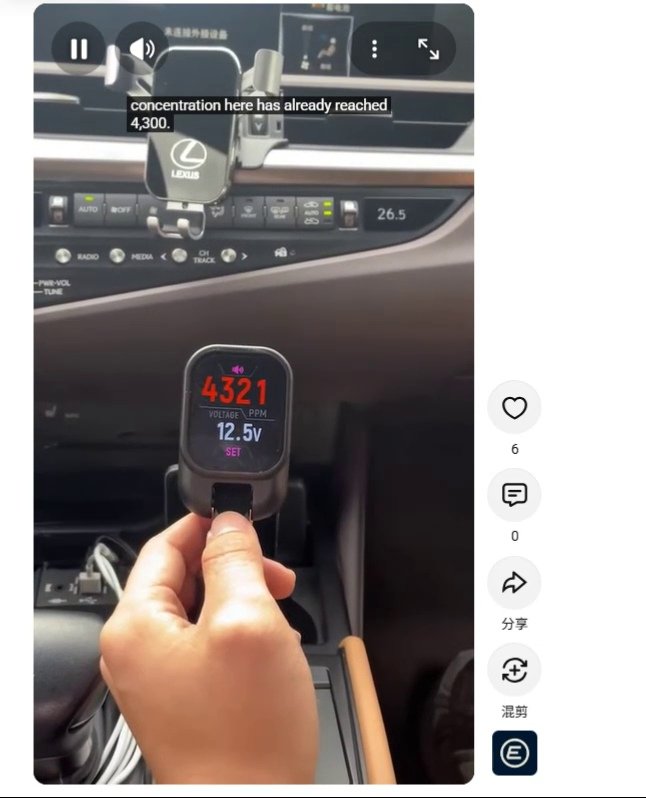
We checked this in a Lexus while monitoring cabin carbon dioxide with our EVO-CO2V.
The monitor showed approximately:
4,296–4,321 ppm CO₂
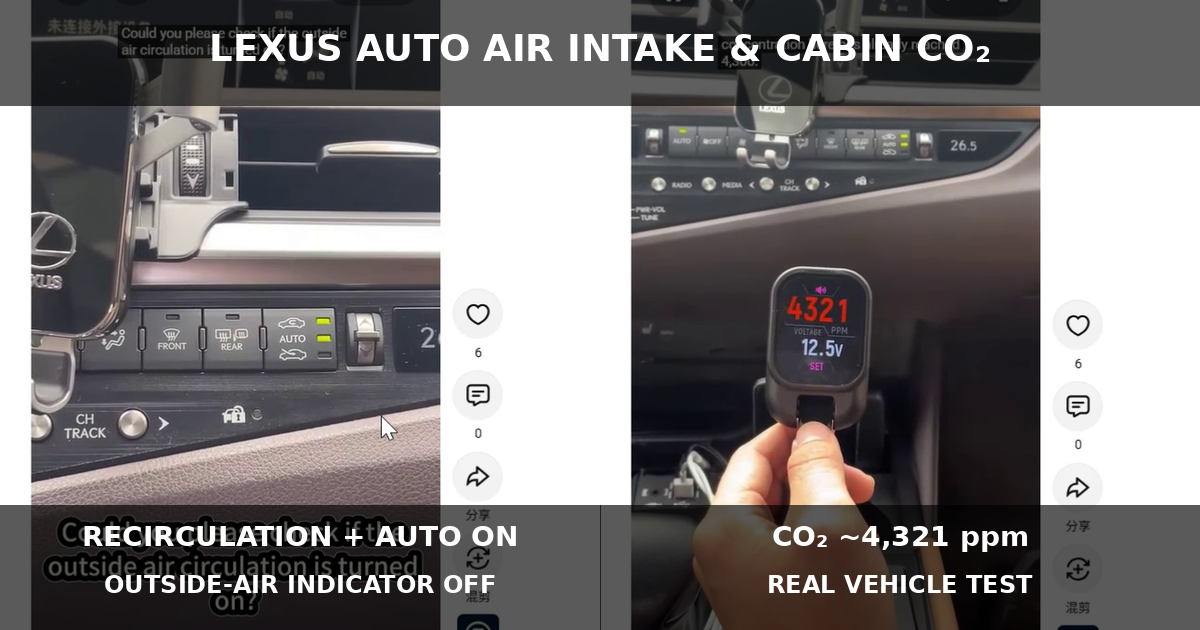
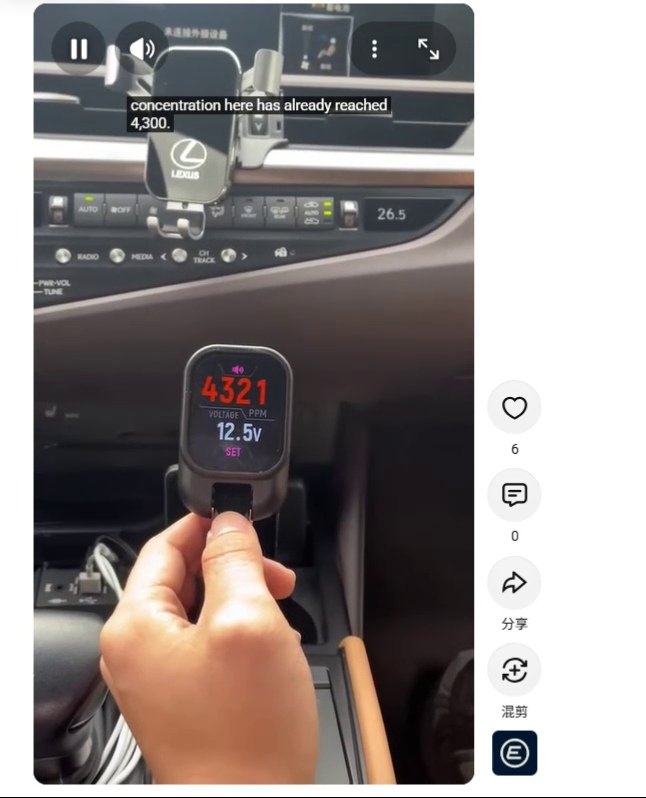
At the same time, the Lexus air-intake panel visibly showed:
Recirculation indicator: ON
AUTO indicator: ON
Outside-air indicator: OFF
During the sequence we recorded, we did not observe the displayed intake state switch to outside air.
Quick Answer
Our directly visible evidence was:
| What we checked | What we observed |
|---|---|
| Cabin CO₂ | ~4,296–4,321 ppm |
| Recirculation indicator | ON |
| AUTO air-intake indicator | ON |
| Outside-air indicator | OFF |
So our direct observation was:
At around 4,300 ppm cabin CO₂, the Lexus air-intake control was still displaying recirculation with AUTO active during the recorded sequence.
This does not prove that the system never switches to outside air.
It also does not prove that the vehicle lacks a CO₂ sensor.
It simply documents what the dashboard and our CO₂ monitor showed at the same time.
Watch Our Real Lexus AUTO Air-Intake Test
Video published on YouTube: October 1, 2025
During our real vehicle test, the EVO-CO2V showed approximately 4,296–4,321 ppm CO₂. At the same time, the Lexus air-intake panel showed both recirculation and AUTO active, while the outside-air indicator remained off during the recorded sequence.
Why We Ran This Test
We had already been testing automatic climate-control behavior in different vehicles.
A common assumption is:
If AUTO is turned on, the vehicle will automatically bring in fresh air whenever cabin air becomes stale.
That sounds reasonable.
But “AUTO” can mean many different things depending on the manufacturer and vehicle.
So instead of assuming what the Lexus was doing, we checked the physical air-intake indicators while simultaneously measuring cabin CO₂.
What the EVO-CO2V Showed
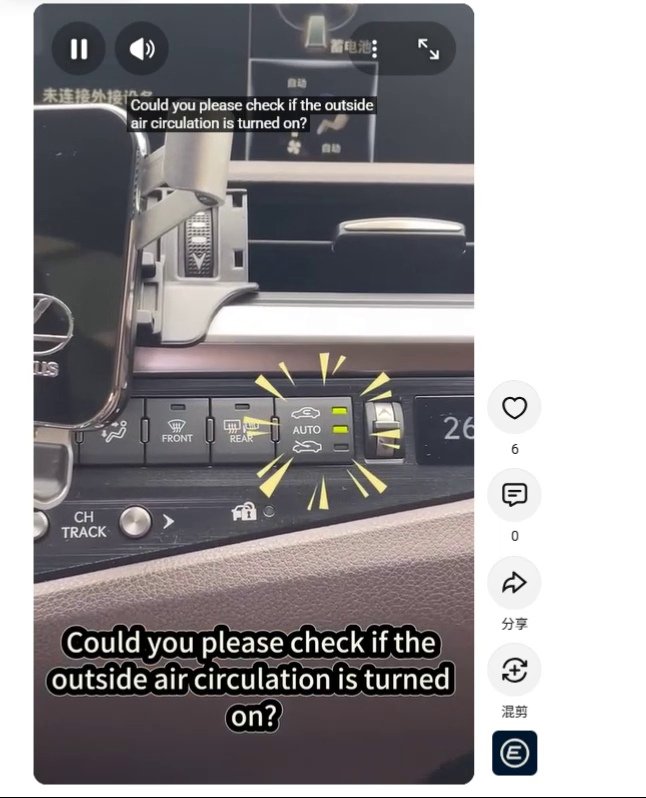
The EVO-CO2V displayed approximately:
4,321 ppm
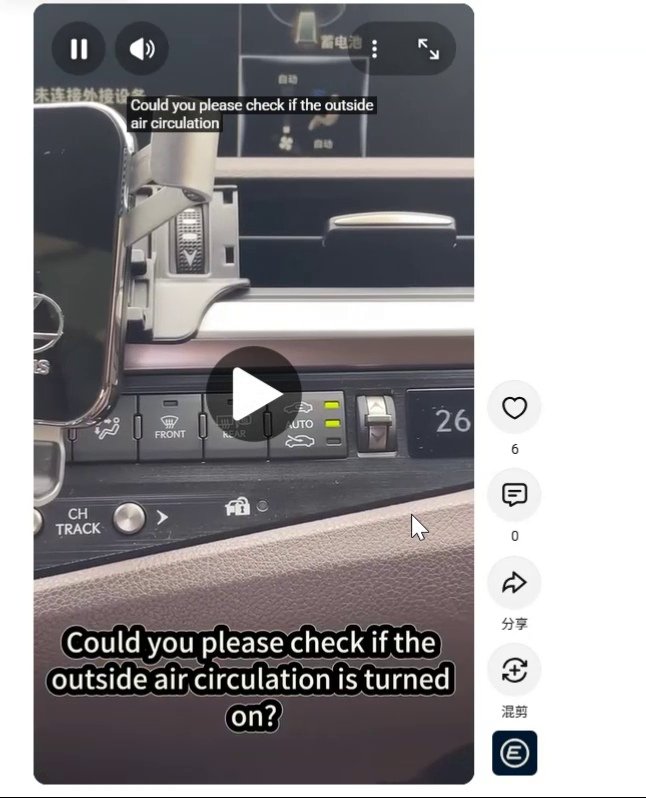
Another visible reading in the recorded sequence was approximately:
4,296 ppm
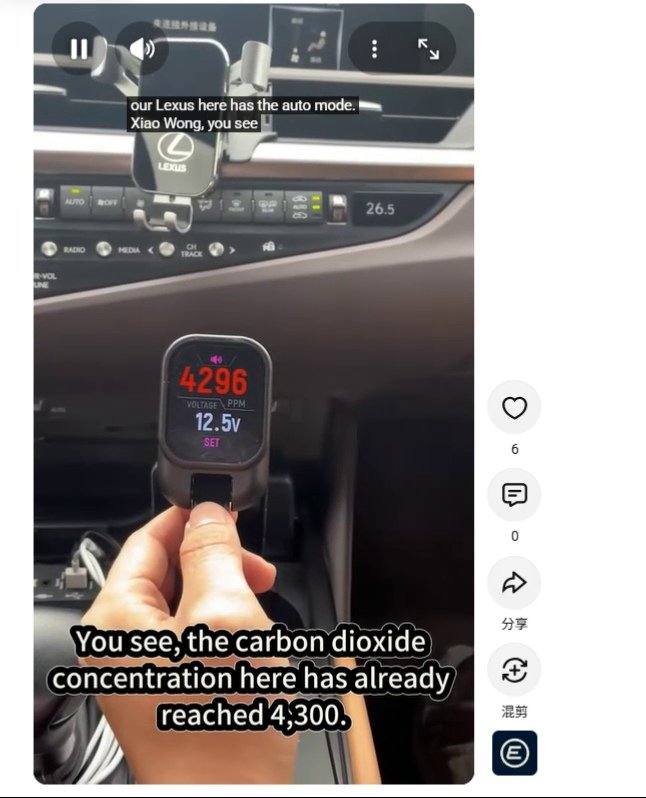
Later, the monitor again showed approximately:
4,321 ppm
So this video was not primarily about a rising CO₂ curve.
The important fact was that cabin CO₂ was already sitting at approximately:
4,300 ppm
while we checked the vehicle’s air-intake status.
What the Lexus Air-Intake Panel Showed
The air-intake button in the video provides unusually clear evidence.
Three states are shown vertically on the panel:
- recirculated-air symbol;
- AUTO;
- outside-air symbol.
During our recorded check:
The recirculation indicator was illuminated.
The:
AUTO indicator was also illuminated.
But the:
outside-air indicator was not illuminated.
That means the displayed state at that moment was recirculation with AUTO active, not displayed outside-air mode, not displayed outside-air mode.
What Does Lexus Mean by “AUTO”?
This is where the distinction becomes important.
Lexus documentation for various models describes an automatic air-intake function that can switch between outside air and recirculation automatically. Some Lexus documentation specifically describes detecting exhaust gas or other outside pollutants, while other models may also consider conditions such as tunnel information. Lexus documentation on automatic air-intake control
Lexus documentation on automatic air-intake control
But this does not establish that the particular Lexus in our video uses cabin CO₂ as a switching input.
We did not inspect the vehicle’s sensor architecture or software logic.
Therefore, we cannot say that 4,300 ppm should have triggered an automatic switch according to the vehicle’s design.
AUTO Does Not Necessarily Mean CO₂-Controlled
This is probably the most important lesson from the test.
An automatic air-intake system can be designed to respond to factors such as:
- outside pollutants;
- exhaust gases;
- temperature;
- cooling demand;
- humidity;
- windshield defogging;
- tunnel conditions;
- other manufacturer-specific logic.
A cabin CO₂ concentration is a separate variable.
The word AUTO on the dashboard does not by itself prove that the vehicle is measuring CO₂ or using CO₂ as the criterion for changing the intake position.
Why Can CO₂ Remain High During Recirculation?
People inside a vehicle continuously release CO₂ through exhaled breath.
When the HVAC system recirculates cabin air, much of that same air passes through the system again.
Cooling that air does not remove the occupant-generated CO₂.
If the amount of outside air entering the vehicle is insufficient to dilute the CO₂ being produced, cabin concentration can remain elevated or continue increasing.
That is why temperature control and fresh-air ventilation should be treated as separate functions.
What Does Around 4,300 ppm Tell Us?
Our measurement tells us that cabin CO₂ was substantially above typical outdoor-background levels during the test.
EPA explains that indoor CO₂, when interpreted appropriately, can provide information about ventilation because occupants continuously add CO₂ to indoor air. EPA guidance on CO₂ and ventilation
For this experiment, we use the roughly 4,300 ppm reading primarily as evidence that occupant-generated CO₂ had accumulated inside the cabin.
We do not use it as a universal medical threshold.
Does 4,300 ppm Mean an Immediate Emergency?
We would not make that conclusion from this test.
A high cabin CO₂ reading and an acute toxic exposure threshold are not the same thing.
Our test did not measure:
- blood CO₂;
- oxygen saturation;
- cognitive performance;
- reaction time;
- other physiological variables.
So our article should stay focused on what we actually measured:
Cabin CO₂ and the displayed HVAC intake state.
This Does Not Mean the Lexus AUTO System “Failed”
That would also be too strong.
If the AUTO intake system was designed primarily to react to outside pollution, exhaust gas or other operating conditions, remaining in recirculation could be consistent with its programmed logic.
Our experiment did not test whether those functions were working correctly.
We tested a different question:
What was the displayed intake state while cabin CO₂ was already around 4,300 ppm?
And the answer in our recorded sequence was:
Recirculation + AUTO displayed, outside-air indicator off.
Related Test: Automatic Climate Control at 2,980–3,813 ppm
One day earlier, we performed another automatic climate-control test.
During that recorded sequence, cabin CO₂ increased from approximately:
2,980 ppm
to:
3,813 ppm
while the displayed air-intake state remained in recirculation.
Related Test: Tesla Model 3 Automatic Intake Change
We have also observed a different behavior in a Tesla Model 3.
In that test, cabin CO₂ increased from approximately:
892 ppm
toward:
1,790 ppm
and during the recorded sequence we observed the vehicle’s intake state change.
We did not establish that CO₂ itself caused the Tesla to change modes.
This comparison is useful because different vehicles can use very different automatic HVAC logic.
Related Test: What Happens When We Manually Bring in Fresh Air?
In another driving test, we manually changed from recirculation toward outside-air ventilation.
Cabin CO₂ fell from approximately:
2,150 ppm
toward:
500 ppm
See our real recirculation vs fresh-air CO₂ test.
CO₂ Is Not Carbon Monoxide
The EVO-CO2V measures:
Carbon dioxide — CO₂
It does not measure:
Carbon monoxide — CO
These are different gases.
Nothing in this Lexus test tells us whether carbon monoxide or exhaust-related pollutants were present.
About the EVO-CO2V 1,400 ppm Alert
The roughly 4,300 ppm readings shown in this video were well above the EVO-CO2V configured alert point of approximately:
1,400 ppm
That is our device’s practical notification setting.
We do not present 1,400 ppm as a universal dividing line between medically “safe” and “unsafe.”
What This Test Does Not Prove
This experiment does not prove that:
- every Lexus behaves this way;
- Lexus AUTO mode never switches to outside air;
- the tested vehicle lacks a CO₂ sensor;
- no outside air was entering the cabin at all;
- approximately 4,300 ppm should trigger the vehicle according to Lexus programming;
- the AUTO system was malfunctioning;
- cabin CO₂ caused any symptom experienced by the occupants.
We also did not measure the actual fresh-air flow rate.
Our directly visible evidence is narrower:
With cabin CO₂ at approximately 4,296–4,321 ppm, the Lexus air-intake panel displayed recirculation and AUTO, while the outside-air indicator remained off during the recorded sequence.
How We Would Improve This Experiment
A stronger follow-up would begin with cabin CO₂ close to outdoor levels.
We would continuously film both:
- the EVO-CO2V; and
- the Lexus intake-control indicators.
We would then leave the air-intake system in AUTO and record whether or when its displayed state changed as cabin CO₂ increased.
We would also document:
- exact Lexus model and model year;
- occupant count;
- outside temperature;
- cabin temperature;
- HVAC temperature setting;
- fan speed;
- outside CO₂;
- elapsed time;
- driving or stationary condition.
That would allow a much stronger comparison between different Lexus vehicles and other manufacturers.
Our Takeaway
This test taught us something important about the meaning of AUTO.
At approximately:
4,300 ppm cabin CO₂
the Lexus panel in our video still showed:
RECIRCULATION + AUTO
while:
OUTSIDE AIR was not displayed.
That does not mean the automatic system was defective.
It means we should not automatically assume that:
AUTO air intake = CO₂-controlled fresh-air ventilation.
When we want to know what is actually happening with cabin CO₂, we prefer to measure the gas and check the HVAC state directly.
Leave a Reply