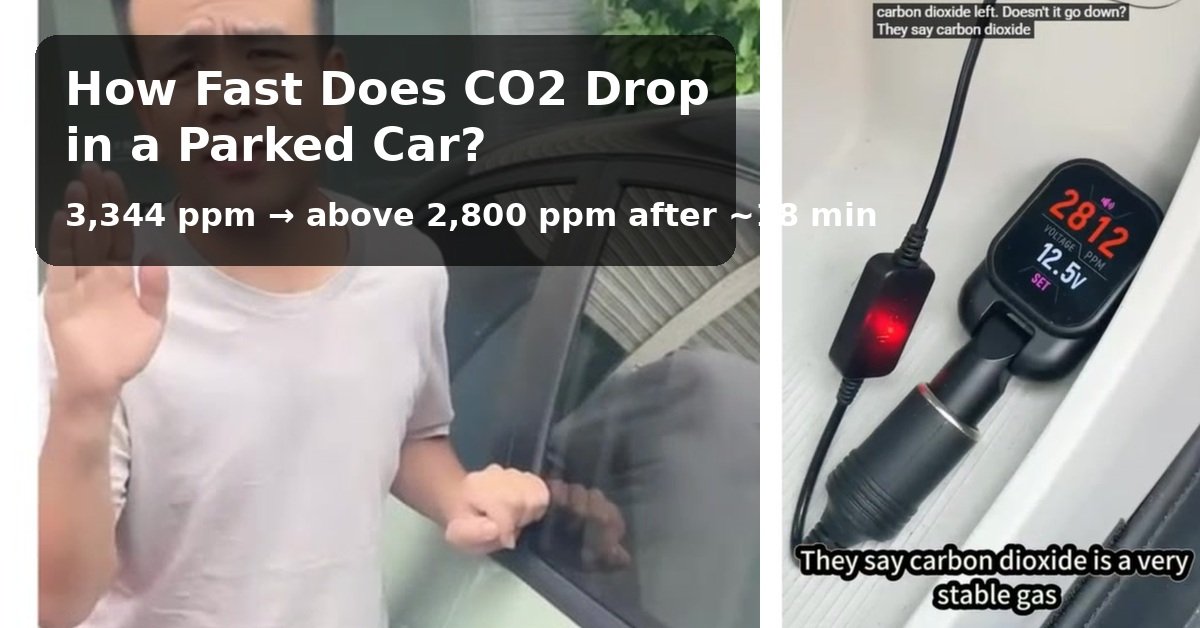
If CO₂ has built up inside a car, what happens after everyone gets out?
Does the concentration quickly return to outside-air levels on its own?
We tested this in a real parked vehicle using the EVO-CO2V car CO₂ monitor.
At the start of the documented test, cabin CO₂ was:
3,344 ppm
There was no one inside the vehicle, and the air conditioner was not running.
After 12 minutes, the measured CO₂ concentration was still:
2,860 ppm
We waited approximately 6 more minutes.
The reported reading was:
2,831 ppm
A subsequent close-up of EVO-CO2V showed approximately:
2,812 ppm CO₂
The result was clear:
Removing the occupants stopped the main internal CO₂ source, but the CO₂ already inside the parked cabin did not disappear quickly without active ventilation.
Quick Answer
In our real-world parked-car test, cabin CO₂ started at 3,344 ppm after the occupants had left the vehicle.
With nobody inside and the A/C off:
| Test Point | Cabin CO₂ |
|---|---|
| Start of documented test | 3,344 ppm |
| After 12 minutes | 2,860 ppm |
| About 6 minutes later | 2,831 ppm |
| Later EVO-CO2V close-up | ≈2,812 ppm |
So even after roughly 18 minutes without occupants, the cabin CO₂ concentration remained above 2,800 ppm in this particular test.
This does not mean every parked car will behave the same way.
It shows what happened in this vehicle under these test conditions.
What Did We Actually Test?
Before the observation period, CO₂ had already accumulated inside the vehicle.
At approximately 2:31, EVO-CO2V showed 3,344 ppm CO₂.

At the start of the parked-car observation, EVO-CO2V showed 3,344 ppm CO₂ with no occupants inside the vehicle.We then observed what happened when:
- no occupants remained inside;
- the vehicle stayed parked;
- the A/C was not operating;
- no active fresh-air ventilation was being used.
The goal was simple:
How quickly would the existing cabin CO₂ decrease on its own?
This was a real-world observation rather than a laboratory air-exchange-rate measurement.
After 12 Minutes: CO₂ Was Still 2,860 ppm
We returned after approximately 12 minutes.
EVO-CO2V showed:
2,860 ppm CO₂

After approximately 12 minutes with no occupants inside and the A/C off, EVO-CO2V measured 2,860 ppm CO₂.The concentration had decreased, but it was still substantially elevated compared with the initial 3,344 ppm reading.
Importantly, no person was inside continuously producing additional CO₂ during this period.
That means the observed decrease mainly reflects the exchange of higher-CO₂ cabin air with lower-CO₂ air from outside the vehicle.
Six More Minutes Later: Still Above 2,800 ppm

After approximately 18 minutes total, cabin CO₂ was still 2,831 ppm in the parked vehicle.We waited approximately another 6 minutes.
The reported value was:
2,831 ppm CO₂
A subsequent close-up of EVO-CO2V showed approximately:
2,812 ppm
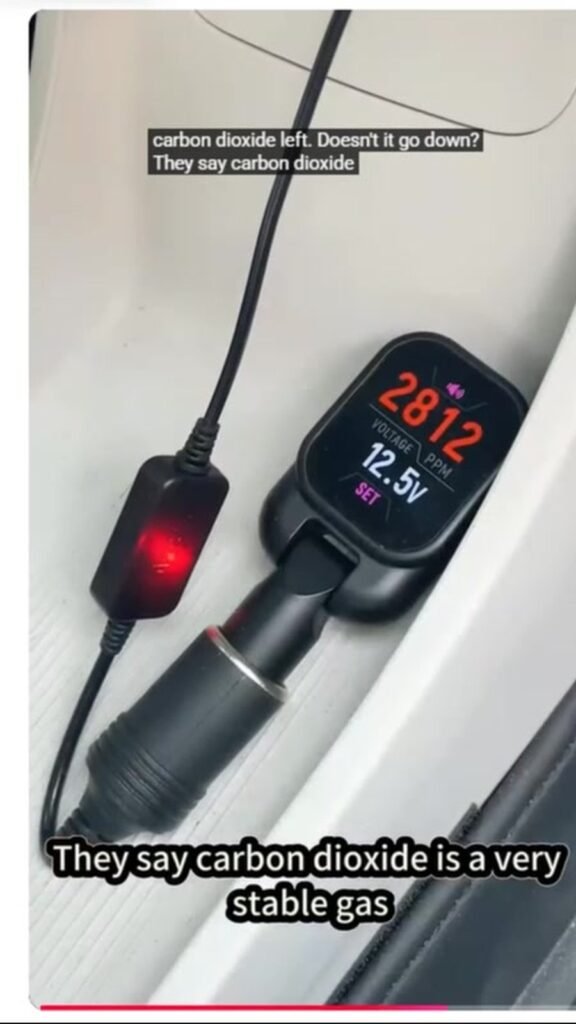
A later close-up of EVO-CO2V showed approximately 2,812 ppm CO₂ and 12.5 V vehicle voltage.We report both values because they are what is actually shown in the test video.
We are not replacing them with an estimated or “cleaned-up” number.
The important observation is the same:
After roughly 18 minutes, the cabin CO₂ remained above 2,800 ppm.
Why Did CO₂ Drop Even Though Nobody Was Inside?
Once everyone left the vehicle, the occupants were no longer adding CO₂ through breathing.
But a parked vehicle is not perfectly airtight.
Air can still move between the cabin and the outside environment through door seals, vents, pressure-relief paths and other leakage routes.
Vehicle research has used CO₂ as a tracer gas specifically because changes in its concentration can reveal cabin air-exchange behavior. Air-exchange rates vary substantially between vehicles and operating conditions, and they can be relatively low when a vehicle is stationary with limited ventilation. PubMed Central (PMC)
So the CO₂ decreased because some air exchange was still occurring.
But in our test, that passive exchange was not fast enough to bring the cabin concentration close to outside-air conditions within the observation period.
Is the Slow Drop Because CO₂ Is a “Very Stable Gas”?
Not in the way that phrase might suggest.
CO₂ is chemically stable under ordinary cabin conditions, but that is not the main reason the meter continued to show a high concentration.
The EVO-CO2V is measuring the concentration of CO₂ molecules present in the cabin air.
For that concentration to fall substantially, the high-CO₂ cabin air must be diluted or replaced by air containing less CO₂.
Therefore, the more useful explanation for this test is:
The CO₂ concentration declined slowly because the parked cabin had limited air exchange, not because CO₂ was waiting to chemically break down.
That distinction is important.
CO₂ does not need to chemically disappear.
It needs to be removed or diluted through air exchange.
Does an Empty Car Automatically Return to Fresh-Air CO₂ Levels?
Not immediately.
Our test shows that simply removing the occupants does not instantly remove the CO₂ they previously exhaled.
Once people leave:
CO₂ production inside the cabin drops sharply.
But the CO₂ already present remains until enough lower-CO₂ outside air replaces or mixes with the cabin air.
How quickly this happens can depend on:
vehicle design, cabin leakage, wind, window position, HVAC settings, fan operation and whether the vehicle is moving or stationary.
Research measuring vehicle air exchange has also found that air-exchange behavior varies widely among vehicles and increases under conditions such as higher vehicle speed or greater active ventilation. ScienceDirect vehicle air-exchange study
Would Opening the Windows Make CO₂ Drop Faster?
Generally, increasing outside-air exchange should dilute elevated cabin CO₂ more quickly.
Studies of vehicle ventilation have found substantially better ventilation when windows are opened or fresh-air ventilation is increased. PMC vehicle ventilation study
But that was not what we tested here.
This experiment intentionally observed what happened without actively ventilating the parked cabin.
So we do not claim a specific time such as:
“Opening the windows will reduce 3,000 ppm to 500 ppm in X minutes.”
That would require a separate controlled comparison.
Why Is This Different From Our Driving Tests?
This experiment addresses a different question from our other EVO-CO2V vehicle tests.
When people are inside a vehicle, respiration continually adds CO₂.
When everyone leaves the vehicle, that internal CO₂ source is removed.
From that point forward, the concentration is mainly affected by how quickly cabin air exchanges with outside air.
That makes this test useful for separating two processes:
CO₂ generation by occupants
versus
CO₂ removal through ventilation and natural air exchange
What Does This Test Actually Prove?
This test directly documents the following:
At the beginning of the observation:
EVO-CO2V displayed 3,344 ppm CO₂.
After approximately 12 minutes:
CO₂ had fallen to 2,860 ppm.
After approximately another 6 minutes:
The reported value was 2,831 ppm.
A later instrument close-up:
EVO-CO2V displayed approximately 2,812 ppm and 12.5 V.
There were no occupants continuously adding CO₂ during the observation period.
The result demonstrates that in this parked vehicle, under these conditions, passive air exchange reduced CO₂ gradually rather than immediately.
What This Test Does Not Prove
The results should not be generalized into a fixed rule such as:
“Every closed car takes more than 18 minutes to clear CO₂.”
We tested one real vehicle under one set of conditions.
Air exchange can vary considerably according to vehicle construction, seal condition, wind, HVAC settings, window position and other environmental factors.
We also did not simultaneously measure outside CO₂ concentration or calculate the vehicle’s formal air-change rate.
Therefore, this should be understood as a real-world observational test, not a laboratory determination of cabin ventilation performance.
Frequently Asked Questions
How quickly did CO₂ fall after everyone left the car?
In our test, CO₂ decreased from 3,344 ppm to 2,860 ppm after approximately 12 minutes.
What was the CO₂ level after about 18 minutes?
The reported value after approximately another six minutes was 2,831 ppm. A subsequent EVO-CO2V close-up showed approximately 2,812 ppm.
Why was CO₂ still high when nobody was inside?
The occupants were no longer producing CO₂, but the CO₂ already inside the cabin could only decrease as cabin air exchanged with lower-CO₂ outside air.
Is a parked vehicle completely airtight?
No. Vehicles have natural leakage and air-exchange paths. The amount of air exchange varies between vehicles and conditions.
Does CO₂ disappear by itself?
The concentration decreases mainly through dilution and air exchange. The important mechanism in this test is ventilation, not chemical decomposition of CO₂.
Would opening the windows lower CO₂ faster?
Increasing outside-air exchange generally increases ventilation and can dilute cabin CO₂ faster, but this experiment did not measure an open-window comparison.
Does EVO-CO2V measure carbon monoxide?
No. EVO-CO2V measures carbon dioxide (CO₂), not carbon monoxide (CO).
Test Conclusion
Our real-world parked-car test began at:
3,344 ppm CO₂
With the vehicle empty and the A/C off, the reading decreased to:
2,860 ppm after 12 minutes
and remained:
above 2,800 ppm after approximately 18 minutes.
The key takeaway is not that CO₂ “stays forever.”
It does not.
The more useful conclusion is:
Stopping the CO₂ source and removing the CO₂ already inside the cabin are two different processes.
When everyone gets out of the vehicle, people stop adding CO₂.
But the CO₂ already inside can remain elevated until enough outside air enters the cabin to dilute it.
That is why ventilation and air exchange matter even after the occupants are gone.
Test Information
Product: EvoDevice EVO-CO2V
Test type: Real-world parked vehicle CO₂ decay observation
Initial documented CO₂: 3,344 ppm
After 12 minutes: 2,860 ppm
Approximately 6 minutes later: 2,831 ppm
Later monitor close-up: approximately 2,812 ppm
Vehicle voltage shown: approximately 12.5 V
Occupancy during observation: No occupants
A/C during observation: Off
Environment: Real parked vehicle, non-laboratory test
Original video date: October 28, 2025
Results apply only to the vehicle and conditions shown in this test. Vehicle air-exchange rates can differ according to vehicle design, leakage, ventilation settings and environmental conditions.
Leave a Reply