
When a gasoline car is running, the engine burns fuel and produces carbon dioxide.
So a reasonable question is:
Does the CO₂ measured inside the passenger cabin come from gasoline combustion?

We tested this in a real gasoline vehicle using the EVO-CO2V car CO₂ monitor.
After the vehicle had been driven, EVO-CO2V displayed:
CO₂: 494 ppm
Vehicle voltage: 14.5 V
The result helps explain an important distinction between CO₂ produced by the engine and CO₂ that accumulates inside the passenger cabin.
Quick Answer
Yes, gasoline combustion produces CO₂.
But under normal vehicle operation, engine exhaust is routed outside the passenger cabin.
Inside the cabin, CO₂ concentration is typically influenced much more directly by people breathing inside the vehicle and the amount of fresh-air ventilation.
In our real-world test, after driving the gasoline vehicle, the EVO-CO2V reading inside the cabin was 494 ppm CO₂.
That does not prove that engine exhaust can never enter a vehicle. It shows what we observed under the conditions of this particular test.
What Did We Actually Test?
The question in our video was simple:
Is the CO₂ inside the car coming from gasoline combustion?
We drove the vehicle normally and then checked the CO₂ concentration inside the cabin with EVO-CO2V.
The measured result was:

| Test Item | Observed Result |
|---|---|
| Vehicle | Gasoline-powered passenger car |
| Vehicle condition | Driven before measurement |
| Cabin CO₂ | 494 ppm |
| Vehicle voltage | 14.5 V |
| Instrument | EVO-CO2V |
Watch the full real-world test below:
This was a real-world observation, not a laboratory source-apportionment experiment.
For that reason, we do not claim that a single 494 ppm measurement identifies every possible source of CO₂ inside every vehicle.
Gasoline Combustion Really Does Produce CO₂
This point is important.
It would be incorrect to say that gasoline combustion does not produce carbon dioxide.
It does.
The U.S. EPA states that vehicles burning gasoline and other fuels emit CO₂ through their tailpipes. CO₂ makes up the great majority of greenhouse gases emitted from the tailpipe of a combustion-powered vehicle. U.S. EPA vehicle emissions guidance
The key distinction is where that combustion-generated CO₂ is supposed to go.
In a normally operating vehicle, engine exhaust is routed through the exhaust system and released outside the passenger cabin.
So:
Engine combustion produces CO₂ → exhaust system carries it outside.
That is different from:
People inside the cabin exhale CO₂ → CO₂ can accumulate if ventilation is limited.
Where Does Rising Cabin CO₂ Usually Come From?
People exhale carbon dioxide continuously.
Inside a relatively small vehicle cabin, one or more occupants can therefore become an important internal CO₂ source.

Vehicle-cabin research specifically models passenger respiration as an in-cabin CO₂ source and finds that CO₂ rises as recirculation increases and fresh-air exchange decreases. More occupants can also accelerate the buildup. PubMed Central (PMC)
This explains why cabin CO₂ can rise even when the engine itself is not supplying exhaust gas to the passenger compartment.
It also explains why the cabin CO₂ level can change with:
occupancy, ventilation mode, fresh-air intake, recirculation and time spent inside the vehicle.
What Does the 494 ppm Reading Tell Us?
In this particular test, EVO-CO2V measured 494 ppm CO₂ after the gasoline vehicle had been driven.
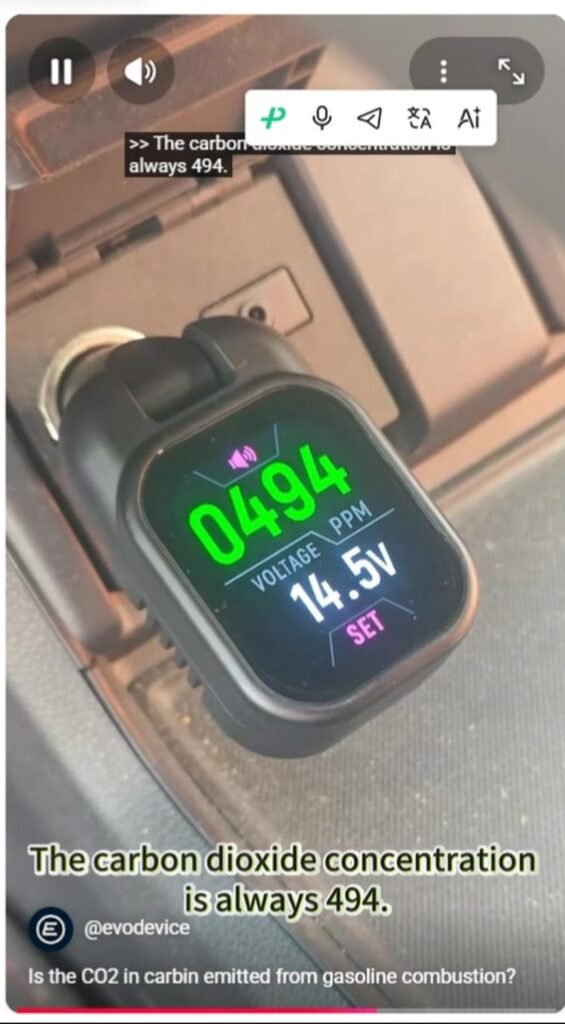
The engine had been operating, yet we did not observe a high cabin CO₂ concentration at the moment shown in the video.
This supports an important practical point:
Running a gasoline engine does not automatically mean that engine-generated CO₂ will accumulate inside a normally operating passenger cabin.
However, the 494 ppm result should not be interpreted as a universal number for all cars.
Different outdoor CO₂ concentrations, ventilation settings, passenger numbers, driving conditions and vehicle designs can produce different readings.
Does This Test Prove Exhaust Can Never Enter the Cabin?
No.
This is an important limitation.
A damaged exhaust system, exhaust leak or certain operating conditions can allow exhaust gases to enter the passenger compartment.
And when discussing vehicle exhaust, carbon monoxide (CO) is particularly important.
The CDC warns that even a small vehicle exhaust-system leak can lead to CO buildup inside a car. CDC carbon monoxide guidance
Therefore, this test should not be interpreted as proof that exhaust gases can never enter a vehicle.
It only documents what EVO-CO2V measured under the conditions shown in our test.
CO₂ Is Not Carbon Monoxide
CO₂ and CO are different gases.
EVO-CO2V measures carbon dioxide — CO₂.
It is not a carbon monoxide detector.
A normal CO₂ reading therefore does not prove that a vehicle is free from carbon monoxide or other exhaust-related pollutants.
If an exhaust leak is suspected, the vehicle should be inspected appropriately rather than relying on a CO₂ monitor.
Why Measure Cabin CO₂?
Cabin CO₂ changes are not always obvious.
A car may feel comfortable while the CO₂ concentration changes as passengers breathe and HVAC settings change.
A direct CO₂ reading helps answer a different question from engine diagnostics:
What is the carbon dioxide concentration inside the passenger cabin right now?
That is the purpose of EVO-CO2V.
What Did Our Real-World Test Show?
Our test produced one clear measured result:
After the gasoline vehicle had been driven, EVO-CO2V displayed 494 ppm CO₂ and 14.5 V inside the cabin.
The test does not show that gasoline combustion produces no CO₂.
Instead, it illustrates the difference between tailpipe CO₂ produced by fuel combustion and CO₂ measured inside the passenger cabin.
For typical cabin CO₂ buildup, occupants and ventilation conditions are key factors.
Frequently Asked Questions
Does gasoline combustion produce carbon dioxide?
Yes. Burning gasoline produces CO₂, which is normally released through the vehicle’s exhaust system.
Does engine CO₂ normally enter the passenger cabin?
A properly functioning exhaust system is designed to discharge exhaust outside the vehicle. Cabin CO₂ buildup during normal use is commonly influenced by occupant respiration and ventilation.
What CO₂ level did EVO-CO2V measure in this test?
The measured cabin CO₂ concentration shown in the video was 494 ppm.
What voltage did EVO-CO2V display?
The monitor displayed approximately 14.5 V.
Does 494 ppm prove there was no exhaust leakage?
No. This was a CO₂ measurement, not a complete exhaust-gas test.
Does EVO-CO2V detect carbon monoxide?
No. EVO-CO2V measures CO₂, not CO.
Can vehicle exhaust enter the cabin?
It can under abnormal conditions such as an exhaust-system leak. CDC guidance specifically warns that even a small exhaust leak can allow carbon monoxide to build up inside a vehicle. CDC carbon monoxide guidance
Test Conclusion
Gasoline combustion produces CO₂, but that does not mean the CO₂ measured inside a normal passenger cabin is coming directly from the engine.
In our real-world test, after driving the gasoline vehicle, EVO-CO2V measured:
494 ppm CO₂
and
14.5 V vehicle voltage.
For normal cabin use, passenger respiration and ventilation conditions are important factors affecting CO₂ concentration.
Most importantly, CO₂ monitoring and exhaust-leak detection are not the same thing.
EVO-CO2V measures cabin carbon dioxide. It should not be used as a substitute for a carbon monoxide detector or vehicle exhaust-system inspection.
Leave a Reply