After a car has been sitting in strong sunlight, what is a practical way to ventilate the cabin, cool it down, and manage rising CO₂?
We tested a simple sequence in a real vehicle using the EVO-CO2V car CO₂ monitor.
The test followed five steps:
Open three windows → Move the driver’s door about 20 times → Use A/C recirculation → Measure CO₂ → Switch to fresh-air mode.
During the recirculation stage, EVO-CO2V displayed 1,034 ppm CO₂ and approximately 14.4 V vehicle voltage.
At that point, we switched the HVAC system from recirculation to fresh-air mode to increase outside-air exchange.
Quick Answer
In this real-world test:
- The vehicle had been parked in strong sunlight.
- Three windows were opened while the driver’s window remained closed.
- The driver’s door was opened and closed approximately 20 times.
- The A/C was then turned on with recirculation selected.
- EVO-CO2V measured 1,034 ppm CO₂.
- We then switched from recirculation to fresh-air mode.
The test shows why cabin temperature and cabin CO₂ should be considered separately.
A car can already feel cool while CO₂ inside the cabin is still changing.
Step 1 — Open Three Windows
Before turning on the air conditioner, we opened three windows.
The driver’s window remained closed.
This was the first step in exchanging the hot cabin air with outside air before entering the vehicle.

Three windows were opened while the driver’s window remained closed before the cabin ventilation test.Three windows were opened while the driver’s window remained closed before the cabin ventilation test.
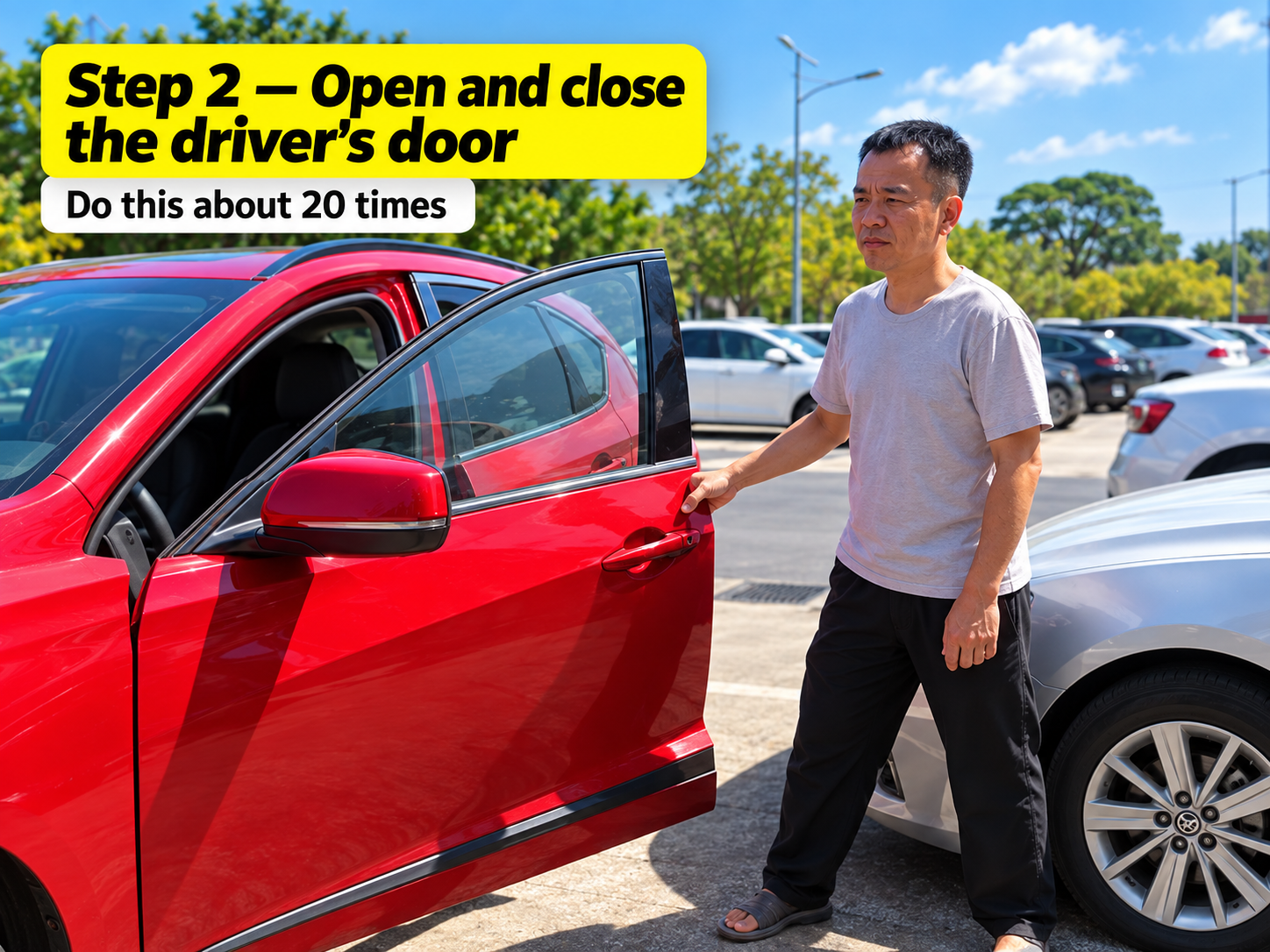
Step 2 — Open and Close the Driver’s Door About 20 Times
Next, we repeatedly opened and closed the driver’s door approximately 20 times.
The purpose was to promote additional air exchange before starting the A/C.

This is the actual procedure shown in our test video.
Step 3 — Turn On the A/C and Use Recirculation
After the initial ventilation, we entered the vehicle and turned on the air conditioner.
We selected recirculation mode first.
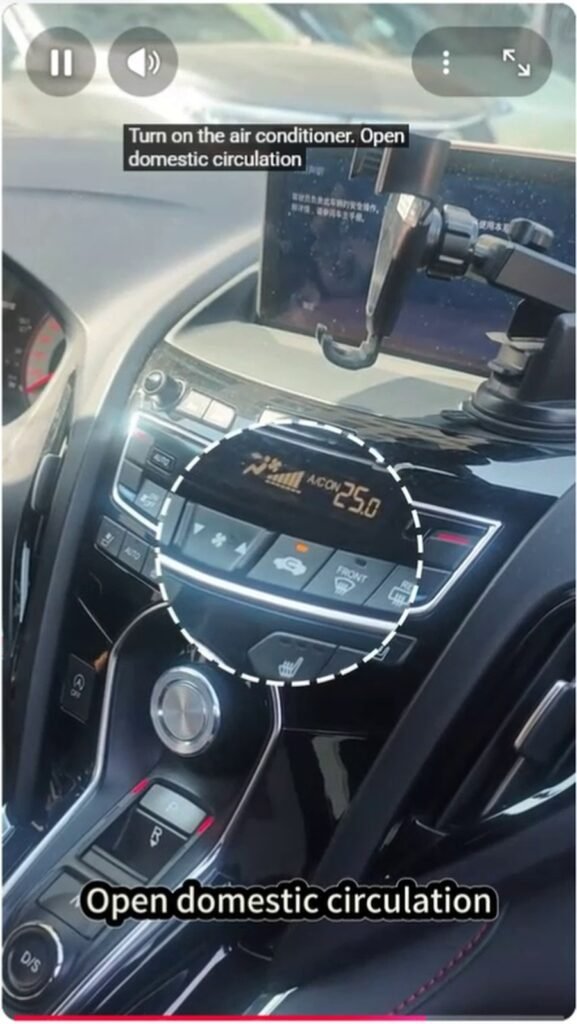
Recirculation reuses more of the air already inside the cabin instead of continuously bringing in outside air.
For a hot cabin, this is commonly used during the initial cooling stage.
However, while people remain inside the vehicle, they continue to exhale CO₂.
That means cabin temperature and cabin CO₂ do not necessarily change in the same way.
The A/C was set to recirculation mode after the initial cabin ventilation to cool the hot interior more quickly.
Step 4 — EVO-CO2V Measured 1,034 ppm CO₂
During the recirculation stage, EVO-CO2V displayed:
CO₂: 1,034 ppm
The monitor also displayed approximately:
Vehicle voltage: 14.4 V
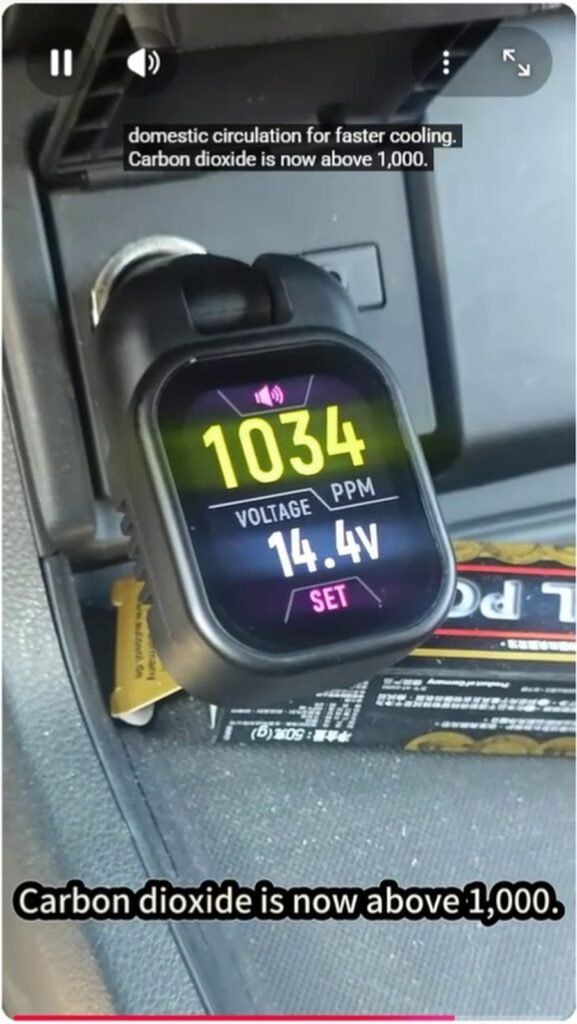
This is the key measured result from the test.
EVO-CO2V displayed 1,034 ppm CO₂ during the recirculation stage, while also showing approximately 14.4 V vehicle voltage.
Actual Test Reading
| Test Item | Observed Result |
|---|---|
| Vehicle condition | Parked in strong sunlight |
| Initial ventilation | Three windows opened |
| Driver’s window | Closed |
| Driver’s door movement | Approximately 20 times |
| Initial A/C setting | Recirculation |
| Measured CO₂ | 1,034 ppm |
| Vehicle voltage shown | Approx. 14.4 V |
| Next action | Switch to fresh-air mode |
The 1,034 ppm value is an actual reading observed during this test.
It should not be interpreted as a universal medical or safety threshold.
Step 5 — Switch to Fresh-Air Mode
After EVO-CO2V displayed 1,034 ppm CO₂, we changed the vehicle from recirculation to fresh-air mode.
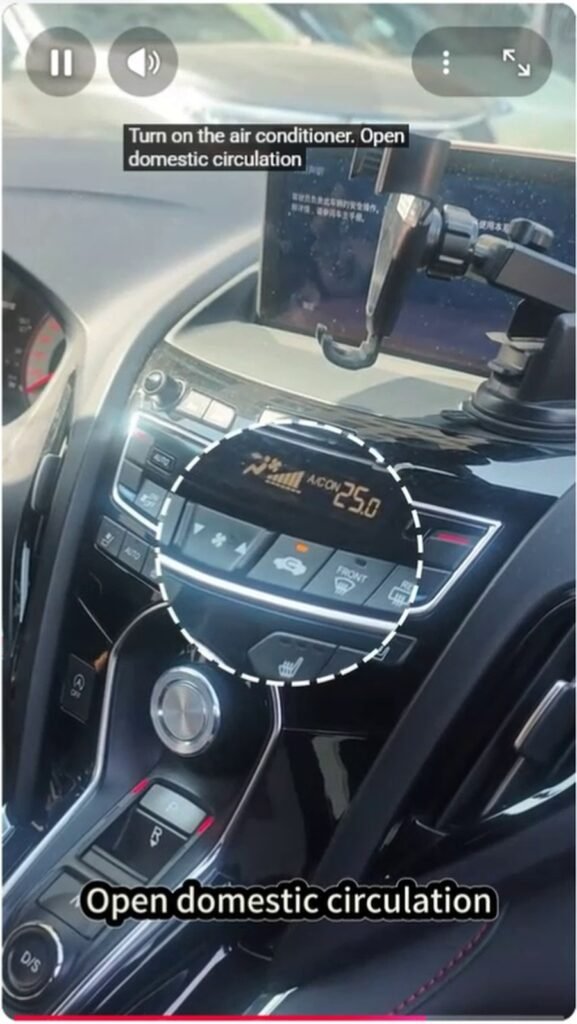
The purpose was to increase the amount of outside air entering the cabin.
After the EVO-CO2V displayed 1,034 ppm CO₂, the HVAC system was switched from recirculation to fresh-air mode to increase outside-air exchange.
There is an important limitation to this test:
The video does not show a final measured CO₂ value after switching to fresh-air mode.
For that reason, we are not claiming that the CO₂ concentration dropped from 1,034 ppm to any specific lower value.
We are reporting only what the test actually recorded.
Why Can CO₂ Build Up Inside a Car?
People continuously exhale carbon dioxide.
Inside a vehicle, the cabin is a relatively small enclosed space.
When outside-air exchange is limited, CO₂ generated by the driver and passengers can accumulate over time.
Several factors can affect how quickly this happens, including:
- Number of occupants
- Vehicle cabin volume
- HVAC mode
- Fan setting
- Vehicle speed
- Window position
- Air leakage
- Outside-air intake
This is why a fixed rule such as “use recirculation for exactly 10 minutes” cannot describe every vehicle and every trip.
Direct measurement provides information about what is happening inside that particular vehicle.
Why Measure CO₂ Instead of Guessing?
CO₂ is invisible.
A driver cannot look at the cabin and know whether the concentration is:
500 ppm, 800 ppm, 1,000 ppm or higher.
Cabin temperature does not tell you the CO₂ concentration either.
A vehicle may already feel cool and comfortable while the ventilation conditions continue to change.
EVO-CO2V provides a direct CO₂ reading so the driver can observe the cabin environment instead of relying only on time or intuition.
What Does EVO-CO2V Measure?
EVO-CO2V measures:
Carbon dioxide — CO₂
It also displays vehicle voltage.
EVO-CO2V does not measure:
- Carbon monoxide — CO
- Formaldehyde
- TVOCs
- Nitrogen dioxide — NO₂
- PM2.5
These are different pollutants and require different sensors.
The measured result in this article is specifically the CO₂ reading recorded by EVO-CO2V.
What Did This Real-World Test Show?
The test documented a complete ventilation sequence:
Step 1: Open three windows.
Step 2: Open and close the driver’s door approximately 20 times.
Step 3: Turn on the A/C and use recirculation.
Step 4: EVO-CO2V measures 1,034 ppm CO₂.
Step 5: Switch to fresh-air mode.
The main takeaway is simple:
Cabin temperature and cabin CO₂ are two different things.
You can feel the temperature.
You cannot see CO₂.
Measuring it provides additional information about the ventilation conditions inside the vehicle.
Frequently Asked Questions
Should I use recirculation when cooling a hot car?
In our test, we first ventilated the hot cabin and then used A/C recirculation during the initial cooling stage.
Recirculation can reduce the amount of outside air entering the cabin, so CO₂ generated by occupants may accumulate over time.
What CO₂ level did EVO-CO2V measure?
During this test, EVO-CO2V displayed 1,034 ppm CO₂.
Why did you switch to fresh-air mode?
After observing the 1,034 ppm reading, we switched from recirculation to fresh-air mode to increase outside-air exchange.
Did you measure how far CO₂ dropped afterward?
No.
The video does not show a final CO₂ measurement after switching to fresh-air mode, so we do not claim a specific decrease.
Is 1,034 ppm a dangerous CO₂ level?
This article does not define 1,034 ppm as a danger threshold.
It is simply the actual value recorded during this particular test.
Does EVO-CO2V measure carbon monoxide?
No.
EVO-CO2V measures carbon dioxide (CO₂), not carbon monoxide (CO).
Does EVO-CO2V measure formaldehyde or VOCs?
No.
EVO-CO2V does not measure formaldehyde or VOCs. The measurement documented in this test is specifically CO₂.
Test Conclusion
In this real-world vehicle test, we first ventilated a sun-heated cabin, then used A/C recirculation for initial cooling.
During the recirculation stage, EVO-CO2V measured:
1,034 ppm CO₂
and approximately:
14.4 V vehicle voltage
We then switched the vehicle to fresh-air mode to increase outside-air exchange.
The most important point is not that every vehicle will produce the same number.
Different cars, passenger counts and HVAC settings can produce different results.
The value of measuring CO₂ is that it shows what is happening inside the vehicle at that moment.
Test Information
Product: EvoDevice EVO-CO2V
Test type: Real-world vehicle ventilation test
Vehicle condition: Parked in strong sunlight
Measured parameter: Carbon dioxide (CO₂)
Measured CO₂ reading: 1,034 ppm
Vehicle voltage displayed: Approx. 14.4 V
Test sequence: Three windows open → Driver’s door × approximately 20 → A/C recirculation → CO₂ measurement → Fresh-air mode
Environment: Real vehicle, non-laboratory test
Results apply to the conditions shown in this test. Vehicle design, occupancy, HVAC operation and environmental conditions can produce different results.
Leave a Reply