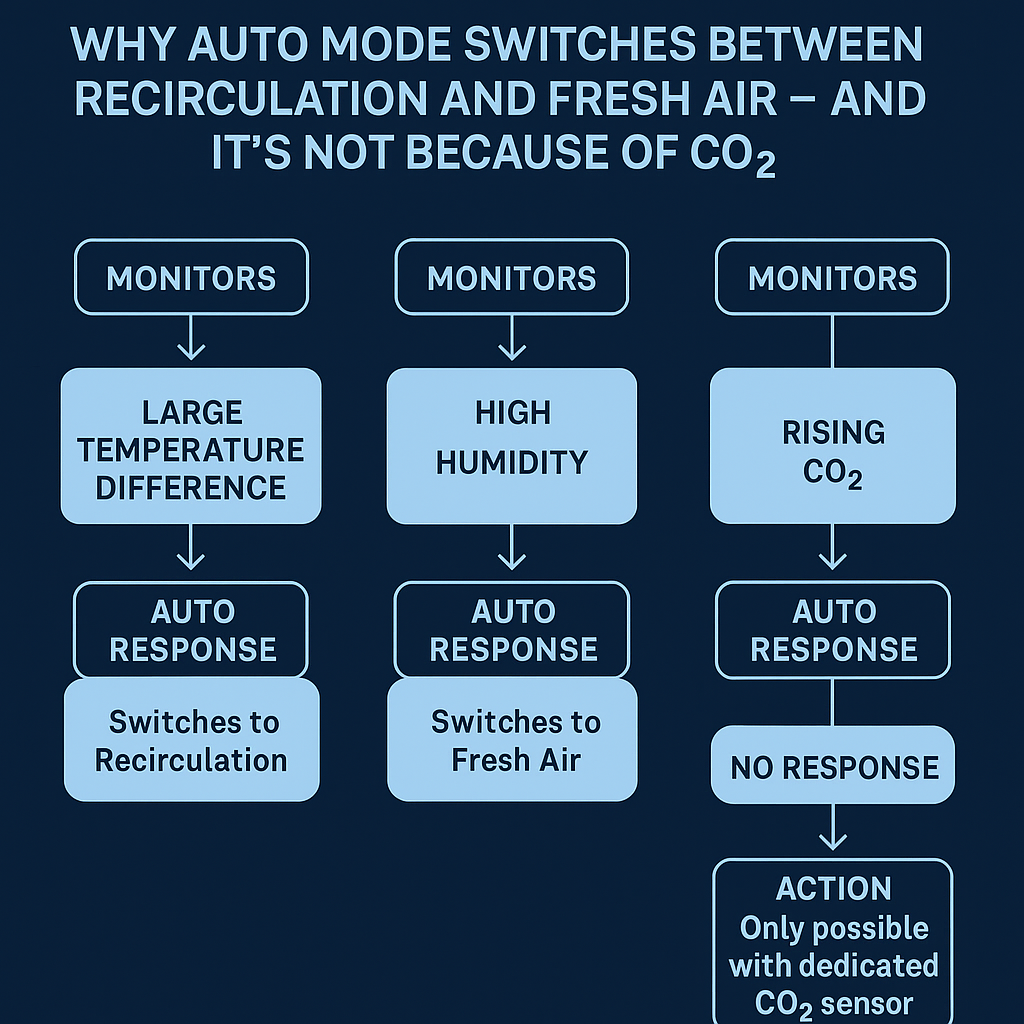
For the longest time, I assumed Auto mode in a car’s climate control was doing something smarter than I gave it credit for.
I pictured it as this invisible air quality guardian —
quietly deciding when to bring in fresh air, when to recirculate, and keeping the cabin just right.
What surprised me most was when I started thinking seriously about CO₂ inside the car — and then watching how Auto mode actually behaves.
Here’s the honest conclusion:
👉 Auto mode does not switch between fresh air and recirculation because it detects CO₂ levels.
That’s not what it’s designed to do.
Instead, Auto mode is optimizing things like temperature, comfort, humidity, and efficiency — not CO₂ concentration.
What Auto Mode Actually Cares About
When a car is in Auto, the system is juggling a few key goals:
🔥 1. Temperature Control
If it’s hot outside, Auto will often start with recirculation because:
- it cools the cabin faster
- the air feels more comfortable sooner
Once the temperature stabilizes, it may blend in outside air simply because the system’s logic changes — not because it “smelled” or measured CO₂.
💨 2. Humidity and Dew Prevention
Auto mode also tries to control humidity — because too much moisture can:
- fog up windows
- make the air feel sticky
- reduce comfort
Sometimes it brings in outside air to help balance humidity — even if CO₂ is high or low — simply because that improves the moisture balance.
🌡️ 3. Energy and Fuel Efficiency
This is especially true in EVs and hybrids:
- recirculation saves energy when heating or cooling
- outside air can force the system to work harder
Auto mode often prioritizes efficiency —
not alertness or air recycling logic tied to breathing.
So if outside air would cool or heat more efficiently, it might bring it in — even though CO₂ isn’t being measured.
Why Auto Mode Isn’t a CO₂ Monitor
This is the part that finally clicked for me:
CO₂ doesn’t have a temperature or humidity signature that typical HVAC sensors can detect.
There’s:
- no smell
- no heat change
- no moisture change
- no simple physical property for an HVAC to “sense” without a dedicated CO₂ sensor
Most cars simply don’t have CO₂ sensors in their HVAC loops —
so Auto mode has no way to know whether CO₂ is high or low.
If the system “decides” to switch between recirculation and fresh air, it’s because of:
- temperature goals
- humidity balancing
- outside air temperature
- energy optimization
- defogging logic
Not CO₂.
What That Feels Like in Practice
This explains things that used to confuse me:
- On a cool day, Auto stays in fresh-air mode longer
→ because the temperature is easy to maintain - In heavy traffic, Auto might stay in recirculation
→ because outside temperature + recirc logic = comfort - Near pollution or exhaust, Auto doesn’t instantly pull fresh air
→ because it doesn’t know about contamination without a sensor
So while Auto seems like it’s managing air quality intelligently, what it’s really doing is managing comfort and energy efficiency.
How I Think About It Now
Once I stopped assuming Auto was protecting me from CO₂, I had to rethink how I use ventilation:
👉 Auto optimizes comfort.
I optimize air quality.
That means:
- I stopped expecting Auto to fix CO₂ buildup
- I manually switch to fresh air when I notice dullness or rising CO₂
- I don’t assume a quiet cabin = fresh cabin
- I treat CO₂ management as a driver’s decision, not a car’s job
Auto mode is a convenience.
CO₂ awareness is a conscious choice.
Final Thoughts
Auto mode is good at what it was designed for — keeping temperature and humidity comfortable.
But it’s not designed to monitor or respond to CO₂.
So next time your car switches between recirculation and fresh air, don’t assume it’s reacting to the invisible gas your body isn’t smelling or sensing.
It’s reacting to:
- heat
- humidity
- energy logic
- comfort algorithms
And that’s fine — as long as you know the difference.
Because when it comes to CO₂,
you need awareness — not assumptions.e wheel — a dedicated CO2 meter is not optional. It’s essential.
Amazon is a trademark of Amazon.com, Inc. or its affiliates.
Leave a Reply to Why EVO-CO2V Is the CO2 Meter That’s Actually Designed for Cars Cancel reply