Scope: This article explains public code-change context and SPD monitoring. For exact requirements, consult the published NEC, the local authority having jurisdiction and a qualified electrician.
The 2026 National Electrical Code (NEC) includes updates related to surge protection. But understanding the requirements is not just about selecting a device with a large surge-current number. The applicable code edition, type and placement of the surge protective device (SPD), electrical-system compatibility, and the ability to recognize a loss of protection all matter.
This guide explains the broader context of NEC Section 230.67, the 2026 changes highlighted by electrical-industry sources, and what homeowners and electricians should check when evaluating a panel-mounted whole-house SPD.
What does NEC Section 230.67 address?
Section 230.67 addresses surge protection for services supplying specified occupancies. The requirements include the selection and placement of surge protective devices in the service electrical system, subject to the applicable edition, exceptions, and local amendments. A panel-connected SPD helps limit short-duration transient overvoltages; it does not correct sustained overvoltage, defective wiring, or every possible electrical disturbance.
The National Fire Protection Association (NFPA) publishes NFPA 70, the National Electrical Code. The 2026 edition is available, but publication of a national code edition does not mean that every state or city has adopted and begun enforcing that same edition.
What changed in the 2026 NEC for surge protection?
Electrical-industry commentary on the 2026 NEC identifies an expanded set of locations covered by the surge-protection provisions of Section 230.67, including certain sleeping quarters in fire, police, ranger, and ambulance stations. It also describes clarifications affecting how service and downstream distribution equipment are evaluated for SPD placement. Related feeder requirements should be reviewed together with the service provisions.
These changes should be read in the context of the actual installation. For example, a service supplying only feeder circuits presents different considerations from service equipment that also directly supplies branch circuits. The applicable wording, local amendments and decisions of the authority having jurisdiction (AHJ) control the final installation requirements.
For further reading, see the Independent Electrical Contractors' overview of 2026 NEC Chapter Two changes. This article is an educational summary, not a substitute for the published code text or a local electrical inspection.
Does every U.S. home have to follow the 2026 NEC today?
No single answer applies nationwide. States and municipalities adopt different NEC editions on different schedules and may add amendments or exceptions. Before specifying a surge protective device or making a code-compliance claim, verify the edition and amendments adopted at the project's location and consult the local AHJ.
Type 1 vs. Type 2: what should buyers understand?
Type 1 and Type 2 describe different SPD classifications and intended installation applications under the relevant product standards. A panel-mounted Type 2 SPD is commonly used on the load side of the service overcurrent protection arrangement. Correct classification alone is not enough: verify electrical-system compatibility, the installation instructions, suitable product listing/certification status, required overcurrent protection, and the applicable electrical code.
A qualified electrician should assess service configuration, the point of connection, conductors, grounding/bonding, and compatibility with the distribution equipment. Homeowners should not attempt live panel work to install or test an SPD.
Which SPD specifications matter?
Surge-current capacity, nominal discharge current (In), short-circuit current rating (SCCR), maximum continuous operating voltage (MCOV), and voltage protection rating (VPR) each describe different aspects of the device. They should be reviewed together with the electrical system, equipment markings and installation manual. A large peak surge-current rating does not by itself establish compliance or guarantee protection from every surge or direct lightning strike.
For a plain-language comparison of the EvoDevice models and their monitoring features, see the EvoDevice Whole-House Surge Protection Guide.
Why does SPD protection status matter after installation?
Surge-protective components can be stressed by repeated or severe transient events. A device may still be physically connected to the electrical system even when one or more protection elements no longer report normal status. A voltage display or a recorded surge-event count is not the same thing as an indication of protection-element health.
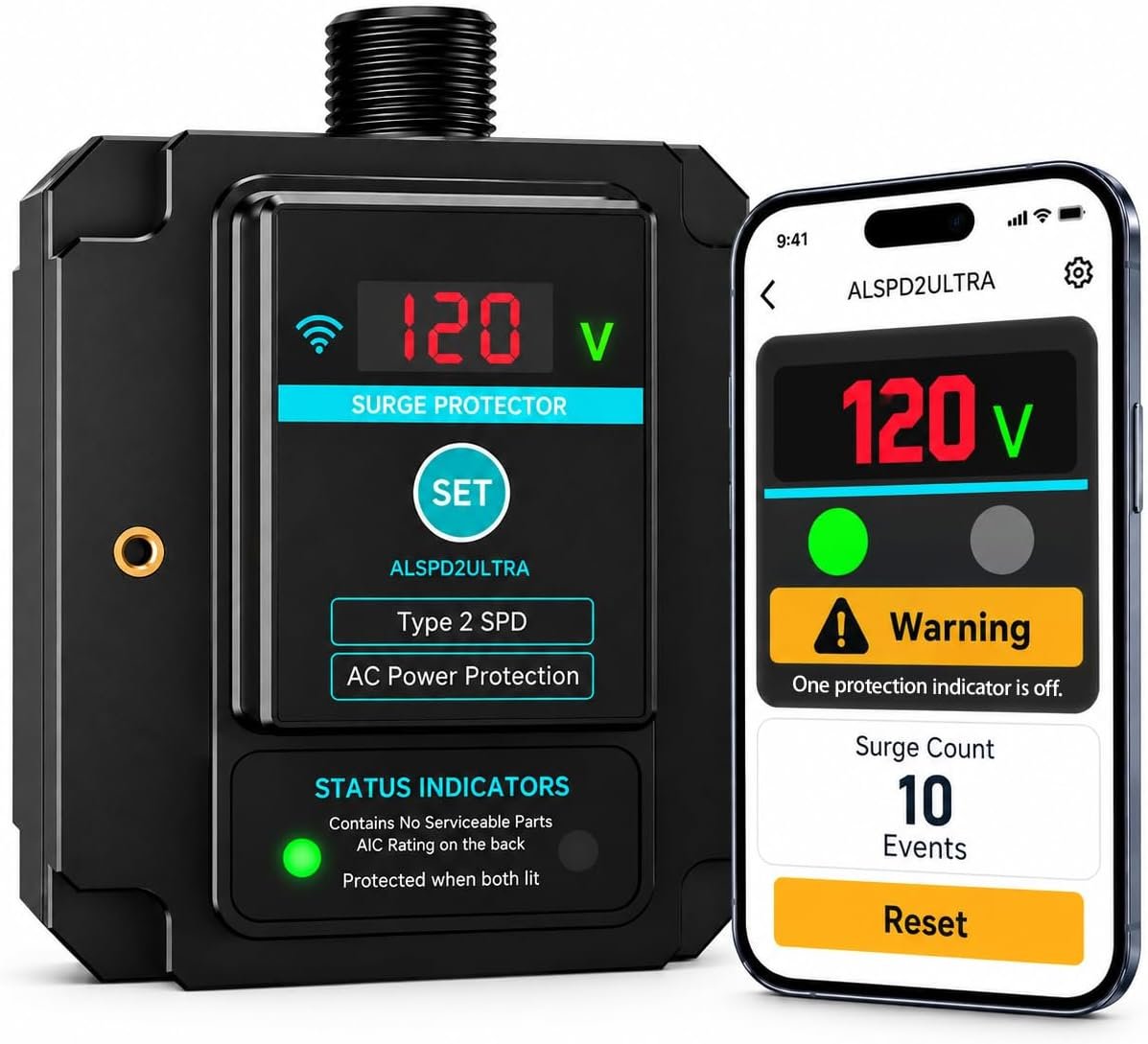
The EvoDevice ALSPD2ULTRA is a Type 2 whole-house SPD designed for supported 120/240 V AC residential systems. It combines two local protection-status indicators with Tuya Smart Wi-Fi monitoring. In the product's reported status scheme, both indicators on represent normal status; one indicator off represents a warning or partial protection failure; both off indicate lost protection requiring qualified inspection and replacement if the elements have failed. Phone alerts require appropriate 2.4 GHz Wi-Fi connectivity, app configuration and notifications.
The ALSPD2ULTRA also provides local AC-voltage and surge-count information. These indicators serve different purposes: a recorded event does not by itself prove that the protective elements have failed. Smart monitoring helps communicate device status; it does not restore failed protective components.
Watch a protection-status demonstration
The ALSPD2ULTRA product demonstration on YouTube shows the front-panel displays, changes in reported protection status, and Tuya Smart phone monitoring. This demonstration illustrates monitoring functions; it is not a certification test or a substitute for installation instructions.
Before choosing a whole-house SPD: a practical checklist
- Confirm the locally adopted NEC edition and any amendments or exceptions.
- Confirm the SPD type and installation location for the actual electrical system.
- Review the exact model's instructions, ratings and verifiable product listing/certification documentation.
- Check how a homeowner or electrician can identify normal, warning and failed protection states.
- For Wi-Fi monitoring, check connection requirements and what happens if the network is unavailable.
- Arrange installation and any replacement through a qualified electrician.
Further reading and product resources
- NFPA: National Electrical Code (NFPA 70)
- Independent Electrical Contractors: 2026 NEC Chapter Two changes
- EvoDevice Whole-House Surge Protection Guide
- ALSPD2ULTRA specifications and product demonstration
- EvoDevice Product Selection Guide
Technical and safety note: The information above is general educational content, not legal, electrical-engineering or installation advice. Requirements depend on local code adoption, amendments, product-specific approvals, and the authority having jurisdiction. Product functionality is not a claim of NEC compliance, UL listing, or certification unless supported by the exact model's official documentation.