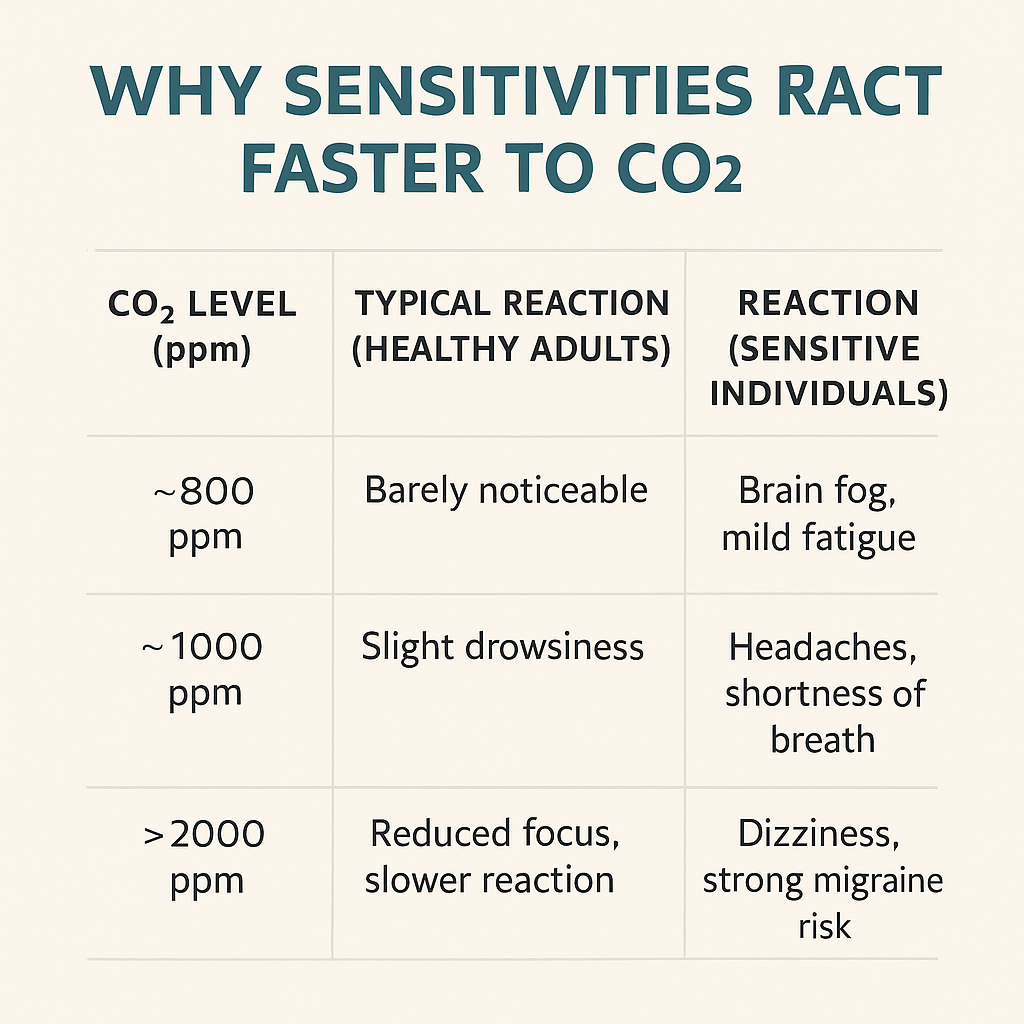
This Made Sense Once I Stopped Asking “Is It Dangerous?” and Started Asking “Is It Subtle?”
For a long time, I struggled to explain something that felt very real to me.
Some car rides felt perfectly fine.
Others felt oddly draining.
Nothing obvious was wrong:
- the temperature was comfortable
- the cabin was quiet
- the air didn’t smell bad
Yet I felt:
- mentally tired
- overstimulated
- slightly uneasy
- “off” in a way I couldn’t describe
If you’re someone with sensitivities — sensory, neurological, respiratory, or simply heightened awareness — you probably recognize this feeling.
What I eventually realized was this:
👉 People with sensitivities don’t need extreme conditions to feel an effect.
They react to small, invisible changes that others adapt to without noticing.
CO₂ in cars is one of those changes.
What I Mean by “Sensitivities”
When I say sensitivities, I don’t mean illness.
I mean people who:
- notice environmental changes quickly
- feel overstimulation sooner
- have lower tolerance for subtle stressors
- are more affected by light, sound, smell, or air quality
This includes:
- migraine sufferers
- people with asthma or mild respiratory issues
- those sensitive to sensory overload
- people prone to anxiety or fatigue
- anyone whose nervous system reacts early
These aren’t weaknesses.
They’re traits.
And traits change how environments feel.
Why CO₂ Hits Sensitive People First
CO₂ doesn’t announce itself.
It:
- has no smell
- causes no irritation
- rises slowly
- feels “normal” while it’s changing
For many people, the brain simply adapts.
But sensitive nervous systems are less forgiving of slow, invisible drift.
🧠 1. Sensitive Brains Detect “Off” Before “Bad”
Most people notice problems only when something becomes uncomfortable.
Sensitive people often notice:
- subtle imbalance
- reduced clarity
- low-grade mental strain
CO₂ doesn’t make the air feel bad —
it makes thinking feel slightly harder.
And sensitive brains pick that up early.
🫁 2. Breathing Effort Matters More
Even small increases in CO₂ can:
- change breathing rhythm
- affect perceived air quality
- increase awareness of respiration
For someone sensitive to bodily signals, this can feel distracting or uncomfortable — even when others feel nothing at all.
🧩 3. Small Stressors Add Up Faster
A car already contains:
- noise
- motion
- visual input
- constant attention demands
CO₂ adds another subtle load.
For someone without sensitivities, that extra load blends into the background.
For someone with sensitivities, it stacks.
And stacking is where problems begin.
Why Cars Are a Special Challenge
Cars are almost designed to amplify this issue:
- small enclosed space
- tight sealing
- long exposure times
- recirculation mode
- quiet cabins that remove feedback
The air feels calm.
The ride feels smooth.
But internally, conditions are slowly changing.
Sensitive people don’t need an alarm to notice.
They feel the drift.
The Mistake I Used to Make
I used to think:
“If others are fine, the problem must be me.”
That thinking kept me from adjusting the environment.
Once I understood CO₂, the narrative changed.
It wasn’t that I was overreacting.
It was that I was reacting earlier.
And earlier reactions are often protective, not irrational.
What Changed Once I Paid Attention to CO₂
When I stopped guessing and started observing, patterns emerged:
- longer recirculation → faster mental fatigue
- sealed cabin → more overstimulation
- early ventilation → clearer head
- fresh air → improved tolerance to noise and light
Nothing dramatic.
Just fewer bad drives.
Why a CO₂ Meter Helps Sensitive People More
Sensitive people don’t need more reassurance.
They need clarity.
A CO₂ meter:
- externalizes an invisible variable
- confirms what the body already suspects
- removes self-doubt
- allows early, gentle correction
Instead of pushing through discomfort, I can adjust the air before it becomes a problem.
That’s not fragility.
That’s self-regulation.
Final Thoughts
CO₂ in cars doesn’t affect everyone the same way.
For people with sensitivities, it doesn’t have to be “high” to matter.
It just has to be persistent.
Sensitive systems notice:
- small imbalances
- slow changes
- invisible loads
And in a car — where you can’t easily leave — those things matter.
Once I stopped asking,
“Is this dangerous?”
and started asking,
“Is this making things harder than they need to be?”
the answer became obvious.
Managing CO₂ isn’t about fear.
For sensitive people, it’s about creating an environment that supports — rather than quietly drains — the nervous system.
And that awareness makes every drive gentler.
Leave a Reply