This Hit Me Hard Once I Looked at It From Their Perspective
I’ve always been careful about heat when it comes to dogs in cars.
We all hear the warnings:
- never leave a dog in a hot car
- crack a window
- watch the temperature
But for a long time, I didn’t think about CO₂ at all.
That changed when I realized something uncomfortable:
👉 Dogs experience high CO₂ very differently than humans — and they have far fewer ways to cope with it.
Once I understood that, I couldn’t ignore it anymore.
Dogs Don’t Get a Choice About the Air They Breathe
When CO₂ rises in a car or RV, I can:
- feel slightly dull
- decide to open a window
- switch to fresh air
- step outside
A dog can’t do any of that.
They can’t:
- understand what’s happening
- change ventilation settings
- recognize that the air itself is the problem
They just stay there and adapt — until they can’t.
Why CO₂ Builds Up Faster With Dogs Present
This surprised me at first.
Dogs:
- breathe faster than humans
- exhale more frequently
- produce CO₂ continuously
- are often closer to the floor, where airflow is weaker
In a small, sealed space like a car or RV:
- every breath matters
- added respiration accelerates CO₂ buildup
- especially if windows are closed or recirculation is on
Even one dog can noticeably change cabin air over time.
Why Dogs Are More Vulnerable Than Humans
This is the part most people don’t realize.
🫁 1. Dogs Have Different Respiratory Regulation
Dogs rely heavily on breathing to regulate:
- oxygen balance
- stress
- temperature
Elevated CO₂ interferes with that balance more quickly for them.
🐾 2. Panting Makes It Worse — Not Better
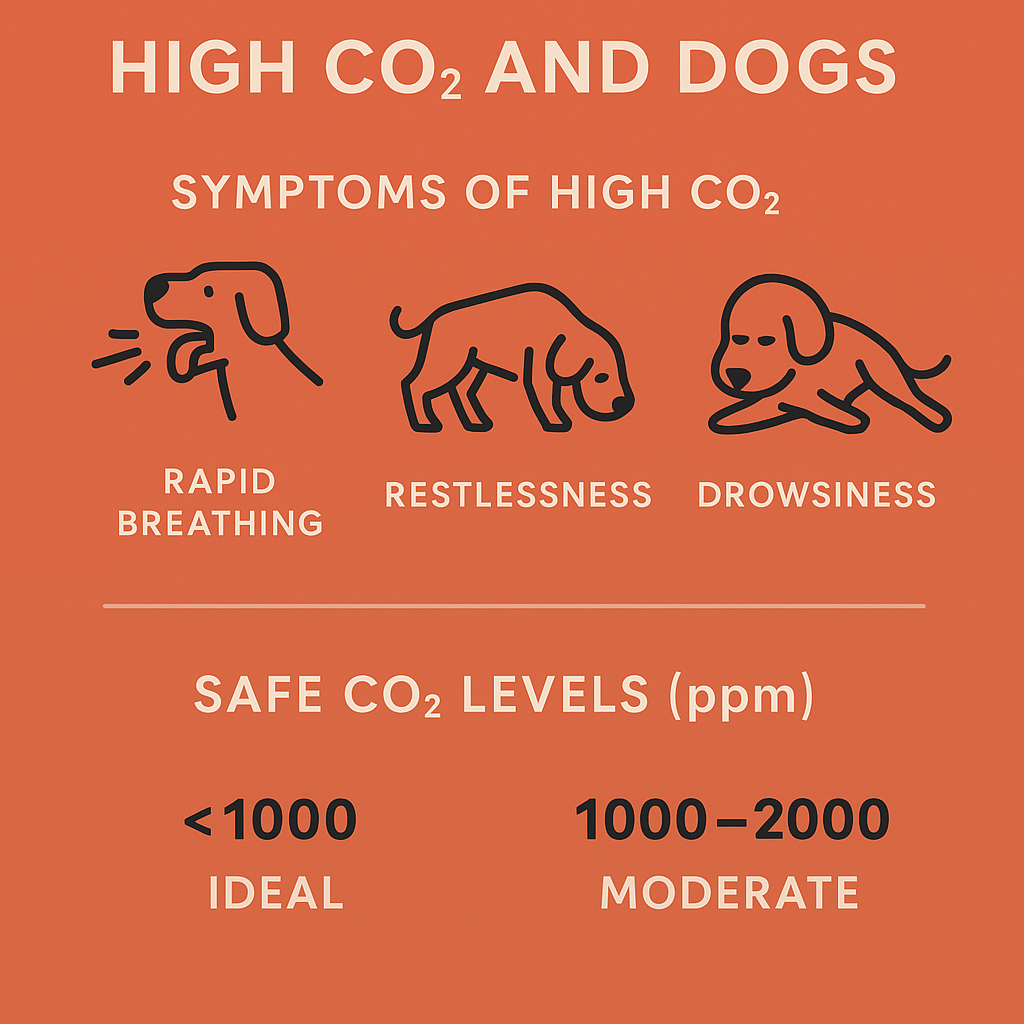
When CO₂ rises or stress increases, dogs often pant.
Panting:
- increases breathing rate
- increases CO₂ exchange
- can actually accelerate CO₂ accumulation in a closed space
So the body’s natural response can unintentionally make the environment worse.
🧠 3. Dogs Can’t Interpret Subtle Symptoms
A human might think:
“I feel a bit off — maybe the air is stale.”
A dog just feels:
- uneasy
- stressed
- restless
- uncomfortable
Without understanding why.
That stress alone can increase breathing rate, creating a feedback loop.
Why This Is Especially Risky in Cars and RVs
Cars and RVs share a few dangerous traits:
- small or medium air volume
- good sealing
- long occupancy times
- reliance on recirculation or closed windows
Add a dog, and you now have:
- another constant CO₂ source
- an animal sensitive to respiratory imbalance
- limited airflow near floor level
And unlike temperature, CO₂ gives no obvious warning signs.
No smell.
No visible signal.
No alarm.
The Mistake I Used to Make
I used to think:
“If the dog seems calm, everything must be fine.”
But calm doesn’t mean safe.
High CO₂ often causes:
- lethargy
- reduced responsiveness
- quiet behavior
Which can look like relaxation —
when it’s actually reduced alertness.
That realization was sobering.
What I Do Differently Now
I don’t panic — but I’m intentional.
When traveling with a dog, especially in a car or RV, I now:
- prioritize fresh-air mode over recirculation
- ventilate earlier, not later
- avoid sealing the cabin completely
- ensure airflow reaches lower areas of the cabin
- treat unexplained lethargy as a signal, not a mood
CO₂ management becomes part of pet care — just like temperature and water.
Why This Matters Even More During Rest Stops and Overnight Stays
This is especially important when:
- parked
- resting
- sleeping
- running A/C quietly
- assuming “everything is stable”
CO₂ doesn’t stop accumulating just because the vehicle isn’t moving.
And dogs don’t wake you up to tell you the air is bad.
Final Thoughts
Heat gets all the attention — and rightly so.
But air composition matters too, especially for animals that:
- breathe faster
- regulate stress through respiration
- can’t communicate subtle distress
High CO₂ isn’t dramatic.
It doesn’t cause panic.
It causes quiet impairment.
And for dogs in cars and RVs, quiet problems are the most dangerous ones.
Once I started thinking about air quality from their perspective —
not mine —
I realized it’s not just about comfort.
It’s about responsibility.
Amazon is a trademark of Amazon.com, Inc. or its affiliates.
Leave a Reply