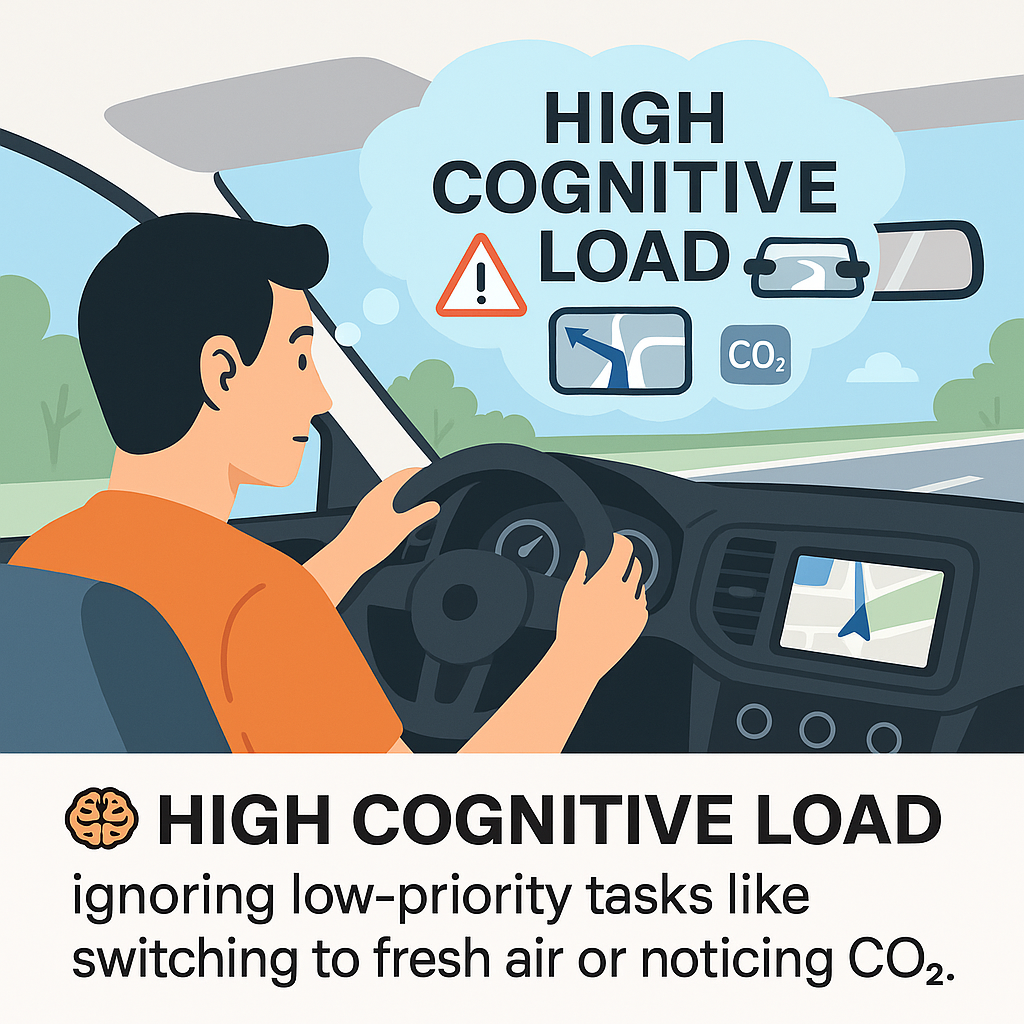
I used to think this was just a bad habit.
I’d switch to recirculation mode for a tunnel, traffic, heat, or pollution…
and then completely forget about it.
Minutes turned into an hour.
An hour turned into the whole drive.
And I’d only realize something was off when I felt:
- oddly tired
- mentally slow
- heavy-headed
Sound familiar?
Once I paid attention, I realized this isn’t carelessness — it’s human behavior interacting with car design.
Why Forgetting Happens So Easily
The more I thought about it, the more obvious it became.
1️⃣ Recirculation Solves an Immediate Problem
We usually switch to recirculation for a clear reason:
- it cools faster
- it blocks bad smells
- it feels quieter
- it feels more comfortable
The problem is solved instantly.
And once the discomfort is gone, our brain moves on.
There’s no reminder to switch back.
2️⃣ Fresh-Air Mode Doesn’t Create a Sensation
This was the key insight for me.
Switching to recirculation feels noticeable.
Switching back to fresh air often feels… like nothing.
No dramatic change.
No obvious reward.
So there’s no sensory cue that says:
“Hey, now would be a good time.”
Our brains are terrible at remembering invisible tasks.
3️⃣ Modern Cars Encourage “Set and Forget”
Auto mode, climate presets, quiet cabins — they all encourage trust.
We’re trained to think:
“The car will handle it.”
But most HVAC systems:
- don’t monitor CO₂
- don’t care how long air has been reused
- optimize comfort, not cognition
So nothing forces a reset.
4️⃣ CO₂ Doesn’t Warn You
This makes the habit even worse.
CO₂:
- has no smell
- causes no irritation
- doesn’t feel “bad”
Instead, it feels like:
- boredom
- fatigue
- a long drive
So even when the air needs refreshing, nothing feels urgent.
By the time I notice, the effect has already happened.
The Simple Fix I Use Now
I stopped relying on memory.
Because memory is the problem.
Instead, I changed the system.
✅ Fix #1: I Treat Recirculation as Temporary — Always
Now, whenever I switch to recirculation, I mentally label it as:
“This is temporary.”
Not a mode.
A short-term tool.
That one framing change made a difference.
✅ Fix #2: I Use CO₂ as a Trigger, Not a Feeling
I stopped waiting for:
- tiredness
- discomfort
- intuition
Instead, I watch CO₂ rise.
When it crosses my comfort threshold, I don’t negotiate with myself.
I switch to outside air.
No thinking required.
✅ Fix #3: I Ventilate Before I Feel Bad
This was the biggest shift.
I no longer wait until I feel dull.
I switch back early, while I still feel fine.
Because the goal isn’t recovery —
it’s prevention.
✅ Fix #4: I Let the Meter Do the Remembering
This was the real breakthrough.
I realized:
“If something is invisible and silent, I shouldn’t rely on my brain to track it.”
A CO₂ meter doesn’t forget.
It doesn’t get distracted.
It doesn’t normalize slow changes.
It just shows what’s happening.
That alone solved the problem for me.
Why This Isn’t a “Driver Problem”
I don’t blame myself anymore.
Drivers forget because:
- recirculation feels good
- fresh air doesn’t announce itself
- CO₂ gives no warning
- cars don’t remind us
This is a design gap, not a personal flaw.
Once I saw that, fixing it became easy.
Final Thoughts
Forgetting to switch back to fresh air isn’t laziness.
It’s what happens when:
- comfort is immediate
- consequences are delayed
- signals are invisible
The fix isn’t trying harder to remember.
The fix is:
- treating recirculation as temporary
- ventilating intentionally
- using real feedback instead of feelings
Once I stopped trusting memory and started trusting information,
this problem basically disappeared.
And the drives feel clearer because of it.
Amazon is a trademark of Amazon.com, Inc. or its affiliates.
Leave a Reply