I Used to Think the Air Was Clean — Until I Looked Closer
For a long time, I never questioned the air inside my car.
It didn’t smell bad.
The A/C worked well.
The cabin felt sealed, quiet, and comfortable.
So I assumed the air must be clean.
But once I started learning more about what actually exists inside a car cabin, I realized something important:
👉 The air inside a car isn’t automatically safe just because it feels comfortable.
Some harmful gases are obvious.
Others are completely invisible — and easy to ignore.
The Big Mistake I Used to Make
I used to think “air pollution” only came from outside:
- traffic exhaust
- factories
- smog
Once the doors closed and the windows were up, I felt protected.
But a car cabin is a small, enclosed environment, and some gases can:
- enter from outside
- be produced inside
- or accumulate simply because of human presence
Comfort doesn’t equal cleanliness.
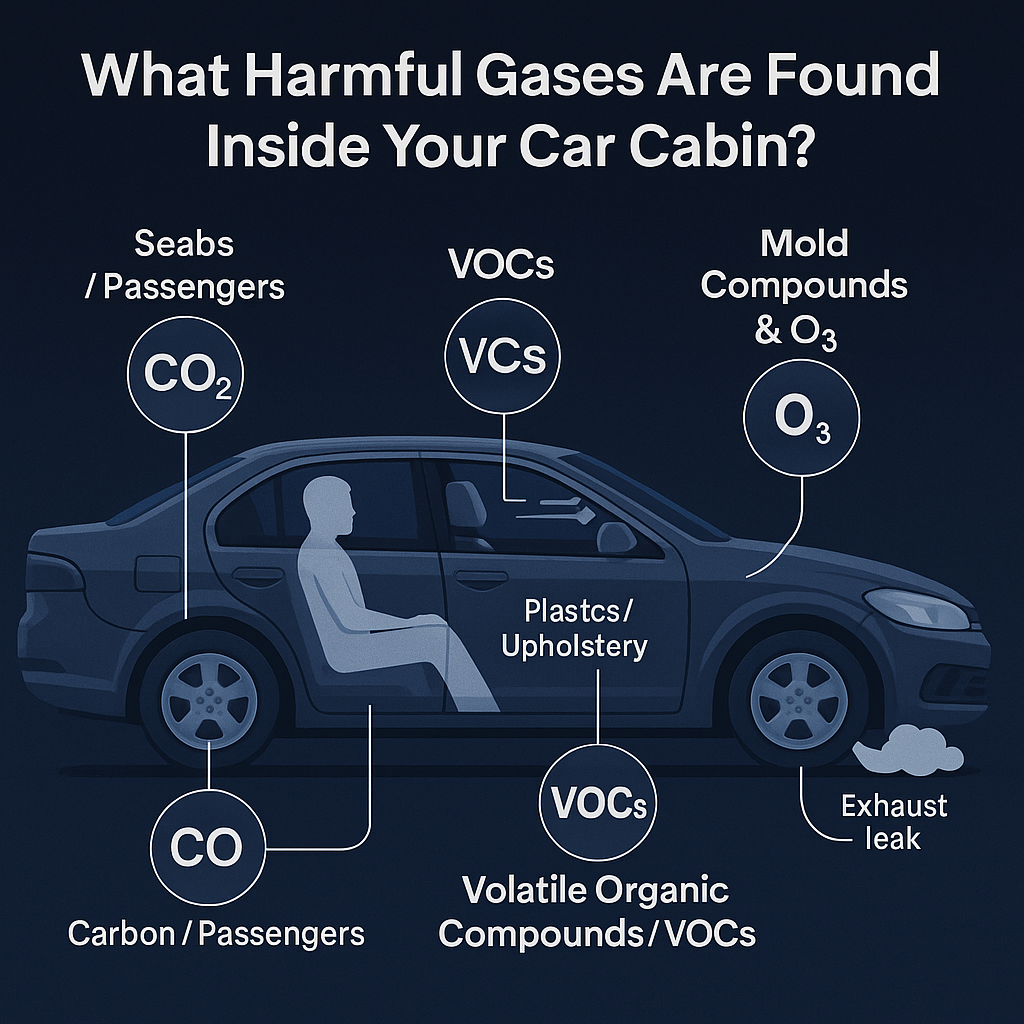
1️⃣ Carbon Dioxide (CO₂) — The Most Overlooked Gas
This is the one that changed my thinking completely.
CO₂ isn’t toxic in the dramatic sense.
It doesn’t smell.
It doesn’t irritate.
It doesn’t trigger alarms.
But inside a car, CO₂ can build up surprisingly fast, especially when:
- recirculation mode is on
- windows are closed
- multiple people are inside
- the drive is long
What it affects isn’t your lungs — it’s your brain.
High CO₂ levels are linked to:
- reduced alertness
- slower reaction time
- mental fatigue
That’s why CO₂ matters in a driving context, even though most people never think about it.
2️⃣ Carbon Monoxide (CO) — Rare, But Dangerous
Carbon monoxide is very different from CO₂.
CO comes from incomplete combustion, usually due to:
- exhaust leaks
- engine problems
- running a vehicle in enclosed spaces
Modern cars are designed to prevent CO from entering the cabin, so in normal driving, it’s uncommon.
But when it does occur, it’s dangerous because:
- it’s odorless
- it blocks oxygen transport in the blood
- it can cause serious health effects quickly
This is why CO is treated as a safety hazard, not a comfort issue.
(Important note: CO and CO₂ are completely different gases with different risks.)
3️⃣ Nitrogen Oxides (NOₓ) — From Traffic Outside
Nitrogen oxides mainly come from:
- vehicle exhaust
- diesel engines
- heavy traffic
They usually enter the cabin from outside air, especially when:
- driving in congestion
- following trucks or buses
- ventilating near busy roads
NOₓ can irritate the respiratory system and contribute to headaches or discomfort.
Cabin filters help reduce exposure — but they don’t eliminate everything.
4️⃣ Volatile Organic Compounds (VOCs) — From the Car Itself
This one surprised me.
VOCs don’t always come from outside.
They often come from inside the car:
- plastics
- upholstery
- adhesives
- dashboard materials
- new-car interiors
That “new car smell” is actually VOCs off-gassing.
In small amounts, they’re usually not harmful, but:
- heat increases VOC release
- sealed cabins concentrate them
- long exposure can cause discomfort or headaches
This is one reason ventilating a parked car matters — even when it’s brand new.
5️⃣ Ozone (O₃) — Rare, But Possible
Ozone isn’t commonly found inside car cabins, but it can appear:
- in polluted urban environments
- near industrial zones
- if aftermarket air purifiers generate ozone (a big red flag)
Ozone can irritate the lungs and airways, even at low concentrations.
This is why I’m cautious about any device that claims to “purify air” by producing ozone.
Why Cars Are a Special Case
What makes all these gases more relevant in cars isn’t just their presence — it’s the environment:
- small air volume
- tight sealing
- long occupancy
- recirculation modes
- limited ventilation
Even low concentrations can matter more because there’s less air to dilute them.
The Key Insight I Took Away
Here’s the conclusion I reached:
A car cabin isn’t dangerous by default —
but it is a space where invisible things can quietly accumulate.
Some gases are rare but serious (like CO).
Some are common but subtle (like CO₂).
Some come from outside, others from the car itself.
And none of them announce themselves clearly.
What I Do Differently Now
I don’t panic about cabin air.
But I do:
- ventilate intentionally
- avoid overusing recirculation
- air out the car when parked in heat
- separate “comfort” from “air quality”
Most importantly, I stopped assuming that silence and comfort mean safety.
Final Thoughts
The most harmful gases inside a car cabin aren’t always the ones that scare us the most.
Often, they’re the ones we don’t notice at all.
Understanding what’s actually in the air helped me:
- drive more alert
- feel better on long trips
- and stop guessing based on smell or comfort
Because in a small, sealed space like a car,
what you can’t see or smell often matters the most.
Amazon is a trademark of Amazon.com, Inc. or its affiliates.
Leave a Reply