When I first started working with CO₂ measurement devices, I didn’t really understand how they actually detect carbon dioxide in the air.
I assumed there was some magical little chip inside that just “knew” how much CO₂ was around.
But as I dug into the technology — and used it every day — I came to appreciate the true star behind the scenes: NDIR — non-dispersive infrared sensing.
It’s not fancy chemistry.
It’s not a new semiconductor trick.
It’s physics — very simple, very elegant, and incredibly reliable. CO2 Meter+1
The Magic of Infrared Absorption — The CO₂ “Fingerprint”
Here’s the key: CO₂ molecules absorb infrared (IR) light at very specific wavelengths.
That’s just a physical property of the molecule — the same way chlorophyll absorbs red and blue light and reflects green.
In the case of CO₂, there’s a part of the infrared spectrum — around ~4.26 µm — that it really likes to absorb. Unitense+1
This is the core idea behind NDIR sensors:
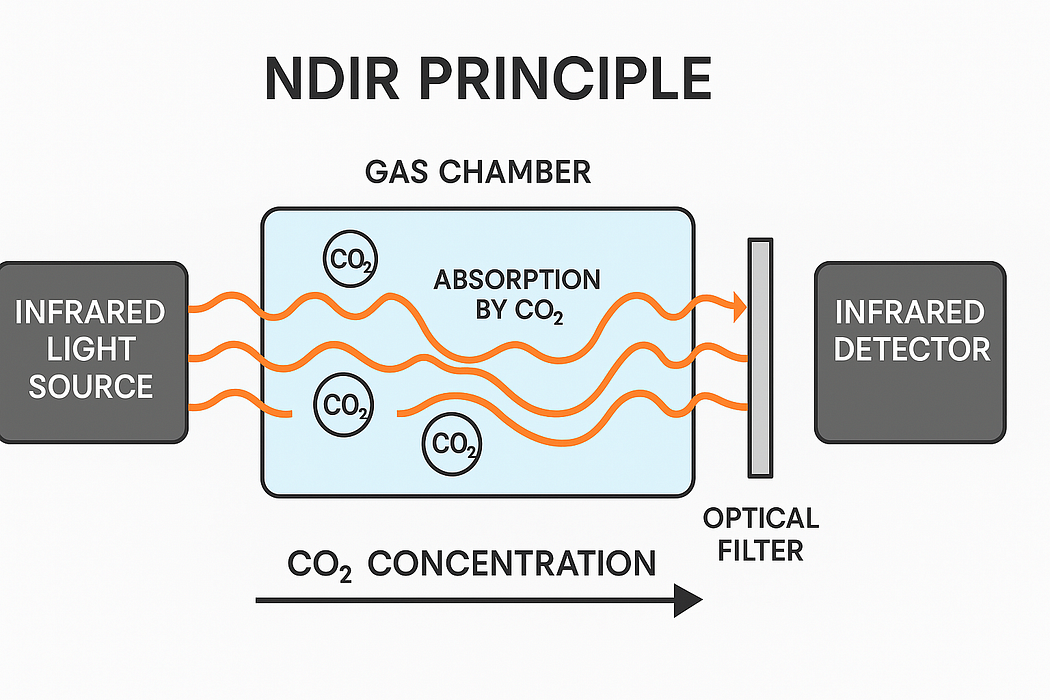
- An infrared light source shines IR light into a small air chamber.
- CO₂ molecules in that chamber absorb some of that light.
- A detector on the other side measures how much IR light actually made it through.
- The less light that reaches the detector, the more CO₂ must be present — because CO₂ absorbed it. CO2 Meter+1
This follows what’s known in science as the Beer-Lambert law — basically:
More absorbing molecules → less transmitted light. Winsen Sensor
That’s the entire measurement. Simple, physics-based, and no chemical reactions involved.
Why “Non-Dispersive” Matters
You might wonder what “non-dispersive” really means.
In spectroscopy, a dispersive instrument would separate the full infrared light into a rainbow of wavelengths (like a prism) and measure parts of that spectrum.
In contrast, NDIR doesn’t disperse the light.
Instead:
- It uses a broad IR light source.
- It relies on optical filters tuned to the specific absorption wavelengths.
- The detector looks only at the wavelengths CO₂ absorbs — ignoring all others. 维基百科
So NDIR focuses on the gas’s “signature wavelength” without complex optics — making it simpler, cheaper, and more robust than a full spectrometer.
What Actually Happens Inside the Sensor
Let me paint a mental picture of what’s inside an NDIR CO₂ sensor:
- IR Light Source
A tiny lamp or IR LED produces a broad spectrum of infrared light. Akm - Optical Cavity / Gas Chamber
Air from the environment enters this tube or chamber. CO2 Meter - IR Light Path
The IR light passes through the chamber, interacting with the air sample. Akm - Filter and Detector
A filter lets through only the specific wavelengths CO₂ would absorb. A detector measures the remaining IR light. 维基百科 - Signal Processing
The sensor compares the detected light to what it expects if there were no CO₂ present. That difference is converted into a CO₂ concentration value. Sensirion AG
This combination gives CO₂ sensors repeatable, stable results — which is why NDIR is the dominant technology used in indoor air quality monitors, HVAC systems, safety devices, environmental sensors, and consumer products alike. Pressac
Why I Trust NDIR More Than Other Approaches
I came to appreciate this technology for a few reasons:
✅ No chemical reactions — no consumable reagents to wear out.
✅ Good stability over time — the physics doesn’t change unless something is physically damaged. PMC
✅ Very clear principle — it’s literally measuring how many CO₂ molecules are removing light from a known path.
Other gas sensors (like chemical or metal-oxide types) often rely on surface reactions that change resistance or produce a voltage. They can drift, be temperature-sensitive, and need frequent calibration.
But NDIR — it’s optical physics — and once you understand how it works, it feels trustworthy and intuitive.
Wrapping Up
So now when I think of CO₂ measurement, I don’t imagine tiny electrochemical reactions — I think of light and molecules dancing inside a tiny chamber:
- IR light goes in.
- CO₂ absorbs its favorite wavelength.
- The detector measures what’s missing.
- Software turns that into a CO₂ ppm value.
It’s elegant, it’s reliable, and it’s rooted in physics — not guesswork.
And that’s why, for me, NDIR is the gold standard for measuring CO₂ concentration in the air.
Amazon is a trademark of Amazon.com, Inc. or its affiliates.
Leave a Reply