I Used to Think the Answer Was Obvious — It Isn’t
For a long time, I thought this was a simple question.
Underground parking garage?
Of course I should use recirculation, right?
After all:
- there are exhaust fumes
- cars are idling
- the air smells “dirty”
Fresh air felt like the wrong choice.
But once I started paying closer attention to how air actually behaves in enclosed spaces, I realized something important:
👉 In underground garages, “fresh air” doesn’t always mean clean air — and recirculation doesn’t always mean safer air.
The right choice depends on what problem you’re actually trying to avoid.
Why Underground Garages Feel So Uncomfortable
Underground parking garages share several characteristics that make air quality tricky:
- limited natural ventilation
- accumulated vehicle exhaust
- higher CO₂ levels than outdoors
- slow air exchange
- multiple emission sources close together
Even when a garage is mechanically ventilated, air movement is often uneven.
Some zones are better.
Some are worse.
And your car moves through all of them.
The First Instinct: “Block Outside Air”
My instinct was always:
“Outside air here must be worse than inside air.”
So I’d switch to recirculation automatically.
That does make sense for certain pollutants:
- strong exhaust odors
- particulate matter
- NOₓ and hydrocarbons
Recirculation can reduce how much of that you pull directly into the cabin.
But that’s only half the story.
What Recirculation Quietly Does in a Garage
When recirculation is on:
- the cabin becomes a closed loop
- outside pollutants are reduced
- CO₂ from passengers accumulates faster
- air refresh rate drops sharply
In a short garage pass, that’s usually fine.
But in situations like:
- waiting for a spot
- queuing at an exit
- idling in traffic inside the garage
- sitting in the car while parked
CO₂ can rise faster than people expect.
And unlike exhaust smell, CO₂ gives no warning.
Why “Fresh Air” Isn’t Truly Fresh in a Garage
Here’s the uncomfortable truth I had to accept:
👉 Air drawn from an underground garage is still garage air.
Fresh-air mode in this context means:
- air from the garage space
- not outdoor ambient air
- often higher CO₂ than outside
- often mixed with exhaust
So switching to fresh air doesn’t magically solve everything.
It trades:
- lower cabin CO₂ buildup
for - increased exposure to garage pollutants
Neither option is perfect.
The Real Question Isn’t “Fresh or Recirculation”
The real question is:
How long am I in this environment — and what risk matters more right now?
I now think of it in time scales.
My Practical Rule of Thumb
Here’s how I handle it now:
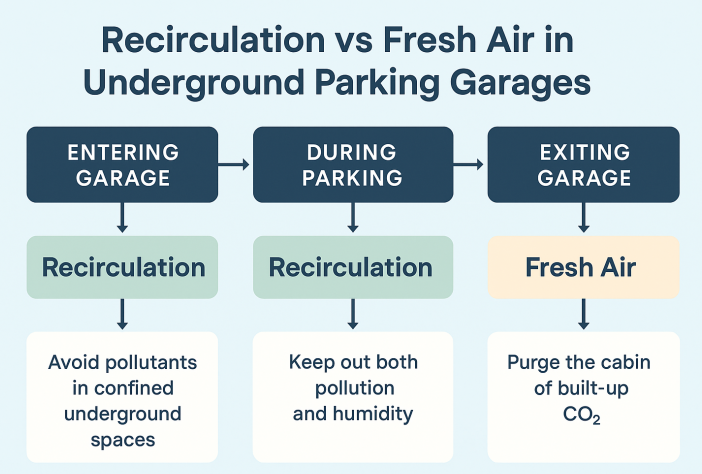
⏱️ Short Pass Through the Garage
- driving in or out
- no waiting
- no stopping
👉 Recirculation is usually fine.
You minimize exhaust intake, and CO₂ doesn’t have time to build up.
🚦 Slow Traffic or Waiting Inside the Garage
- queuing
- idling
- searching for parking
- waiting in the car
👉 I prioritize periodic fresh air.
Even though the air isn’t ideal, breaking the closed loop matters.
🅿️ Sitting Parked in the Garage
- engine on
- A/C running
- windows closed
👉 This is where awareness really matters.
Recirculation for long periods is the easiest way to let CO₂ climb unnoticed.
In this case, I either:
- ventilate intermittently
- open windows briefly if safe
- or leave the car sooner
Why There’s No Perfect Setting
Underground garages are compromise spaces.
You’re choosing between:
- chemical pollutants
- reused air
That’s not a failure of your car.
It’s the nature of enclosed infrastructure.
The goal isn’t perfection.
It’s minimizing the dominant problem for the time you’re there.
What Changed My Mindset
I stopped asking:
“Which mode is correct?”
And started asking:
“What is the air doing right now — and how long will I be here?”
That single shift made my decisions calmer and more consistent.
No panic.
No rigid rules.
Just situational awareness.
Final Thoughts
In underground parking garages:
- “fresh air” isn’t truly fresh
- recirculation isn’t automatically safer
- CO₂ and exhaust behave differently
- time matters more than mode
The mistake I used to make was treating this as a binary choice.
It isn’t.
It’s a temporary strategy for a temporary environment.
Once I understood that, I stopped relying on habit
and started relying on context.
And in spaces where air quality is inherently compromised,
context is the most reliable guide you have.
Amazon is a trademark of Amazon.com, Inc. or its affiliates.
Leave a Reply