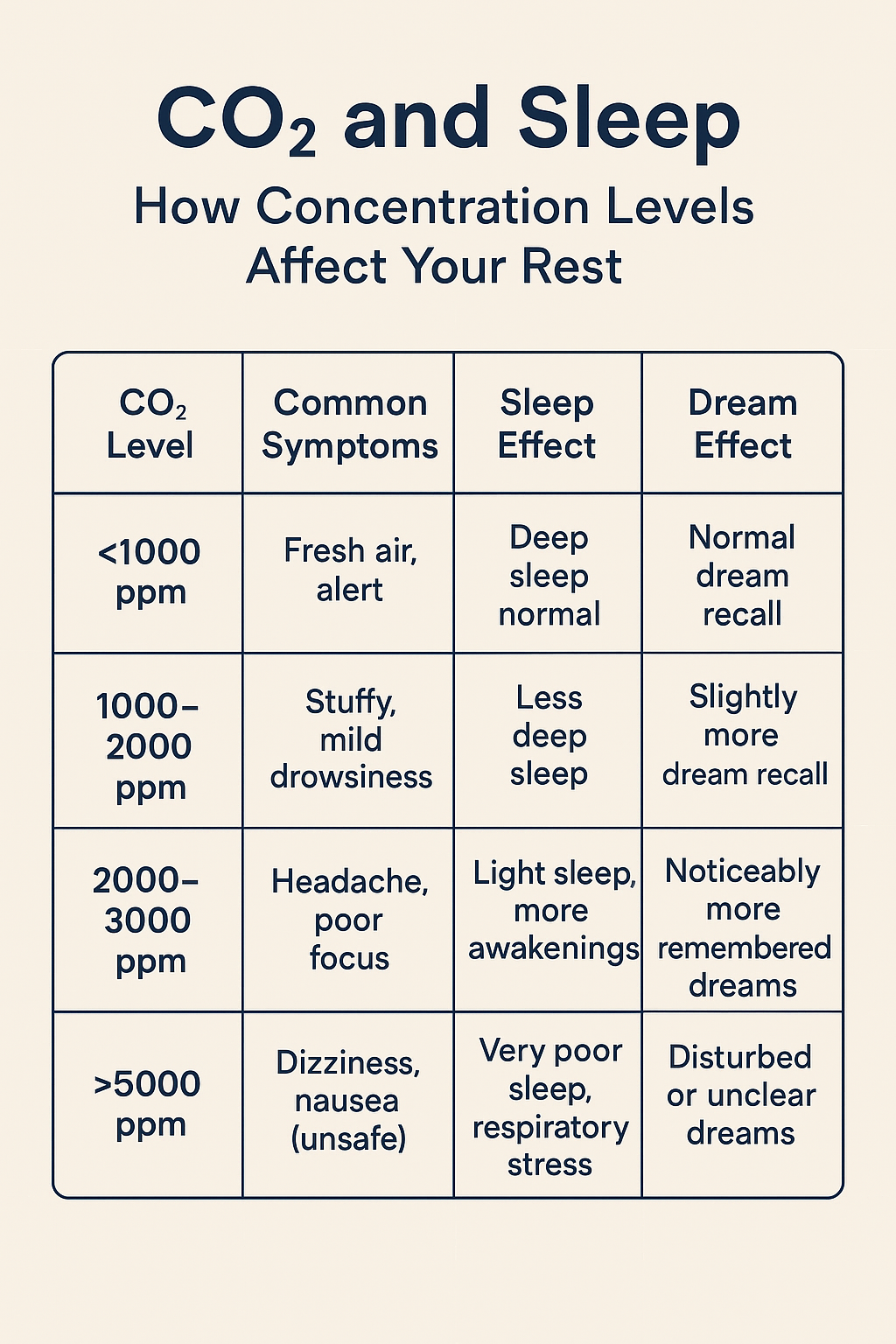
My Honest Take After Thinking About CO₂, Sleep, and the Brain
This is the kind of question that sounds like a quirky late-night thought:
“I slept in my car last night… my dreams were weird… was it because of high CO₂?”
I had the same thought once — especially after car camping and waking up feeling like my brain had been in a weird place overnight.
But here’s what I learned when I dug into it:
👉 There’s no solid scientific evidence that high CO₂ directly causes more dreams.
However, CO₂ can affect sleep quality and brain state, which may change how you remember or experience dreams.
Let me explain how that works — in practical, real-world terms.
🧠 First: Dreams Happen in REM Sleep
Dreams almost always occur during Rapid Eye Movement (REM) sleep, the stage when the brain is most active and the body is most relaxed.
Whether you remember dreams depends on:
- how long you stay in REM
- how often you wake up during or after REM
- how deep your sleep cycles were
- factors that affect brain oxygenation and alertness
So anything that changes sleep architecture — even subtly — might change how dreams are experienced or remembered.
💤 So Where Does CO₂ Come In?
High CO₂ doesn’t directly “cause dreams,” but it can influence factors linked to dream experience:
1. Difficulty Getting Deep Sleep
Elevated CO₂ is linked to:
- reduced oxygenation perception
- subtle physiological stress
- sleep fragmentation
If your brain senses even mild respiratory imbalance, it can move you out of deep, restorative sleep more often.
That means:
- less slow-wave sleep
- more frequent transitions
- potentially more frequent REM awakenings
Waking up near or during REM makes dreams easier to remember — which can feel like “more dreaming.”
But it’s memory, not creation.
2. Increased Light Sleep and Fragmentation
High CO₂ can subtly interfere with breathing regulation.
Even if you don’t fully wake up, your nervous system may:
- increase micro-arousals
- raise brain activity slightly
- shift sleep stages more often
That makes REM episodes more accessible to awareness.
Not more dreams — just more recall.
3. Subtle Physiological Stress
CO₂ doesn’t irritate or smell. It doesn’t trigger alarm signals.
Instead, it influences:
- blood gas balance
- respiratory drive
- neural regulation
While it doesn’t act like a poison (like carbon monoxide), it can make the sleep environment slightly suboptimal — and the body notices.
The result?
Your brain may:
- cycle differently
- enter or leave REM more frequently
- generate more vivid dream recall
Not because CO₂ creates dreams — but because it changes the context your brain is sleeping in.
🧠 But Does CO₂ Increase the Number of Dreams?
Here’s the honest conclusion:
❌ High CO₂ does not create more dreams as a direct cause.
Dreams are generated by brain activity in REM sleep — and CO₂ doesn’t trigger REM onset.
✔ High CO₂ may alter sleep architecture enough that you experience or remember dreams differently.
That’s why some people report “weirder” dreams, “more vivid” dreams, or “feeling like I dreamed more” after nights in enclosed spaces.
But this is about sleep quality and transitions, not CO₂ creating dreams.
🛌 So What Does High CO₂ Actually Do During Sleep?
From what I’ve gathered and experienced personally:
- makes sleep feel less deep
- increases light sleep phases
- may increase waking near REM
- can subtly affect oxygen regulation
- leads to more dream recall, not more dream production
In simple terms:
👉 You don’t dream more —
you wake up in ways that make dreams stick with you.
That’s a big difference in experience, even if the brain’s actual dream count stays the same.
🧠 My Personal Experience
After sleeping in a closed car with limited ventilation, I noticed:
- dreams felt more “vivid”
- I remembered more of them
- I woke up feeling less refreshed
- the night felt more “fragmented” in hindsight
That felt like dreaming more — but once I tracked air quality and sleep quality together, the pattern made sense:
Poor air exchange → subtle sleep disruption → more REM proximity on waking → stronger dream memory.
Not “CO₂ causes dreams.”
🧡 Final Thoughts
High CO₂ doesn’t directly cause more dreams.
But it can influence the conditions of your sleep — and that can change how your brain cycles through sleep stages and how vivid or memorable your dreams feel when you wake up.
So if you’ve ever woken up from a night in a closed car and thought:
“Wow, I had so many dreams last night!”
…that’s probably your sleep architecture reacting to the environment — not CO₂ pouring dream energy into your brain.
And that’s an important distinction.
Amazon is a trademark of Amazon.com, Inc. or its affiliates.
Leave a Reply