I Used to Mix These Up Too. That Was a Mistake.
For a long time, I avoided talking about CO₂ in cars because of one reason:
People kept confusing it with CO.
Same letters.
Similar names.
Completely different risks.
And the more I paid attention, the more I realized this confusion isn’t harmless — it actually prevents people from understanding both problems properly.
So I want to explain this the way it finally made sense to me.
The Critical Difference I Didn’t Fully Understand at First
Here’s the sentence that changed everything for me:
CO₂ affects how well your brain works.
CO affects whether your blood can carry oxygen at all.
They are not variations of the same danger.
They are fundamentally different gases with different behaviors.
What CO₂ (Carbon Dioxide) Really Is in a Car
CO₂ is a natural byproduct of breathing.
Inside a car, CO₂ comes from:
- you
- your passengers
- your pets
That’s it.
CO₂ rises when:
- the cabin is small and sealed
- recirculation mode is used
- fresh air intake is limited
- time passes
It does not come from the engine or exhaust.
What CO₂ Does
At elevated levels, CO₂:
- reduces alertness
- slows reaction time
- dulls thinking
- increases mental fatigue
It does this quietly.
No smell.
No pain.
No warning.
CO₂ is about cognitive performance, not poisoning.
What CO (Carbon Monoxide) Really Is in a Car
CO is a toxic gas produced by combustion.
In cars, CO comes from:
- exhaust leaks
- engine problems
- running a vehicle in enclosed spaces
Modern cars are designed to keep CO out of the cabin — and under normal driving conditions, they usually succeed.
What CO Does
CO:
- binds to hemoglobin in your blood
- blocks oxygen transport
- deprives organs of oxygen
- can cause serious injury or death
CO is a medical emergency gas.
It’s not about comfort or alertness — it’s about survival.
Why Confusing CO₂ and CO Is So Dangerous
Here’s where things go wrong.
When people hear “CO₂ in cars,” they sometimes think:
“Isn’t that the deadly one?”
So they either:
- panic unnecessarily
- dismiss the topic entirely
- assume it’s already regulated like CO
Both reactions miss the point.
CO₂ doesn’t replace CO as a danger.
And CO doesn’t make CO₂ irrelevant.
They are two separate risks, handled in different ways.
Why Cars Warn You About CO — But Not CO₂
This finally clicked for me:
Cars warn about CO because:
- it’s sudden
- it’s dangerous
- it requires immediate action
Cars don’t warn about CO₂ because:
- it rises gradually
- it doesn’t cause acute distress
- it affects performance, not survival
But driving is exactly where performance matters.
Just because something isn’t lethal doesn’t mean it’s irrelevant.
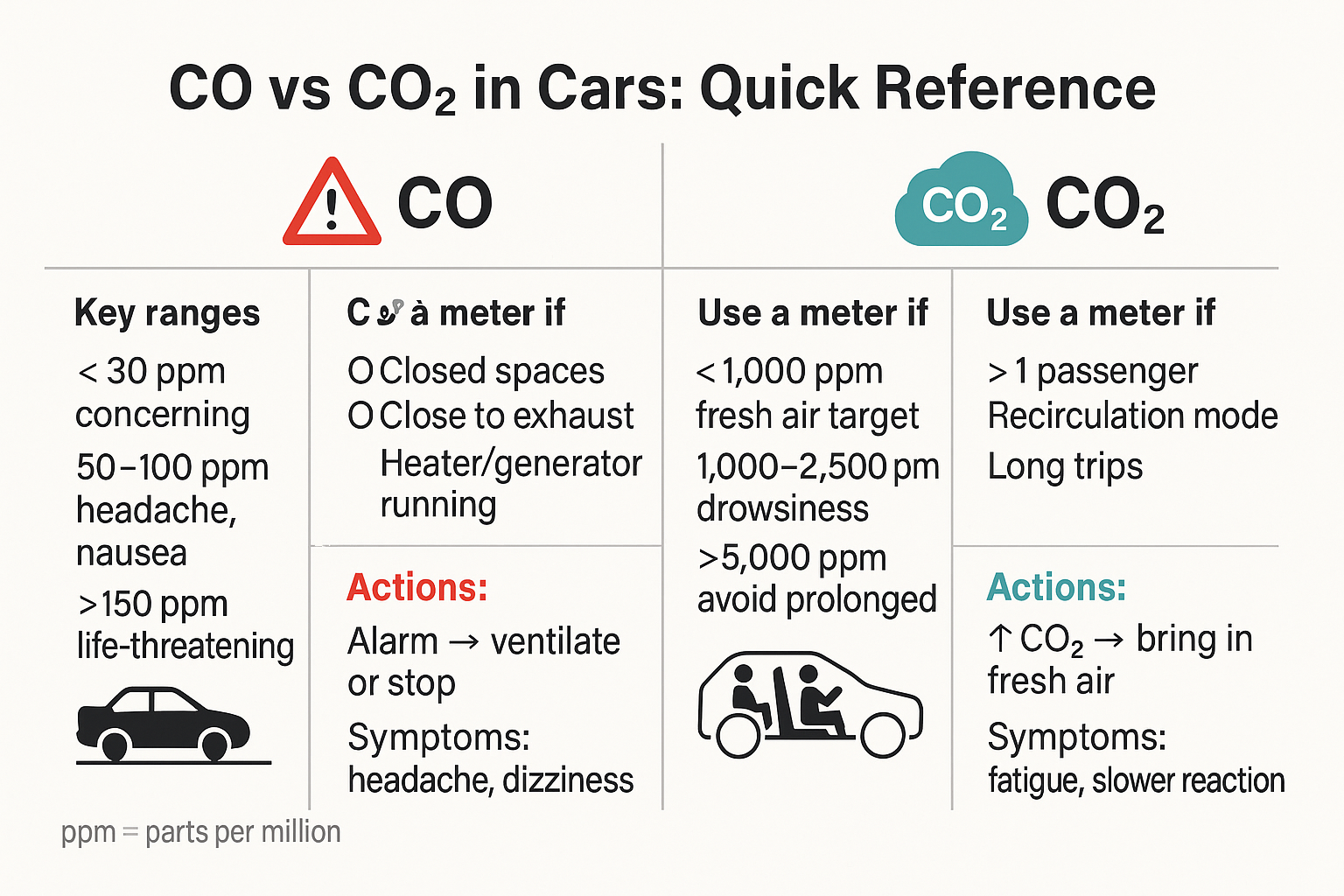
The Table That Helped Me Remember
This mental comparison helped me stop mixing them up:
- CO₂ → breathing, buildup, alertness, fatigue
- CO → combustion, malfunction, poisoning, emergency
Different sources.
Different timelines.
Different consequences.
Why CO₂ Still Deserves Attention in Cars
Once I separated CO₂ from CO in my mind, I stopped asking:
“Is CO₂ dangerous like CO?”
And started asking the better question:
“Do I want to drive while my brain is operating below its best?”
That’s what CO₂ is about.
Not fear.
Not toxicity.
Not emergency alarms.
Just awareness.
Final Thoughts
CO₂ and CO share letters, not meaning.
One dulls your thinking quietly.
The other steals oxygen aggressively.
Confusing them helps no one.
Once I learned to treat them as separate, unrelated risks, I finally understood why:
- CO alarms exist
- CO₂ monitoring still matters
- and modern cars can be safe and mentally demanding at the same time
Understanding the difference doesn’t make driving scarier.
It makes it clearer.
And clarity — especially while driving — is always worth having.
Amazon is a trademark of Amazon.com, Inc. or its affiliates.
Leave a Reply