I Trusted That Screen… Until I Realized What It Wasn’t Showing
For a long time, I felt reassured by my car’s air-quality display.
It showed:
- green when things were “good”
- yellow or red when something was “bad”
Sometimes it even proudly said “Air Quality: Excellent.”
So I assumed:
“If the screen says it’s clean, the air must be fine.”
But once I started learning what that display was actually measuring, I realized something important — and a little uncomfortable:
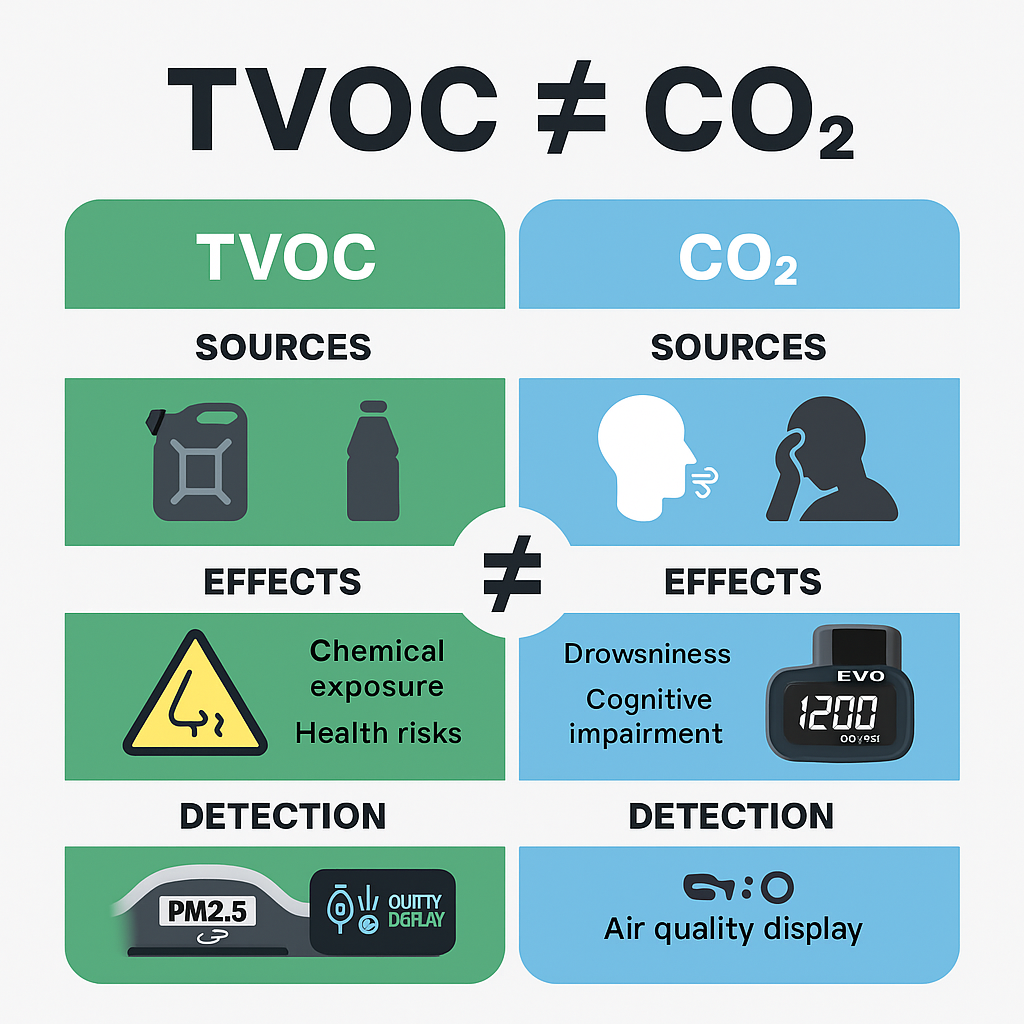
👉 Most in-car air-quality systems are measuring TVOC, not CO₂.
And those are not the same thing.
The Assumption Almost Everyone Makes
The mistake I made — and I see others make too — is this:
“Air quality is air quality.
One good number means everything is fine.”
But air quality isn’t a single thing.
It’s a collection of different variables that behave very differently.
And TVOC and CO₂ are two of the most commonly confused.
What TVOC Actually Measures
TVOC stands for Total Volatile Organic Compounds.
In a car, TVOCs usually come from:
- interior plastics
- adhesives
- upholstery
- dashboard materials
- cleaners or fragrances
- outside pollution
That “new car smell”?
That’s TVOCs.
So when your car’s air-quality system reacts to:
- a strong odor
- outside exhaust
- chemical smells
…it’s doing exactly what it was designed to do.
And that’s useful.
But it’s only part of the picture.
What CO₂ Actually Measures
CO₂ is completely different.
CO₂ comes from:
- you
- your passengers
- breathing
It doesn’t come from materials.
It doesn’t come from smells.
It doesn’t come from pollution outside.
And here’s the key point:
👉 CO₂ rises even when the air smells clean and feels comfortable.
Especially in:
- sealed cabins
- recirculation mode
- long drives
- modern, quiet cars
CO₂ is a reuse-of-air indicator, not a contamination indicator.
Why the Display Can Say “Excellent” While CO₂ Is Rising
This was the moment everything clicked for me.
Your car’s display might say:
- low TVOC
- clean air
- no pollution detected
And all of that can be true.
At the same time:
- CO₂ can be climbing
- fresh air intake can be minimal
- the same air can be reused again and again
So the screen isn’t lying.
It’s just not measuring the thing you think it is.
Why Cars Chose TVOC — Not CO₂
Once I looked at it from the car manufacturer’s perspective, the choice made sense.
TVOC sensors:
- respond to odors and pollution
- align with “new car smell” concerns
- match customer expectations
- tie into filtration and recirculation logic
CO₂ sensors:
- don’t affect smell
- don’t affect temperature
- don’t trigger obvious discomfort
- aren’t regulated for in-car use
So TVOC fits neatly into comfort and marketing.
CO₂ doesn’t.
Why This Matters in Real Driving
Here’s where the gap becomes important.
TVOC affects:
- irritation
- odor
- chemical exposure
CO₂ affects:
- alertness
- reaction time
- mental clarity
If you only look at TVOC:
- you know whether the air smells or contains chemicals
If you look at CO₂:
- you know whether the air is being refreshed
Both matter.
But they answer different questions.
The Mistake I Don’t Make Anymore
I no longer assume:
“Green = everything is fine.”
Now I ask:
- Is the air clean? (TVOC)
- Is the air fresh? (CO₂)
Those are not the same thing.
A cabin can be:
- chemically clean
- odor-free
- filtered
…and still be:
- stale
- reused
- high in CO₂
That realization changed how I think about in-car air quality completely.
Final Thoughts
TVOC and CO₂ aren’t competitors.
They’re different lenses.
TVOC tells you about what’s in the air.
CO₂ tells you about how often the air is replaced.
Most cars only show one of those.
So when your dashboard says “air quality is good,” it’s telling a truth —
just not the whole truth.
Once I understood that, I stopped relying on a single green icon
and started thinking more clearly about what my lungs — and my brain — were actually breathing.
Because in a modern car,
clean air and fresh air are not always the same thing.
Amazon is a trademark of Amazon.com, Inc. or its affiliates.
Leave a Reply