A Driver Habit I Never Knew I Had — Until I Paid Attention
For years, I didn’t think much about the air circulation mode in my car.
I’d turn on recirculation mode to cool down faster, block outside smells, or just get comfortable —
and then completely forget about it.
Minutes passed…
sometimes an hour…
sometimes the whole drive.
At first, I thought it was just me being forgetful.
“I should remember to switch it back,”
I’d tell myself.
But once I started paying attention — instead of blaming myself — I realized something important:
👉 Forgetting to switch back to fresh-air mode isn’t just forgetfulness — it’s human nature.
And once I understood why, it made me rethink how I actually use my car’s ventilation system.
The Decision That Has No Natural Ending
Here’s the thing:
Turning on recirculation solves an immediate problem
— hot air outside, unpleasant odors, slow cooling.
But turning it off doesn’t present the same clear signal.
There’s no:
- discomfort
- smell
- urgent cue
- sensory feedback
to tell your brain,
“Hey — now’s the time to fix it.”
So you put recirculation on for a reason, and the car stays that way…
not because you forgot — but because there was nothing to remind you to switch back.
That’s why it happens again and again.
Comfort Quietly Hides the Problem
This is the part that surprised me most.
Recirculation often feels good:
- the cabin cools faster
- the fan feels steady
- the air feels pleasant
So your brain interprets that as:
“Everything is fine.”
And because recirculation doesn’t hurt,
your nervous system doesn’t register a problem.
Unlike heat or cold —
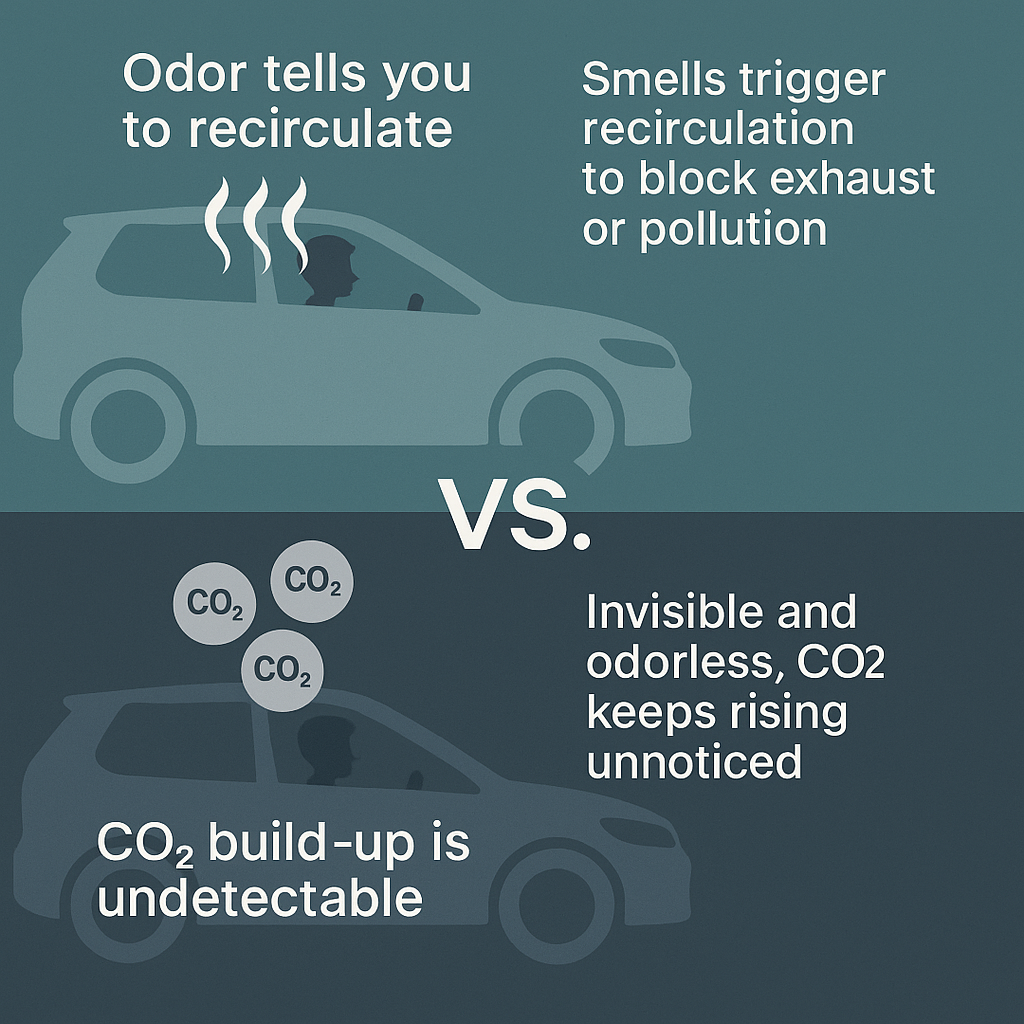
CO₂ doesn’t make us uncomfortable in an obvious way.
It doesn’t:
- burn your eyes
- make you cough
- trigger an instinctive reaction
It just quietly accumulates.
And your brain happily ignores it.
Modern Cars Make It Even Easier to Forget
In older cars, I could tell when ventilation changed:
- the airflow sounded different
- the fan changed pitch
- the indicator light was right there
But modern cars?
They’re quieter.
Softer.
More seamless.
Sometimes the air-circulation status is buried in menus or tiny icons.
That means when the car switches between recirculation and fresh air automatically, most of us never even notice —
because the system never told us in a way that mattered.
Why Our Brains Aren’t Built to Track This
I finally realized something about how humans pay attention:
Our brains are wired to notice things that:
✔ hurt
✔ smell
✔ feel bad
✔ demand a response
But CO₂ doesn’t.
It’s invisible.
No smell, no irritation — just a subtle cognitive drag you don’t consciously notice until later.
So unless something dramatically changes the environment, we simply don’t track it.
That’s normal human behavior — not careless driving.
The Change That Made a Real Difference
What finally helped me wasn’t forcing myself to remember.
It was creating a trigger I actually notice.
Instead of thinking:
“I should remember to switch back,”
I now pay attention to:
- how the air feels neurologically
- whether I suddenly feel dull
- whether my focus feels lower
- the CO₂ number (if I’m using a meter)
When I notice that shift first — before discomfort sets in —
switching to fresh-air mode becomes an active choice, not an afterthought.
A Simpler Way to Think About It
Here’s a habit I developed that helps:
👉 Treat recirculation as a temporary tool — not a mode.
When I switch it on, I immediately tell myself:
“This is temporary.”
This simple mental label makes it easier to remember later.
Not because I’m disciplined —
but because now the mind categorizes the action differently.
Temporary → reversible → noticeable.
It’s subtle, but it works.
Final Thoughts
Forgetting to switch back to fresh-air mode isn’t a flaw.
It’s a predictable result of:
- solving a problem that disappears quickly
- having no sensory alert when the hidden problem (CO₂) builds up
- modern cars hiding circulation feedback
- brains that ignore invisible, slow changes
And once I stopped beating myself up for forgetting, everything changed.
Instead of hoping I’ll remember,
I now understand why I don’t —
and I design my habits around that reality.
Because when the driver stops blaming memory and starts designing attention, the air in the car becomes something you manage — not something you hope is fine.s — but only a CO₂ meter can tell you when to open them again.
Amazon is a trademark of Amazon.com, Inc. or its affiliates.
Leave a Reply