I Used to Think It Was Just “Bad Ventilation” — It’s More Than That
The first time I noticed CO₂ climbing quickly inside an RV, I assumed something was wrong.
Maybe:
- the windows were too tight
- the vents weren’t working
- the RV design was flawed
But the more time I spent inside different RVs, the clearer it became:
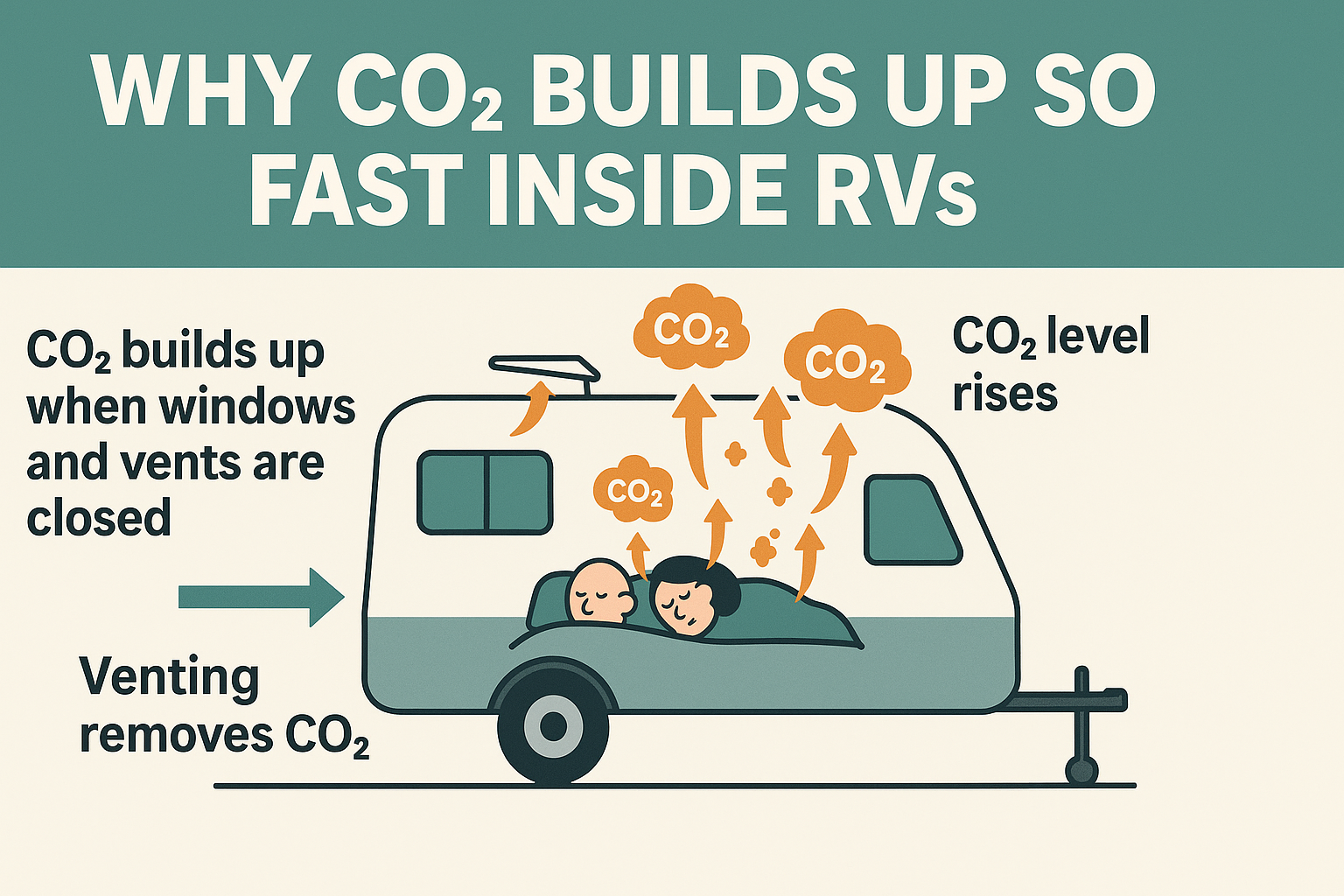
👉 CO₂ builds up fast in RVs not because something is broken — but because RVs are designed to do exactly what they’re good at.
And what they’re good at is sealing space.
RVs Are Small Spaces With Big Occupancy Time
The first factor is simple physics.
An RV has:
- far less air volume than a house
- fewer rooms to dilute air
- one shared sleeping and living space
At the same time, RVs are used in a very specific way:
- people stay inside for long, continuous periods
- especially at night
- often with doors and windows closed
So CO₂ input (from breathing) is steady, while air replacement is minimal.
That imbalance alone explains a lot.
CO₂ Input Is Continuous — Ventilation Is Not
This was the key shift in how I understood the problem.
Inside an RV:
- breathing adds CO₂ every second
- ventilation is usually intermittent or off
That means CO₂ doesn’t spike suddenly — it ramps up.
And because CO₂ is a stable gas, it doesn’t:
- decay
- settle
- get absorbed by materials
It stays in the air until it’s replaced.
Time, not activity, becomes the main driver.
RVs Are Designed to Be Airtight (On Purpose)
Modern RVs are built to:
- retain heat in cold weather
- keep cool air in during summer
- block noise and dust
- improve energy efficiency
All of that requires tight sealing.
That’s great for comfort.
But it also means:
- fewer passive air leaks
- less natural air exchange
- slower dilution of exhaled CO₂
What feels like comfort is also containment.
Sleeping Is the Perfect CO₂ Accumulation Scenario
At night, everything aligns for CO₂ buildup:
- long, uninterrupted occupancy
- minimal movement
- ventilation often turned off
- windows fully closed
- steady breathing for hours
Nothing dramatic happens.
But hour by hour, CO₂ climbs.
And because nothing smells or feels wrong, it goes unnoticed until morning — if at all.
Cooking and Heating Add to the Problem
Sleeping isn’t the only contributor.
Inside RVs, CO₂ can also rise quickly during:
- cooking (especially propane or gas)
- heating with combustion-based systems
- multiple people inside during bad weather
Each of these adds CO₂ faster than normal breathing alone.
And they often happen when windows are least likely to be opened.
Why Fans and Vents Often Don’t Solve It
I used to assume:
“If I have a vent fan, I’m fine.”
But many RV fans are designed for:
- moisture control
- odor removal
- short-term airflow
Not sustained air exchange.
If:
- the fan isn’t running continuously
- intake air has no clear path
- the system recirculates internally
CO₂ still accumulates.
Air has to be replaced, not just moved.
Why You Don’t Feel CO₂ Rising
This is what makes RV CO₂ buildup so deceptive.
CO₂:
- has no smell
- causes no irritation
- doesn’t wake you up
- doesn’t trigger alarms
So even when levels rise significantly, your body doesn’t complain.
You might wake up tired.
Or foggy.
Or slightly off.
But you won’t feel a clear “air problem.”
The Mental Model That Finally Made Sense
Here’s how I think about it now:
An RV is a sealed container where air is slowly reused unless you deliberately refresh it.
CO₂ buildup isn’t a sign of failure.
It’s the default outcome of:
- small volume
- tight sealing
- long occupancy
Once I accepted that, the problem stopped feeling mysterious.
What Changed After I Understood This
I stopped asking:
“Why is this happening?”
And started asking:
“How long has the air been reused?”
That single question changed how I approach:
- ventilation timing
- overnight airflow
- cooking habits
- sleeping comfort
The solution wasn’t extreme.
It was intentional.
Final Thoughts
CO₂ builds up fast inside RVs because:
- the space is small
- the air is sealed
- breathing is constant
- ventilation is optional
- CO₂ is stable
None of this is a defect.
It’s the physics of enclosed living.
Once I understood that, I stopped expecting the RV to “handle it automatically” and started treating air exchange as part of the lifestyle — just like power, water, and temperature.
Because in an RV,
air is a resource too.
Amazon is a trademark of Amazon.com, Inc. or its affiliates.
Leave a Reply