I Used to Think CO₂ Was a Ventilation Issue — Until I Looked at Combustion
For a long time, I thought of CO₂ in cars as a ventilation problem.
Something caused by:
- closed windows
- recirculation mode
- too many people inside
That’s partly true.
But it wasn’t the whole story.
What finally changed my perspective was realizing this:
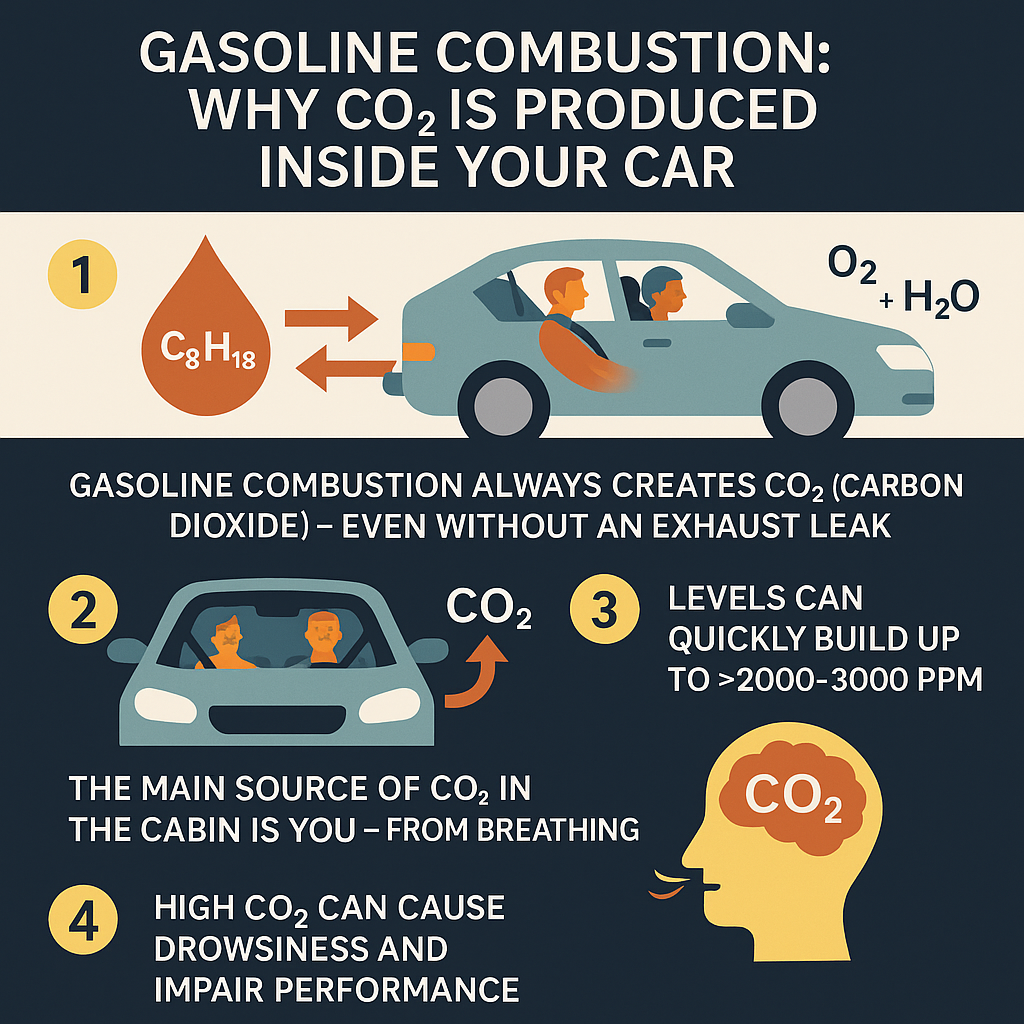
👉 Every car that runs on gasoline produces CO₂ continuously — even when everything is working perfectly.
CO₂ isn’t a malfunction.
It isn’t a leak.
It isn’t a warning sign.
It’s an inevitable byproduct of combustion.
And that makes it the most invisible passenger in every gasoline-powered car.
What Gasoline Combustion Really Produces
At a basic level, gasoline combustion is a chemical reaction.
Fuel + oxygen → energy.
But the reaction doesn’t disappear into motion alone.
It produces byproducts — mainly:
- carbon dioxide (CO₂)
- water vapor (H₂O)
This happens:
- at idle
- at low speed
- at highway speed
- in traffic
- during warm-up
As long as fuel is being burned, CO₂ is being created.
That’s not a flaw.
That’s chemistry.
“But Exhaust Goes Outside — Not Inside”
This was my first reaction.
And technically, it’s correct.
Modern cars are designed so that:
- exhaust gases exit the tailpipe
- the cabin is sealed from direct exhaust intrusion
CO₂ from combustion does not normally leak directly into the cabin.
But here’s the part I didn’t consider at first:
👉 The cabin doesn’t exist in isolation from the environment the car creates.
The Cabin Lives in a CO₂-Rich Bubble
When a gasoline car is operating, especially in real-world conditions, several things happen at once:
- the vehicle produces CO₂ externally
- surrounding air (traffic, tunnels, parking structures) often has higher CO₂
- ventilation systems draw from that environment
- recirculation reduces air exchange
- occupants add their own CO₂ through breathing
So even though combustion CO₂ is “outside,”
it still shapes the air context the cabin lives in.
The car moves through its own emissions footprint.
And over time, that matters.
Why CO₂ Is So Easy to Ignore
This is why CO₂ remains invisible in everyday driving:
- no smell
- no irritation
- no immediate discomfort
- no warning light
Unlike heat, noise, or vibration, CO₂ provides no sensory feedback.
The car feels normal.
The air feels fine.
The drive continues.
That’s why most people never think about it.
Not because it isn’t there —
but because it doesn’t announce itself.
Combustion Is Continuous — So Is CO₂ Presence
One insight helped everything click for me:
CO₂ exposure in cars isn’t an event.
It’s a background condition.
It doesn’t spike suddenly.
It accumulates slowly.
And accumulation is exactly the kind of change humans are worst at noticing.
Especially when:
- the cabin is quiet
- temperature is stable
- airflow feels smooth
Comfort masks accumulation.
This Isn’t About Blame or Fear
It’s important to be clear:
CO₂ from gasoline combustion:
- does not mean the car is unsafe
- does not imply toxic exhaust exposure
- does not indicate engine problems
Modern vehicles are remarkably good at controlling dangerous gases like carbon monoxide.
CO₂ is different.
It’s not a danger signal.
It’s a performance and awareness signal.
Why This Matters for Everyday Driving
Once I understood CO₂ as an unavoidable companion of combustion, I stopped thinking in extremes.
Not:
- “Is this dangerous?”
But: - “Is the air being refreshed enough for sustained clarity?”
Driving is a task that relies on:
- attention
- reaction time
- decision-making
Anything that quietly taxes those systems deserves awareness — even if it’s normal and expected.
The Shift in How I Think About Ventilation
I no longer see ventilation as:
“Something to use when it feels stuffy.”
I see it as:
“A way to manage an unavoidable byproduct of motion itself.”
Gasoline combustion doesn’t stop.
So awareness shouldn’t either.
Fresh air isn’t a correction.
It’s a balance.
Final Thoughts
CO₂ isn’t a problem created by bad driving habits.
It’s created by:
- chemistry
- energy
- motion
Every time a gasoline engine runs, CO₂ is produced.
Every time we sit inside a moving car, we share space with its consequences.
Most of the time, that’s perfectly manageable.
But manageable doesn’t mean irrelevant.
CO₂ is the invisible passenger in every car —
quiet, constant, and easy to forget.
And once I understood that, I stopped ignoring it
and started managing it — calmly, intentionally, and without fear.
Amazon is a trademark of Amazon.com, Inc. or its affiliates.
Leave a Reply