What the Research Says — and How I Learned to Read It Correctly
When people talk about CO₂, the conversation often goes in two extremes.
Either:
- “CO₂ is harmless — we breathe it out all the time.”
or - “High CO₂ is dangerous and deadly.”
Neither framing is particularly helpful.
So instead of guessing or repeating headlines, I decided to look at what controlled scientific research actually says — especially about moderately elevated CO₂ levels, the kind that occur indoors, in offices, classrooms, bedrooms, and car cabins.
What I found was far more nuanced — and far more relevant to everyday life — than I expected.
First, a Critical Clarification
CO₂ is not a poison in the same way carbon monoxide (CO) is.
CO₂:
- is a natural metabolic byproduct
- is continuously present in the air
- is regulated by human respiration
But “not toxic” does not mean “has no effect.”
Most modern research does not focus on lethal CO₂ levels.
It focuses on cognitive, neurological, and physiological performance at moderately elevated concentrations.
That distinction matters.
What Science Considers “Elevated” CO₂
Outdoor air typically contains:
- ~400–420 ppm CO₂
Many indoor environments regularly reach:
- 800–1200 ppm
- sometimes 1500–2500 ppm
- occasionally higher in sealed spaces
These levels are:
- far below toxicity thresholds
- far below emergency levels
- but high enough to measurably affect the body
This is where most modern research is focused.
1️⃣ Cognitive Performance and Decision-Making
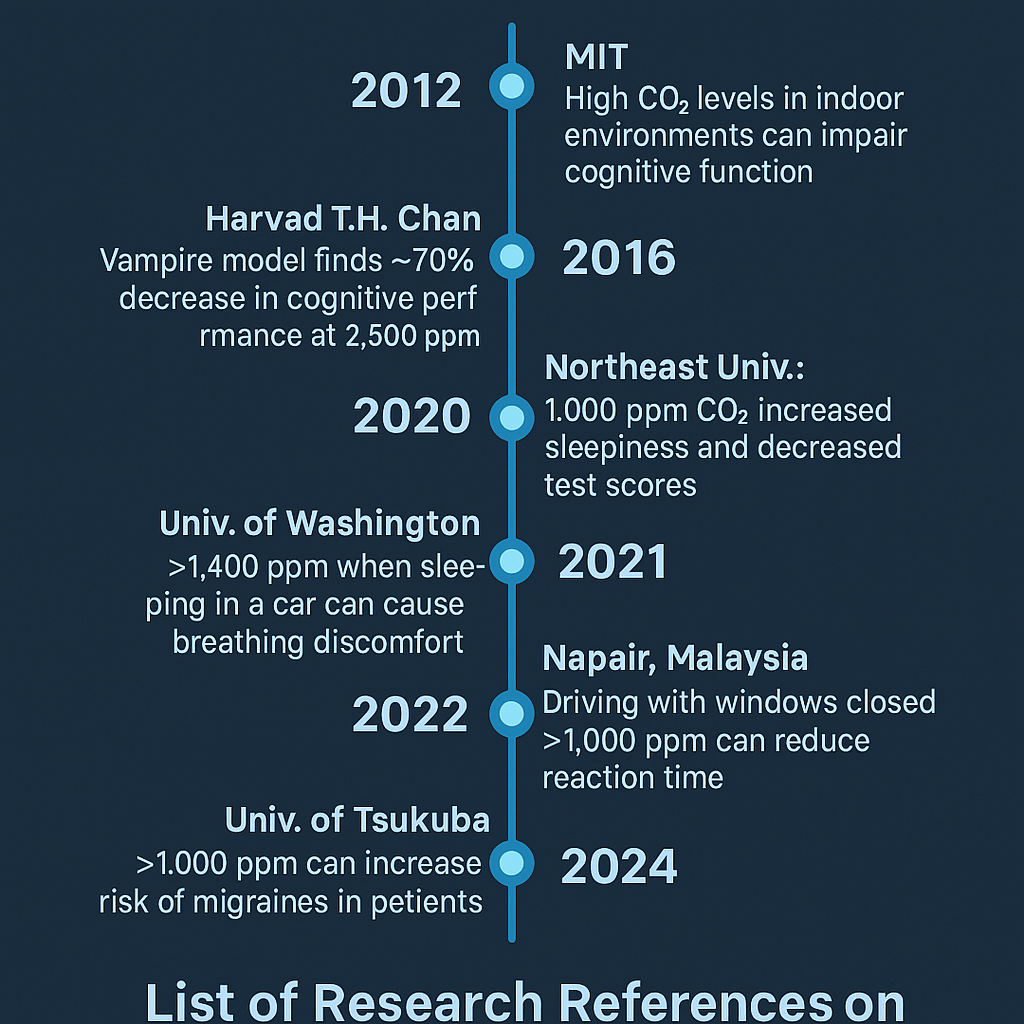
One of the most cited studies in this area comes from Harvard T.H. Chan School of Public Health and SUNY Upstate Medical University.
Key finding:
Even at 1000–2500 ppm, CO₂ was associated with measurable reductions in cognitive performance, particularly in:
- decision-making
- information use
- strategic thinking
- crisis response
📌 Reference:
Allen et al., Environmental Health Perspectives, 2016
“Associations of Cognitive Function Scores with Carbon Dioxide, Ventilation, and Volatile Organic Compounds”
What stood out to me wasn’t panic — it was precision.
Participants didn’t feel “sick.”
They felt less sharp.
That distinction matters for real-world environments like driving.
2️⃣ Attention, Alertness, and Mental Fatigue
Other controlled studies show that elevated CO₂ can:
- increase perceived mental effort
- accelerate fatigue
- reduce sustained attention
This doesn’t happen suddenly.
It happens gradually — exactly the kind of change humans are bad at noticing.
📌 Reference:
Satish et al., Environmental Health Perspectives, 2012
“Is CO₂ an Indoor Pollutant? Direct Effects of Low-to-Moderate CO₂ Concentrations on Human Decision-Making Performance”
This helped me understand why CO₂ often goes unnoticed:
- no smell
- no irritation
- no alarm response
Just quiet cognitive load.
3️⃣ Respiratory and Physiological Effects
At moderately elevated levels, CO₂ can influence:
- breathing regulation
- blood gas balance
- respiratory drive
The body compensates automatically — but compensation requires effort.
For most healthy adults, this is subtle.
For sensitive individuals (asthma, migraines, anxiety-prone nervous systems), it can be felt earlier.
📌 Reference:
NIOSH / OSHA physiological guidance on hypercapnia (non-emergency ranges)
Again, the key word is effort, not danger.
4️⃣ Sleep Quality and Recovery (Indirect Effects)
CO₂ does not directly cause sleep disorders, but research suggests:
- elevated CO₂ can fragment sleep
- increase micro-arousals
- reduce perceived sleep quality
This is especially relevant in:
- bedrooms
- RVs
- car camping
- sealed sleeping environments
📌 Reference:
Strøm-Tejsen et al., Indoor Air, 2016
“The effects of bedroom air quality on sleep and next-day performance”
This helped me understand why people often wake up tired without knowing why.
What These Studies Do Not Say
This is just as important.
The research does not say:
- CO₂ at these levels is acutely dangerous
- CO₂ causes permanent damage
- CO₂ is comparable to CO poisoning
The effects are:
- reversible
- context-dependent
- exposure-time dependent
Ventilation lowers CO₂ quickly.
The body recovers quickly.
That’s why awareness matters more than fear.
Why This Science Is Often Misunderstood
Most public discussions focus on:
- safety thresholds
- emergency limits
- occupational exposure caps
But performance research lives in a different category.
It asks:
- “How well does the brain function?”
- “How much effort does regulation require?”
- “How does subtle load affect complex tasks?”
Driving, studying, working, and decision-making live in that space.
How I Interpret This as a Non-Scientist
Here’s the mental model I use now:
CO₂ doesn’t hurt the body suddenly.
It taxes the system quietly.
It doesn’t trigger alarms.
It reduces margin.
And margin matters most in:
- driving
- complex thinking
- fatigue-prone situations
Final Thoughts
The scientific consensus is not alarming — but it is clear.
Moderately elevated CO₂:
- affects cognition before it affects comfort
- affects performance before it affects health
- matters more over time than in moments
That’s why CO₂ awareness isn’t about danger.
It’s about maintaining clarity in environments where clarity matters.
Science doesn’t tell us to panic.
It tells us to ventilate.
Amazon is a trademark of Amazon.com, Inc. or its affiliates.
Leave a Reply